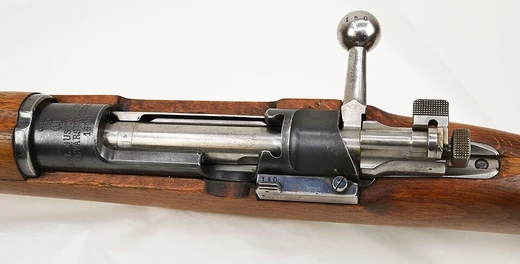
Bars (hunting rifle)
Soviet bolt-action hunting rifle with detachable box magazine.

Frédérick Lelievre, Junior A. Tremblay, Charles Maisonneuve, Richard Saint-Louis · CC BY 2.5
The Bars is a Soviet and Russian bolt-action hunting rifle designed in the early 1960s. It gained international recognition when it was awarded the golden medal of the Leipzig Trade Fair in 1967, the same year Izhevsk Machine-Building Plant began serial production in large numbers.
Quick Facts
- Origin
- USSR
- Is Ranged
- yes
- Designer
- A.I. Nesterov
- Manufacturer
- Izhevsk Machine-Building Plant
- Production Date
- Since 1960s
- Weight
- 3.0 kg
- Length
- 1,030 mm
- Part Length
- 600 mm
- Cartridge
- 5.6×39mm / 7.62×39mm / .223 Remington
- Rate
- Variable
- Feed
- 5-round magazine, loaded individually
- Sights
- Iron sights / Optical sight
Facts from the source article.
Lore & Background
The Bars was designed in the early 1960s. In May 1965, the price of one standard rifle was between 120 and 140 roubles. In 1967, it was awarded the golden medal of the Leipzig Trade Fair, and Izhevsk Machine-Building Plant began its serial production in large numbers. Production continued until June 2018, when Kalashnikov Concern announced its replacement by the Baikal 145 "Los" model.
The rifle features a chrome-plated barrel and a staggered column detachable box magazine. It has a manual safety switch. All variants are equipped with iron sights and a scope base for optical sights. Standard optical sights included PO-4×34 and TO-4 scopes, while the "Bars-223" variant used a PO-4×24 scope made by Novosibirsk Instrument-Building Plant. Custom aftermarket sights are known.
Variants include the "Bars-1" (first model, 5.6×39mm), "Bars-4" (second model, 5.6×39mm and 7.62×39mm, since 1985), "Bars-4-1" (since the 1990s, same calibers), and "Bars-223" (chambered in .223 Remington, designed in the early 2000s, with a small number made in 2001–2002 and serial production announced in January 2003). In 1993, Kazan Optical-Mechanical Plant began producing a night-vision device for the Bars, as well as for the "Los-4" and "Los-7" hunting rifles. In the 2000s, Zagorsk Optical-Mechanical Plant began production of the PKO-2 reflector sight for "Bars-4" rifles.
Reader's Guide
The Bars hunting rifle represents a significant chapter in Soviet and Russian civilian firearms production. Its design in the early 1960s and subsequent serial production from 1967 at Izhevsk Machine-Building Plant marked the beginning of a long service life for hunters. The rifle's international recognition at the Leipzig Trade Fair in 1967 underscored its quality and design. Over decades, the Bars evolved through several variants, adapting to different calibers including 5.6×39mm, 7.62×39mm, and .223 Remington, with the "Bars-223" variant introduced in the early 2000s. The rifle's legacy is tied to its role as a civilian hunting weapon, allowed for import and use in various countries. Its production was discontinued in June 2018 when Kalashnikov Concern replaced it with the Baikal 145 "Los" model. A Bars hunting rifle is preserved in the collection of the M. T. Kalashnikov Museum in Izhevsk, ensuring its place in firearms history.
The War That Sparked a Revolution
During the Russo-Turkish War of 1877–1878, Imperial Russian infantry found themselves at a devastating disadvantage. Armed primarily with single-shot Berdan rifles, they faced Ottoman soldiers equipped with Winchester 1866 repeating rifles. The disparity was laid bare at the brutal Siege of Pleven, where Russian forces sustained heavy casualties against the faster-firing enemy. That experience convinced senior commanders that the standard infantry weapon demanded urgent modernization. The General Staff's armaments bureau, operating under the Ministry of War, began acquiring and evaluating foreign designs. In 1889, a Lebel Model 1886 rifle arrived from France through semi-official channels, accompanied by a sample cartridge and bullet. Crucially, however, the package lacked a primer and smokeless powder. Russian scientists stepped in to close those gaps; notably, the chemist Dmitri Mendeleev personally produced the smokeless powder needed to make the system viable. This groundwork set the stage for a domestic competition that would ultimately shape one of the most enduring military rifles ever fielded.
A Close Call at the Commission Table
In 1889, three competing designs entered the Russian military's evaluation process. Captain Sergei Ivanovich Mosin presented a 3-line (7.62 mm) bolt-action rifle; Belgian engineer Léon Nagant offered a 3.5-line (9 mm) alternative; and Captain Zinoviev submitted yet another 3-line entry. When the trials wrapped up in 1891, the reviewing board was far from unanimous. Nagant's design was faulted for its mechanically complex action and a tedious disassembly procedure that demanded special tools and the unscrewing of two fasteners. Mosin's entry, by contrast, drew criticism over the relatively rough finish of its three hundred artisan pre-production samples. The commission voted 14 to 10 in Mosin's favor. Rather than simply adopting the rifle, the board was reconstituted as the Commission for the Creation of a Small-Bore Rifle, and both inventors were asked to refine their submissions. Under the supervision of General Chagin, further testing confirmed Mosin's bolt-action, which entered production as the 3-line Rifle, Model 1891. The popular Western label 'Mosin-Nagant' persists despite being technically incorrect, a point Nagant himself challenged in a legal dispute.
Engineering the Bolt: A Distinct Mechanical Philosophy
The Mosin's action shares the two-front-locking-lug principle with the German Gewehr 98, yet the two rifles diverge in subtle but meaningful ways. On the Mosin, the lugs engage in a horizontal plane, whereas the Mauser locks them vertically. The bolt body is assembled from multiple pieces rather than machined as a single unit, and the design employs interchangeable bolt heads, a trait it shares with the British Lee-Enfield. Cartridge feeding relies on a push-feed recessed bolt head: as the bolt closes, a spring-loaded extractor snaps over the rim of the round, a mechanism more akin to the Gewehr 1888 or the modern Remington 700 than to the Mauser's controlled-feed system. The bolt is extracted simply by pulling it fully rearward and squeezing the trigger, eliminating the separate bolt-stop lever found on Mausers. The bolt handle sits on a mid-body protrusion that doubles as a guide, echoing the Mannlicher layout, and the 90-degree lift arc matches the Mauser while exceeding the Lee-Enfield's 60-degree throw. The barrel features right-turning four-groove rifling with a twist of either 9.5 or 10 inches, and the five-round fixed magazine accepts cartridges one at a time or via five-round stripper clips.
From Factory Floor to Modern Battlefield
Adopted in 1891, the 3-line Rifle saw its first production run begin in 1892 across three Russian ordnance plants: Tula, Izhevsk, and Sestroryetsk. To supplement domestic output, the military placed a 500,000-rifle order with the French state factory at Châtellerault. Over the following decades and into the modern era, cumulative production surpassed 37 million units, making it one of the most numerous bolt-action military rifles ever manufactured. The weapon served the Russian Empire, the Soviet Union, and a wide array of other nations, and despite its considerable age it has continued to appear in armed conflicts around the globe to the present day. In 1930, a significant modernization produced the M1891/30, a variant that incorporated several elements originally proposed by Nagant. These included attaching the magazine spring to the base plate to prevent loss during cleaning, revising the five-round loading clip, and adding an interrupter mechanism to prevent double-feeding failures that plagued Mosin's original design. The interrupter itself was later refined from a single piece to a two-piece construction. In Russian service the rifle is simply called 'mosinka,' a colloquial shorthand that underscores its deep cultural entrenchment.
Gallery
More in Bolt-Action Rifles, Part 2 1-24
Spotted an error? Know more?
Reader corrections go straight into our review queue. Suggest an edit · How this site is sourced