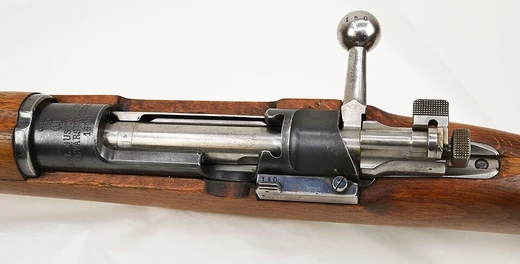
SSG 82
East German Stasi sniper rifle chambered in 5.45×39mm.

Horzhenung Tadiae Sotaod · CC BY-SA 4.0
The SSG 82 (Scharfschützengewehr 82) is a sniper rifle firing the 5.45×39mm Soviet cartridge, produced in East Germany during the final years of the Cold War. It was created specifically for the Ministry for State Security (Stasi) to eliminate the need to import police sniper rifles from non-socialist countries or military sniper rifles from other socialist states.
Development of the rifle took place under the supervision of Erich Mielke. When activists occupied Stasi headquarters, ten SSG 82s were discovered there; these were later handed over to West Germany and eventually reached gun collectors. For a long time, little was known about the weapon, and very few examples entered the West. Around the turn of the century, importer Century International Arms brought in roughly 600 units. At least 2,000 SSG 82s are known to have been manufactured.
The design of the SSG 82 was technically based on the Suhler Kleinkalibergewehr Modell 150 Standard, a .22 Long Rifle (5.6 mm) small-bore competition rifle. As a result, the SSG 82 resembles a European-style small-bore competition rifle. Plans to equip the rifle with a suppressor and a night vision scope were abandoned.
The receiver is cold-hammer forged, and the barrel is free-floating with a semi-bull profile and a target crown. The bolt uses four locking lugs and requires a 60-degree rotation to cycle. A sliding safety is actuated by rotating a small disk on the right side above the trigger. The two-stage trigger is adjustable, with a pull weight between 3 and 4 N. The detachable box magazine holds six rounds, is double-column and double-feed, and is released by pushing a button forward, centered behind the magazine well.
The wooden stock resembles that of the Small bore Standard rifle 150, featuring a raised comb and stippled pistol grip and forearm. The butt plate is adjustable for length of pull by adding or removing spacers, and its height can also be adjusted.
The rifle has no iron sights. It is equipped with a 4×32 telescopic sight (the "Ziel4/S" 4×32 scope, reticle 1) mounted on rails made by VEB Zeiss Jena—the original Zeiss plant captured by the Soviets after WWII. The scope is numbered to the rifle and attached using a quick-detachable Suhler claw mount base.
Quick Facts
- Origin
- East Germany
- Is Ranged
- YES
- Wars
- Lebanese Civil War
- Design Date
- 1982
- Manufacturer
- VEB Fahrzeug- und Jagdwaffenwerk "Ernst Thälmann" Suhl (FAJAS)
- Number
- 2000
- Weight
- 4.5 kg
- Length
- 1080 mm
- Part Length
- 600 mm
- Cartridge
- 5.45×39mm
- Caliber
- 5.45 mm
- Action
- Bolt-action
Facts from the source article.
Lore & Background
The development of the SSG 82 was carried out under the watch of Erich Mielke. When Stasi headquarters was occupied by activists, ten SSG 82s were found and subsequently passed off to West Germany before they were passed on to gun collectors. Very little was known about this weapon, and very few examples have been imported into the West, with importer Century International Arms having imported around 600 at the turn of the century. It is known that at least 2000 SSG 82s were made.
Technically, the SSG 82 was based on the Suhler Kleinkalibergewehr Modell 150 Standard .22 Long Rifle caliber small bore competition rifle, making its design reminiscent of a European-style small bore competition rifle. There were plans to include a suppressor and a night vision scope, but they were called off. The heart of the rifle is a cold-hammer forged receiver and free-floating barrel with a semi-bull profile and a target crown. The bolt has four locking lugs and requires a 60-degree rotation to cycle. The safety is a sliding type actuated by rotating a small disk on the right side above the trigger. The two-stage trigger is adjustable between 3 and 4 N.
The wooden stock resembles that of the Small bore Standard rifle 150, with a raised comb and a stippled pistol grip and forearm. The butt plate is adjustable for length of pull by adding or removing spacers and height. The rifle has no iron sights; it is equipped with a 4×32 telescopic sight (Ziel4/S, reticle 1) with mounting rails made by VEB Zeiss Jena, numbered to the rifle and mounted using a quick detachable Suhler claw mount. This was a basic model of the VEB Zeiss Jena telescopic sight line, as 6×36, 6×42M, 8×56M, and variable 1.5–6×39, 1.5–6×42M, and 3–12×56M magnification variants were also available. The non-M telescopic sight models have elevation correction and focusing turrets but lack a windage correction turret, so windage was corrected by a gunsmith during mounting, dedicating the sight to a particular rifle.
Reader's Guide
The SSG 82 holds significance as a rare and enigmatic Cold War sniper rifle produced exclusively for the East German Stasi, reflecting the political and logistical constraints of the era. Its development under Erich Mielke and the subsequent discovery of ten rifles during the occupation of Stasi headquarters highlight its secretive nature. The rifle's technical basis on a .22 caliber competition rifle is unusual for a military sniper platform, and the cancellation of suppressor and night vision scope plans suggests the project was limited in scope. The import of approximately 600 rifles by Century International Arms at the turn of the century brought a small number into Western hands, but the total production of at least 2000 means many remain unaccounted for. Internet sources report differing information regarding attainable accuracy, with the quality of ammunition often cited as a very important factor. Reports range from one-hole five-shot groups to 100 mm three-shot groups and anywhere in between, leaving the rifle's true precision a matter of dispute. The SSG 82 was used by Stasi units including Department VI, Department XXII, Department PS, and by the Ministry of Interior's Diensteinheit IX. Its legacy is that of a niche, state-security weapon that remains poorly documented and highly sought after by collectors.
Did You Know?
- Plans to equip the SSG 82 with a suppressor and night vision scope were called off.
- Ten SSG 82s were found when Stasi headquarters was occupied by activists and later passed to West Germany.
- The Zeiss Jena 4×32 scope lacks a windage turret; windage correction was done by a gunsmith during mounting.
Engineering Ahead of Its Time
When Steyr Mannlicher developed the SSG 69 in the late 1960s, its design choices would not become standard in military small arms for years. The receiver and barrel were engineered for maximum structural strength at minimum weight. The bolt action employs three pairs of rear-locking lugs—a configuration shared with the British SMLE—rather than the front-locking lugs typical of most contemporary rifles. Because the action is produced only in short-action length, the platform is restricted to non-magnum calibers. The sixty-degree bolt opening angle lets optical sights sit relatively low over the receiver, and the receiver is machined to accept quick-detach SSG sight bases. Perhaps the most striking departure from convention was the stock. While rival sniper rifles of the era still relied on traditional wood, the SSG 69 featured a fiber-glass-reinforced ABS polymer stock with removable spacers for adjusting length of pull and an accessory rail on the forearm's underside for a bipod. The trigger is user-adjustable for both weight and travel. The detachable five-round rotary magazine, molded from transparent polycarbonate resin, lets the shooter see remaining rounds at a glance, and a ten-round staggered box is available as an accessory.
Precision on the Range
For its era and overall weight, the SSG 69 delivered extraordinary accuracy. In international shooting competitions, the rifle has been used to achieve groupings below 0.15 milliradians—equivalent to half a minute of angle—placing it firmly among the most precise bolt actions of its generation. The cold hammer-forged barrel carries a 304.8-millimeter (one-twelfth-inch) twist rate, chosen to adequately stabilize the 7.62×51mm NATO ammunition standard in the 1960s. That same twist, however, proved somewhat slow for the heavier 11.34-gram (175-grain) hollow-point boat-tail sniping projectiles that were not yet available when the rifle was designed. The Austrian military paired the SSG 69 PI with the Kahles ZF 69 6×42 telescopic sight, and later the similar ZF 84 10×42 was also offered. On customer request, these sights could be fitted with a Bullet Drop Compensating elevation turret calibrated to the specific ballistic trajectory of a given gun-cartridge combination, accounting for projectile weight, type, muzzle velocity, and air density. The ZF 69 BDC used by Austrian snipers was graduated from 100 to 800 meters, in 100-meter increments up to 300 meters and 50-meter increments beyond, tuned for 9.3-gram (143.5-grain) 7.62×51mm NATO ammunition.
A Global Service Record
Adopted by the Austrian Army in 1969 to replace the SSG 98k—a system built from modified and accurized surplus Karabiner 98k rifles—the SSG 69 found a far wider audience than its home country. Beyond Austrian military and EKO Cobra special forces, the rifle entered service with armed forces and police units on four continents. In South America, the Argentine and Chilean armies fielded the SSG 69, as did the Peruvian military. In Asia, it saw limited combat use during the Sino-Vietnamese War and was subsequently adopted by the Indonesian Army, the Pakistan Army, the Singapore Armed Forces, and the Republic of Korea Marine Corps. Indian paramilitary forces including the BSF, ITBP, and COBRA (CRPF) also employed the rifle. In Europe, the Croatian Military Police, the Dutch Marine Corps, the Polish military, the Icelandic Coast Guard and Víkingasveitin, and the Irish Garda Emergency Response Unit all incorporated the SSG 69 into their arsenals. In the Middle East, YAMAM operators in Israel used the rifle during the 1980s, and the Turkish Police Special Operation Department adopted it. In North America, the United States Border Patrol's BORTAC unit put the SSG 69 to work. Ba'athist Syria was listed as a former user.
Variants, Civilian Life, and the End of Production
Steyr Mannlicher produced several SSG variants that differed in barrel diameter, the presence or absence of backup iron sights, and cosmetic details such as stock color. The most mechanically distinct was the SSG-PIV, which paired a longer 409-millimeter barrel with a 254-millimeter (one-tenth-inch) twist rate specifically designed to handle heavy subsonic ammunition in conjunction with a suppressor. The SSG action also found a second life in the civilian shooting world. The SSG Match UIT was built as an international 300-meter target rifle for the UIT, the International Shooting Sport Federation's former name. It featured a free-floating heavy barrel, a walnut wood half stock, and a Walther target diopter and globe sight line—marking a deliberate departure from the military rifle's polymer construction. The SSG 69's production run came to a close in 2015 when Steyr ended manufacturing. After nearly five decades of service, the rifle that had introduced synthetic stocks and cold hammer-forged barrels to military sniping in the late 1960s finally retired, leaving behind a legacy of accuracy and forward-thinking design that influenced bolt-action development well beyond its own generation.
Gallery


More in Bolt-Action Rifles, Part 2 1-24
Spotted an error? Know more?
Reader corrections go straight into our review queue. Suggest an edit · How this site is sourced