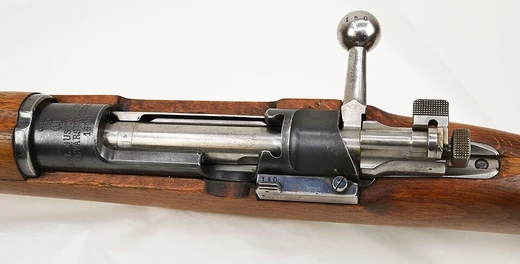
FN Model 24 and Model 30
Belgian Mauser-pattern rifles sold worldwide from the 1920s to 1960s.

Rama · CC BY-SA 2.0 fr
The FN Model 24 and Model 30 are two distinct series of Mauser Gewehr 98 pattern bolt-action rifles produced by the Belgian Fabrique Nationale. The Model 24 series features an intermediate-length action (215 mm), while the Model 30 series uses a standard-length action (223 mm). Both were marketed simultaneously in the 1930s, leading to confusion and the incorrect designation '24/30'.
Quick Facts
- Origin
- Belgium
- Service
- 1924–1986
- Manufacturer
- FN Herstal, Kragujevac Arsenal
- Is Ranged
- yes
- Production Date
- 1924–1964
- Weight
- 3.6-3.85 kg
- Length
- 955-1094 mm
- Part Length
- 415-585 mm
- Cartridge
- 7×57mm Mauser / 7.62×51mm NATO / .30-06 Springfield / 7.65×53mm Mauser / 7.92×57mm Mauser
- Action
- Bolt-action
- Velocity
- 760 m/s
- Range
- 500 m (with iron sights) / >800 m (with optics)
Facts from the source article.
Lore & Background
After World War I, Belgium manufactured a derivative of the Mauser 98, slightly modified. The FN Model 24 series was produced until 1932, when it was replaced by the 1930 pattern. The Model 30 series continued in production, with the last Mauser pattern rifles made in 1964. Both series were offered in long rifle, short rifle, and carbine lengths, with hardwood stocks and straight or curved bolt handles. The Model 30 short rifle shares the same action dimensions as the Mauser Standard Modell and Kar98k, but its barrel is shorter at 585 mm versus the Kar98k's 600 mm, a difference evident in Venezuelan contract rifles made between 1936 and 1939.
Many nations purchased these rifles. Greece bought over 75,000 Model 30 short rifles between 1930 and 1939, used in the Greco-Italian War and German invasion. China received 24,000 Model 24 and 30 rifles from 1930 to 1934, and over 165,000 Model 30 between 1937 and 1939. The Model 30 was copied in China as the Type 21 and Type 77 rifles. After the German invasion of Belgium, captured FN rifles were used by second-line German units, with Belgian Mle 1935 rifles designated Gewehr 220 (b).
Reader's Guide
The FN Model 24 and Model 30 series represent a significant chapter in the global spread of the Mauser 98 design, adapted by Fabrique Nationale to meet diverse customer requirements. Their simultaneous marketing in the 1930s created lasting confusion, but the two models are mechanically distinct, differing in action length. The Model 30, with its standard-length action, became the more widely produced and exported variant, serving in conflicts from the Chaco War to the Congo Crisis and beyond. Its use by dozens of nations—from Ethiopia and Liberia to Indonesia and Israel—demonstrates its adaptability and enduring utility. The rifles were chambered in multiple calibers, including 7.65×53mm, 7×57mm, 8×57mm IS, .30-06 Springfield, and later 7.62×51mm NATO, with many examples converted post-war. The Model 30 short rifle's barrel length difference from the Kar98k is a common point of collector misconception. The series' legacy is one of widespread military service, with some examples remaining in reserve storage into the 1990s.
Did You Know?
- The FN Model 24 and Model 30 were marketed at the same time in the 1930s, causing the incorrect '24/30' designation.
- The Model 30 short rifle has a barrel length of 585 mm, shorter than the Kar98k's 600 mm.
- China copied the Model 30 as the Type 21 and Type 77 rifles.
- Indonesia likely ordered a batch of Model 30 carbines in 7.62×51mm NATO between 1962 and 1975.
Origins & Design Heritage
The Winchester Model 70 entered the American market in 1936 as a bolt-action rifle that would go on to earn the enduring nickname "Rifleman's Rifle." Its mechanical DNA traces back through the Winchester Model 54 to the Mauser 98-type action, and that lineage is visible in several of its core design elements. From the moment it reached gun shops, shooters recognized the action's strength and precision, and the rifle quickly carved out an iconic position in American sporting culture. Over the decades, Winchester offered the Model 70 in a wide range of grades and finishes, adapting it to different hunting and target-shooting needs. The rifle's reputation was cemented not only by its engineering but also by the loyalty it inspired among sportsmen who valued a dependable, high-quality action. By 1999, Shooting Times magazine formally recognized that legacy by naming the Model 70 the "Bolt-action Rifle of the Century," a title that reflected nearly six decades of consistent regard from the shooting community.
The Pre-1964 Action & Controlled Round Feed
Rifles produced between 1936 and 1963 featured an action that many shooters still consider the gold standard. The receiver was machined from solid bar-stock steel, and the bolt incorporated two forward locking lugs paired with a Mauser-style nonrotating claw extractor. This extractor gripped the cartridge rim as it traveled up from the magazine, a process known as controlled round feed, which kept the round positively secured until it reached the chamber. The ejector was a blade type that, while similar in concept to the Mauser M98, avoided cutting a slot through the left locking lug; instead, the slot sat in the bolt face below the lug, preserving the strength of both lugs. Additional features included a three-position wing safety, a cone breeching system to protect bullet noses during loading, a one-piece bolt, a machined steel trigger guard and floor plate, and an adjustable trigger. Gun writer Jack O'Connor helped build the rifle's following, particularly in the .270 Winchester caliber. Today, pre-1964 examples—identifiable by serial numbers below 700,000 and a fore-end barrel screw—command a significant price premium among collectors and hunters who prize the more positive extraction for dangerous-game work.
The 1964 Redesign & Its Controversy
By the early 1960s, rising labor costs and the competitive pressure of the Remington Model 700 pushed Winchester to rethink how the Model 70 was built. In 1964, the company introduced a batch of changes: the controlled round feed was abandoned in favor of a simpler push-feed system with a smaller hook extractor, the stock shape was altered, and the previously cut checkering was replaced with impressed patterns. The receiver, for the first time, was forged and then machined rather than turned from bar stock, with heat treatment applied only to the locking lugs and cams to avoid warping. The trigger guard and floor plate became a single stamped piece. Jack O'Connor, a longtime champion of the rifle, was openly critical, calling the new trigger guard "flimsy looking" and saying he wished he had bought a few more of the old version before the change. Yet he conceded the redesigned action was actually stronger, with the bolt head fully enclosing the case head, and noted that feeding problems were rare. Despite these qualifications, the shooting public largely never embraced the post-1964 version with the same enthusiasm as its predecessor.
Production History & Enduring Legacy
The Model 70's manufacturing story spans nearly eight decades and three different corporate owners. Winchester Repeating Arms Company built the rifle in New Haven, Connecticut, from 1936 until 1980. Beginning in the early 1980s, U.S. Repeating Arms took over production under a licensing agreement with Olin Corporation, which permitted the use of the Winchester name and logo, and continued building the rifle in the same Connecticut facility until production halted in 2006. In the fall of 2007, Belgian firearms maker FN Herstal announced it would bring the Model 70 back to life. By 2012, new rifles were rolling out of FN's plant in Columbia, South Carolina, before assembly shifted to Portugal in 2013. The rifle's cultural footprint extends well beyond the shooting range: in 2014, the pre-1964 Model 70 was officially designated a state firearm of Alaska, a recognition that underscored how deeply the gun is woven into the identity of American hunting traditions.
Gallery
More in Bolt-Action Rifles, Part 2 1-24
Spotted an error? Know more?
Reader corrections go straight into our review queue. Suggest an edit · How this site is sourced