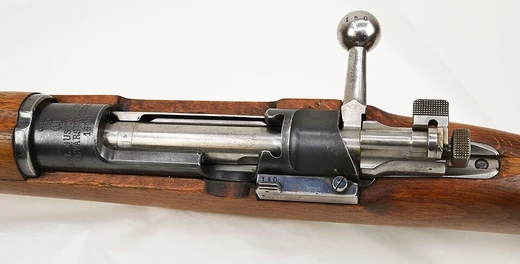
Ruger M77
Ruger's first bolt-action rifle, modernizing the Mauser 98 design.

The Ruger M77 is a bolt-action rifle produced by Sturm, Ruger & Co., designed primarily as a hunting rifle. It features a traditional Mauser K98-style two-lugged bolt with a claw extractor, and was designed by Jim Sullivan during his three years with Ruger. The M77 was Ruger's first bolt-action rifle, introduced to the U.S. market in 1968 after several years of design and innovation.
Quick Facts
- Designer
- L. James Sullivan
- Spec Label
- Ruger M77 Standard
- Length
- 42 -
- Action
- Bolt-action
- Origin
- United States
- Is Ranged
- "yes"
- Design Date
- 1968
- Manufacturer
- Sturm, Ruger & Co.
- Production Date
- 1968-1984 (Tang Safety, Push Feed) / 1985-1992 (Transitional Model) / 1989- (Mk II, Controlled Feed)
- Weight
- 6.75 -
- Part Length
- 22 -
- Cartridge
- Various
Facts from the source article.
Lore & Background
The Ruger M77 was designed by Jim Sullivan, who was hired by Bill Ruger in 1965 primarily to develop the rifle. Investment casting was used to save on costs, a choice favored by Bill Ruger over a forged receiver. The M77 was intended as a modernized Mauser 98, though numerous changes were made: the Sullivan-designed bolt used a plunger-style ejector instead of the Mauser blade type, and a two-position tang safety and redesigned trigger system were created from scratch. The stock design was carried out with the aid of stock designer Lenard Brownell. The M77 uses an angled screw that draws the action down and to the rear, tightly bedding it against the stock.
The M77's popularity rose quickly due to features such as the Mauser-type claw extractor, which filled a market gap that occurred in 1964 when Winchester discontinued the controlled-round-feed version of the Model 70. The writings of the late Jack O'Connor also favored the rifle. The original model was not a true controlled-round-feed action but a push feed with an external claw, and barrels were provided by third parties, leading to accuracy variation among rifles. The first change involved incorporating a proprietary scope mount milled integral with the receiver, as early production rifles had simple rounded-top receivers drilled and tapped for separate scope mounts.
Reader's Guide
The Ruger M77 underwent several redesigns that shaped its legacy. In 1991, it was entirely retooled and reintroduced as the Model 77 Mark II, with hammer-forged barrels made at Ruger's factory, a redesigned safety, bolt, trigger, and bottom metal. The claw extractor was retained, but the bolt face was opened up to create a true controlled-round-feed action, and the plunger ejector was replaced with a Mauser-style fixed blade ejector. The tang safety was replaced by a three-position safety similar to the Winchester M70, allowing the bolt to be operated while on safe. The Mark II offered variants from blued steel to stainless steel and from circassian walnut stocks to synthetic. The RSM Mark II variant, known as the Safari Magnum, featured a circassian walnut stock, express sights, and a long magnum action for cartridges like .375 H&H, .416 Rigby, and .458 Lott. In 2006, the Hawkeye introduced the LC6 trigger to address consumer complaints about the Mark II trigger, along with a recontoured stock. The Hawkeye also introduced new short magnum cartridges and proprietary dangerous game cartridges. The .30-06 SAR Rifle was designed for Canada's search and rescue technicians, featuring a 14.5-inch barrel and a folding orange buttstock. The Gunsite Scout rifle, developed with Gunsite Training Center in 2013, met the criteria of the modern scout rifle set by Colonel Jeff Cooper, chambered in .308 Winchester with a 16.5-inch barrel and 10-round Mini-14 style magazine.
Did You Know?
- The M77 Mark II replaced the plunger ejector with a Mauser-style fixed blade ejector.
- The Gunsite Scout rifle was developed in 2013 in collaboration with Gunsite Training Center.
More in Bolt-Action Rifles, Part 2 1-24
Spotted an error? Know more?
Reader corrections go straight into our review queue. Suggest an edit · How this site is sourced