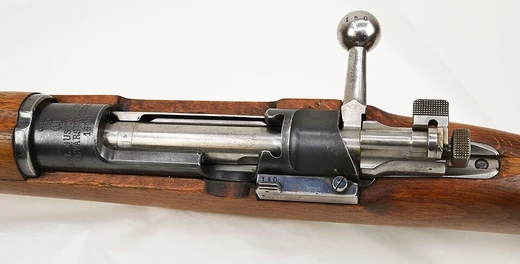
MAS-36 rifle
French bolt-action rifle adopted 1936, used through mid-20th century conflicts.

The MAS Modèle 36 (Fusil à répétition 7 mm 5 M. 36) is a French military bolt-action rifle adopted in 1936 to replace the Berthier and Lebel series. Manufactured by Manufacture d'Armes de Saint-Étienne (MAS) from late 1937, it saw service through World War II and beyond, with about 1.1 million produced by 1952.
Quick Facts
- Origin
- France
- Is Ranged
- yes
- Service
- 1936–1967 (France) / 1936–Present
- Design Date
- 1927–1936
- Manufacturer
- Manufacture d'armes de Saint-Étienne
- Production Date
- 1937–1952
- Number
- 1,100,000
- Weight
- 3.72 kg unloaded
- Length
- 1020 mm
- Part Length
- 575 mm
- Cartridge
- 7.5×54mm French
- Action
- Bolt action
Facts from the source article.
Lore & Background
The MAS-36 is a short carbine-style rifle with a two-piece stock and slab-sided receiver, chambered for the rimless 7.5×54mm French cartridge. It combined features from other rifles: rear locking lugs from the British SMLE, a dog-leg bolt handle from the British P14/U.S. M1917 Enfield, bolt disassembly similar to the Japanese Arisaka Type 38, and a five-round box magazine from the German Gewehr 98. The rifle had just five user-removable parts, including a Lebel-type cruciform bayonet stored under the barrel. Its bolt handle was bent forward, though some have since been found bent backwards. The MAS-36 had no manual safety and was fitted with large aperture rear and post front sights calibrated for 100–1200 meters. The front stock fittings used non-standard spanner-head screws to discourage disassembly, and only armorers had the appropriate tools.
Reader's Guide
The MAS-36 was intended as an economical rifle for rear-echelon, colonial, and reserve troops, sharing machining with a planned semi-automatic rifle. Budget constraints limited its production, so it served alongside Lebel and Berthier rifles during the Battle of France. After the German occupation, captured MAS-36s were designated Gewehr 242(f) and used by German garrison units and the Volkssturm. Post-war production introduced simplifications like stamped nose caps, hooded front sights, and phosphating. The rifle saw extensive use in the First Indochina War, Algerian War, and Suez Crisis, where French paratroop marksmen used telescope-sighted versions. It remained a substitute-standard rifle after the adoption of the MAS-49 semi-automatic, but its bolt design continued in the FR F1 and FR F2 sniper rifles. Civilian hunting versions were made in several calibers, and some military surplus rifles were converted to 7.62×51mm NATO.
Did You Know?
- Only 250,000 MAS-36 rifles were available during the Battle of France in 1940.
- The MAS-36 had no manual safety; the firing mechanism could be blocked by raising the bolt handle.
- The bayonet storage design could cause two rifles to become permanently mated if one bayonet locked into an empty tube.
- Post-war rifles could not close the bolt on an empty chamber, indicating the need to reload.
More in Bolt-Action Rifles, Part 2 1-24
Spotted an error? Know more?
Reader corrections go straight into our review queue. Suggest an edit · How this site is sourced