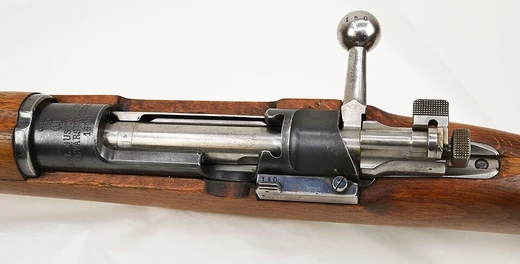
Lebel Model 1886 rifle
First military rifle to use smokeless powder ammunition.

The Lebel Model 1886 rifle (French: Fusil Modèle 1886 dit "Fusil Lebel"), also known as the "Fusil Mle 1886 M93" after a bolt modification in 1893, is an 8 mm bolt-action infantry rifle that entered service in the French Army in 1887. It is notable as the first military firearm to use smokeless powder ammunition, a nitrocellulose-based propellant called "Poudre B" invented in 1884 by French chemist Paul Vieille. The rifle holds up to ten rounds: eight in its fore-stock tube magazine, one in the elevator, and one in the chamber.
Quick Facts
- Origin
- French Third Republic
- Is Ranged
- yes
- Service
- 1887–1945 (France) / 1945–present (limited usage)
- Designer
- Team led by Gen. Baptiste Tramond · fr (Gras, Lebel, Vieille, Bonnet, Desaleux, Close, Verdin)
- Design Date
- 1885–1886
- Manufacturer
- Manufacture d'armes de Saint-Étienne / Manufacture d'armes de Châtellerault / Manufacture Nationale d'Armes de Tulle
- Unit Cost
- 40 francs (1891)
- Production Date
- 1887–1920
- Number
- 3,450,000
- Weight
- 4.41 kg / (loaded with 8 rounds) / 4.18 kg / (unloaded)
- Length
- 130 cm
- Part Length
- 80 cm
Facts from the source article.
Lore & Background
The Lebel rifle was developed under the direction of General Tramond, appointed by war minister General Georges Ernest Boulanger in January 1886, with a one-year deadline. The 11 mm Gras cartridge case was necked-down to 8 mm by Gras and Lieutenant Colonel Desaleux. The repeating mechanism derived from the French Mle 1884 Gras-Kropatschek rifle, implemented by Albert Close and Louis Verdin. The bolt's two opposed front locking lugs were inspired by the Swiss Vetterli rifle and designed by Colonel Bonnet. The 8 mm flat-nosed full metal jacket "Balle M" bullet was suggested by Tramond and designed by Lieutenant Colonel Nicolas Lebel, after whom the rifle is informally named, though Lebel protested that Tramond and Gras deserved the credit.
The rifle features an oversized bolt with front locking lugs and a massive receiver, a two-piece wood stock, and a spring-loaded tubular magazine in the fore-end. The ladder rear sight is adjustable from 850 to 2,400 meters, with a fixed combat sight up to 400 meters revealed by flipping the ladder forward. A magazine cutoff is located on the right side of the receiver. The rifle was issued with the Épée-Baïonnette Modèle 1886, a 52 cm quadrangular épée bayonet dubbed "Rosalie" by French soldiers in World War I. In 1893, the Mle 1886 M93 modification improved the bolt head to redirect gases from ruptured cases away from the shooter's face and improved rear sight fixation.
Between 1937 and 1940, a carbine version, the Mle 1886 M93-R35, was issued to mounted colonial troops in North Africa, with a 17.7-inch barrel and a shortened tube magazine holding three rounds. About 50,000 were assembled at Manufacture d'Armes de Tulle.
Reader's Guide
The Lebel rifle's significance lies in its pioneering use of smokeless powder, which rendered all black-powder military rifles obsolete upon its introduction. It alarmed Germany, as tests at Spandau arsenal in the winter of 1887-1888 showed the Lebel could fire 43 rounds per minute compared to 26 for the German Mauser M71/84 using black powder. Despite this early advantage, the Lebel design became outdated faster than later magazine-fed rifles of other European militaries. Its tube magazine required individual loading of bullets, unlike the stripper clips of competitors, and affected the rifle's balance when fired. Nevertheless, it remained the basic weapon of French infantry during World War I (1914–1918). A total of 3.45 million Lebel rifles were produced by three French state factories between 1887 and 1916.
Did You Know?
- The 8 mm Lebel cartridge used a primer cover and circular groove to prevent accidental percussion in the tube magazine.
- The rifle's épée bayonet, the Épée-Baïonnette Modèle 1886, was 52 cm long and had an X-shaped cross section.
- Lieutenant Colonel Nicolas Lebel protested that Generals Tramond and Gras deserved credit for the rifle's design, not himself.
More in Bolt-Action Rifles, Part 2 1-24
Spotted an error? Know more?
Reader corrections go straight into our review queue. Suggest an edit · How this site is sourced