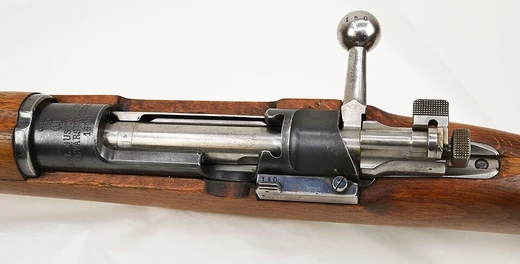
Gewehr 1888
Germany's first smokeless-powder service rifle, adopted in 1888.

The Gewehr 1888, commonly called the Model 1888 commission rifle, was a late 19th-century German bolt-action rifle adopted in 1888. It was developed by the German Rifle Commission in response to the French adoption of smokeless powder ammunition for the Lebel Model 1886 rifle, which rendered Germany's earlier Mauser Model 1871 obsolete. The rifle used the new Patrone 88 cartridge, also designed by the commission, and marked Germany's shift to smokeless powder.
Quick Facts
- Origin
- German Empire
- Is Ranged
- yes
- Service
- 1888−1945
- Used By
- 25+ countries / See Users
- Wars
- 25+ wars / See Conflicts
- Designer
- German Rifle Commission
- Manufacturer
- Ludwig Loewe, C.G. Haenel, ŒWG, Imperial Arsenals of Amberg, Danzig, Erfurt, and Spandau, Hanyang Arsenal
- Production Date
- 1888–1899
- Number
- 2,800,000
- Variants
- Gewehr 88/05, Gewehr 88/14, Karabiner 88, Hanyang 88
- Weight
- 3.9 kg / 3.1 kg (Karabiner 88)
- Length
- 1245 mm / 950 mm (Karabiner 88)
Facts from the source article.
Lore & Background
The Gewehr 1888 was developed by the German Rifle Testing Commission after the French Lebel Model 1886 made Germany's Mauser Model 1871 obsolete. The commission adapted a Swiss cartridge design to create the Patrone 88, an 8 mm rimless necked cartridge with a round-nose bullet and single-base smokeless powder. In 1905, the cartridge was replaced by the 7.92×57mm Mauser S Patrone with a spitzer bullet and more powerful double-base smokeless powder, yielding higher velocity and energy.
The rifle combined a receiver and bolt derived from the Gewehr 1871 with a Mannlicher-style en-bloc magazine. Cartridges were loaded into a steel carrier (clip) inserted into the magazine; after the last round was chambered, the clip dropped through a hole in the bottom. This system allowed speedy reloading but created an entry point for dirt. The barrel was encased in a sheet metal tube to prevent contact with the stock, intended to improve accuracy, but the tube could trap water and promote rusting. The Karabiner 88 had a different bolt handle resembling those on commercial sporting rifles.
Early production flaws due to rushed ammunition were exploited in 1892 by agitator Hermann Ahlwardt, who spread an anti-Semitic conspiracy theory accusing manufacturer Loewe & Company of supplying defective rifles. The claims were found insupportable, and Ahlwardt was sentenced to four months in prison for malicious falsehood.
Reader's Guide
The Gewehr 1888 served as Germany's primary service rifle for just over a dozen years before being replaced by the Gewehr 98, but it remained in widespread use for decades. It saw field service in Germany's colonial expansion, including the Boxer Rebellion, and was a front-line weapon for German troops in World War I until 1915. After replacement, many rifles were given to Austria-Hungary and the Ottoman Empire, with Turkish forces using them extensively through the 1930s and 1940s. The rifle was also used by Yugoslavia, Czechoslovakia, Poland, and other nations, and appeared in numerous conflicts including the Russian Civil War, the Turkish War of Independence, the Polish–Soviet War, the Spanish Civil War, and World War II by second-line units and partisans. China used the Gewehr 88 extensively, first purchasing rifles for the First Sino-Japanese War and later producing unlicensed Hanyang 88 copies. These saw action in the 1911 Revolution, the Chinese Civil War, the Second Sino-Japanese War, and even the Korean War. The rifle's legacy lies in its role as Germany's first smokeless-powder service rifle and its long service life across multiple continents and conflicts.
Did You Know?
- The Gewehr 88 was developed by the German Rifle Commission, not by Mauser, and Mauser was one of the few major German arms manufacturers that did not produce it.
- To settle a patent infringement claim by Steyr-Mannlicher, Germany contracted the Austro-Hungarian company to manufacture Gewehr 88s.
- The rifle's barrel was encased in a sheet metal tube to prevent contact with the stock, but this increased rust risk by trapping water.
- Hermann Ahlwardt spread an anti-Semitic conspiracy theory about the rifle in 1892, but was sentenced to four months in prison for malicious falsehood.
More in Bolt-Action Rifles, Part 2 1-24
Spotted an error? Know more?
Reader corrections go straight into our review queue. Suggest an edit · How this site is sourced