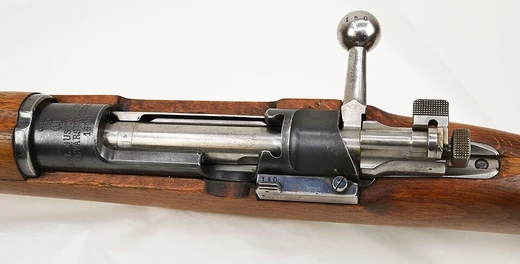
Dreyse needle gun
First bolt-action breechloader, key Prussian infantry weapon of German unification.

The Dreyse needle gun was a 19th-century military breech-loading rifle and the first such weapon to employ a bolt action for opening and closing the chamber. It was invented in 1836 by German gunsmith Johann Nikolaus von Dreyse, who had been experimenting with designs since 1824. The rifle became the primary infantry weapon for the Prussians during the Wars of German Unification.
Its name came from the firing pin, which passed through the paper cartridge like a needle to strike a percussion cap at the bullet’s base. To hide the design’s revolutionary nature, the rifle entered military service in 1841 under a different designation. It could fire about six rounds per minute.
Early versions of the needle gun were muzzle-loading. They used a long, needle-shaped firing pin powered by a coiled spring. When the trigger was pulled, the needle pierced the cartridge and hit a percussion cap on the sabot’s base, igniting the charge. Dreyse later combined this ignition system with a bolt-action breech-loading design, allowing rear loading instead of muzzle loading. This boosted the rate of fire and made the rifle more practical for military use.
After successful testing in 1840, Prussian King Friedrich Wilhelm IV ordered 60,000 of the new rifles. Dreyse set up a factory in Sömmerda with state loans to ramp up production. The weapon was accepted for service in 1841, but only 45,000 units had been produced by 1848.
The needle gun first saw combat during the German revolutions of 1848–49 and proved its superiority in street fighting during the May Uprising in Dresden in 1849. Many German states later adopted it, but the Sömmerda factory could only produce 30,000 rifles a year, failing to meet demand. Most Prussian infantry in the 1850s still used the obsolete 1839 Model Potsdam musket, a smoothbore weapon whose range and accuracy were far inferior to the French Minié and Austrian Lorenz rifles. Low funding meant only 90 battalions had the needle gun by 1855.
Dreyse agreed to state manufacture to increase production. The Royal Prussian Rifle Factory at the Spandau Arsenal began production in 1853, followed by Danzig and Erfurt. Spandau initially produced 12,000 needle guns a year, rising to 48,000 in 1867.
The British Army evaluated the Dreyse needle gun from 1849 to 1851. Trials showed it could fire six rounds per minute and maintain accuracy at 800 to 1,200 yards.
Quick Facts
- Is Ranged
- yes
- Origin
- Kingdom of Prussia
- Designer
- Johann Nikolaus von Dreyse
- Design Date
- From 1824
- Service
- 1841–1876 (Kingdom of Prussia and German Empire)
- Cartridge
- Acorn-shaped lead bullet in paper cartridge
- Action
- Breech-loading bolt action
- Rate
- ~6 rounds per minute
- Caliber
- 15.4 mm
- Velocity
- 305 m/s (1,000 ft/s) (before de · Aptierung), 350m/s (de · aptiert)
- Max Range
- 527 m (maximum setting on sights for M/62) · 678 m (maximum setting on sights for M/65)
- Part Length
- 91 cm
Facts from the source article.
Lore & Background
Early versions of the needle gun made by Dreyse were muzzle-loading, using a long, needle-shaped firing pin powered by a coiled spring. When the trigger was pulled, the needle pierced the cartridge and struck a percussion cap on the base of the sabot, igniting the charge. Dreyse later combined this ignition system with a bolt-action breech-loading design, allowing loading from the rear and significantly increasing the rate of fire. The cartridge consisted of a paper case, an acorn-shaped bullet, a percussion cap, and black powder; the primer was attached to the base of the bullet, so the firing needle passed through the powder charge to strike it, creating a front-to-rear burn pattern that minimized unburnt residues and muzzle flash.
After successful testing in 1840, the Prussian king Friedrich Wilhelm IV ordered 60,000 rifles. Dreyse set up a factory in Sömmerda with state loans, but only 45,000 units had been produced by 1848. The needle gun first saw combat during the German revolutions of 1848–49 and proved its superiority in street fighting during the May Uprising in Dresden in 1849. Many German states adopted the weapon, but the Sömmerda factory could only produce 30,000 rifles a year. By 1855, only 90 Prussian battalions were equipped with it, as most infantry still used the obsolete 1839 Model Potsdam musket. To increase production, Dreyse consented to state manufacture; the Royal Prussian Rifle Factory at Spandau Arsenal began production in 1853, followed by other arsenals, with Spandau's output rising to 48,000 per year by 1867.
The British Army evaluated the Dreyse in 1849–1851, finding it capable of six rounds per minute and accurate at 800–1200 yards, but judged it 'too complicated and delicate' for service. The French Minié-type muzzle-loading rifle was considered superior. Between 1859 and 1863, Prussian army funding increased by 25%, and reforms were carried out by Wilhelm I, Albrecht von Roon, and Helmuth von Moltke the Elder. The needle gun played an important role in the Second Schleswig War against Denmark in 1864, though Prussian line infantry, inexperienced with the weapon, often wasted ammunition. By the outbreak of the Austro-Prussian War in 1866, the Prussian Army had 270,000 Dreyse needle guns. Its superior rate of fire over the Austrian muzzle-loading Lorenz—which could fire 1–2 rounds per minute—contributed to the Prussian victory, though Austrian reliance on bayonet charges also played a role. By the Franco-Prussian War in 1870, the Prussian inventory had grown to 1,150,000 needle guns.
Reader's Guide
The Dreyse needle gun's significance lies in its role as the first bolt-action breech-loading rifle adopted by a major military power, fundamentally changing infantry tactics and firepower. Its rate of fire—about six rounds per minute—gave Prussian infantry a decisive advantage over opponents still using muzzle-loaders, as demonstrated in the Wars of German Unification. The weapon's front-to-rear ignition system was innovative, using a needle-like firing pin that passed through the paper cartridge to strike a percussion cap at the bullet's base, ensuring efficient powder burn and reducing muzzle flash.
However, the design had notable limitations. British trials in 1849–1851 identified a delicate spring driving the needle, a tendency to misfire when dirty (with a new needle required every 12 shots), difficulty operating the bolt when the gun was hot and fouled, barrel wear at the junction with the cylinder, and worsening gas escape at the breech during sustained firing. Its effective range was less than that of the French Chassepot, which replaced it in service after the Franco-Prussian War. The needle gun was eventually superseded by the Mauser Model 1871 rifle.
Despite these drawbacks, the Dreyse needle gun's legacy is that of a pioneering military arm that demonstrated the potential of bolt-action breech-loaders, influencing subsequent rifle development worldwide. It was exported to Romania and Japan, and China also acquired examples for military modernization. Nikolaus von Dreyse's son Franz attempted to modernize the design with an automatic cocking system patented in 1874, but only the Baden border guards adopted it, though commercial rifles were produced until around 1900.
Did You Know?
- The needle gun's name came from its firing pin, which passed like a needle through the paper cartridge to strike a percussion cap at the base of the bullet.
- To conceal the revolutionary nature of the design, the rifle entered military service in 1841 under a different name.
- The cartridge used a front-to-rear burn pattern, which minimized unburnt residues and allowed a smaller powder charge to achieve the same velocity as a rear-ignited charge.
- By the outbreak of the Franco-Prussian War in 1870, the Prussian Army had 1,150,000 needle guns in its inventory.
More in Bolt-Action Rifles, Part 2 1-24
Spotted an error? Know more?
Reader corrections go straight into our review queue. Suggest an edit · How this site is sourced