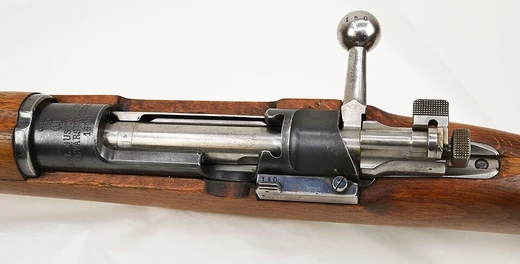
Blaser R93
A straight-pull modular rifle with quick-change barrels and manual cocking.

The Blaser R93 is a straight-pull action precision rifle manufactured by the German firearms company Blaser. Designed by Meinhard Zeh in 1993, it features a manual cocking system and a proprietary saddle scope mount that attaches optics directly to the quick-change barrel, making it notable for its modularity and ease of barrel swapping.
Quick Facts
- Origin
- Germany
- Is Ranged
- yes
- Designer
- Meinhard Zeh
- Design Date
- 1993
- Manufacturer
- Blaser
- Production Date
- 1993–2017
- Number
- 200,000 / +
- Variants
- Blaser 93 Tactical
- Caliber
- Various; see [http: · www.blaser-usa.com/fileadmin/editor/caliber-pdf/Blaser_Calibers_Bolt_Action_R8_EN.pdf]
- Action
- Radial locking straight-pull bolt-action
- Feed
- 3- or 4- round internal box magazine
- Sights
- Aperture-type iron sights or telescopic sight
Facts from the source article.
Lore & Background
The Blaser R93 succeeded the Blaser R84, a 60-degree turn bolt action rifle discontinued after the R93's introduction in 1993. Its modular design is built around an aluminum alloy frame, allowing users to switch barrels, bolt heads, and magazine inserts for different calibers. The barrel is attached with two screws and a hex key, and the scope mounts directly to the barrel, enabling removal and replacement without losing zero. The rifle's trigger is placed under the magazine, giving it a shorter overall length than traditional designs.
The R93 uses a straight-pull bolt with a 14-lug radial collet that locks into a 360-degree groove in the barrel, providing a locking surface of 66 mm² compared to 56 mm² for the Mauser 98. It also features a secondary lockup via a camplate against a hardened steel plate in the magazine box. The bolt is symmetric and self-centering, and stressed parts are hammer-forged steel with plasma nitriding. The trigger is a single-stage direct trigger with a manual cocking system for safe carry.
Several recalls were issued: in 2000 for plastic bolt carriers on the R93 Offroad model, and in May 2003 for non-stainless steel pins in trigger units of US-sold rifles (excluding UIT, CISM, and LRS/LRS2 models). Multiple incidents of rifle explosions were reported between 1994 and 2014, with investigations attributing some to overpressure ammunition or barrel obstructions, though disputes remain in some cases.
Reader's Guide
The Blaser R93's significance lies in its straight-pull action and modularity, which set it apart from traditional bolt-action rifles. Its quick-change barrel system, combined with scope mounts on the barrel, allowed users to switch calibers and maintain zero without re-sighting, a feature rare at its introduction. The manual cocking system and sear-free trigger mechanism contributed to its reputation for safety and accuracy. Production of over 200,000 rifles by 2017 indicates broad adoption among hunters and precision shooters. The R93 was succeeded by the Blaser R8 in 2008, which has a larger locking surface and a detachable box magazine/trigger combination, but the R93 remained in production until 2017. Its legacy includes influencing modular rifle design and establishing Blaser as a notable manufacturer in the hunting and precision rifle market.
Did You Know?
- The Blaser R93's bolt locks using a 14-lug radial collet in a 360-degree groove in the barrel.
- A rimfire conversion kit was available for .22 Long Rifle and .17 HMR.
- In 2000, a recall was issued for plastic bolt carriers on the R93 Offroad model.
- The R93's scope mounts on the barrel, not the receiver, allowing barrel swaps without losing zero.
More in Bolt-Action Rifles, Part 2 1-24
Spotted an error? Know more?
Reader corrections go straight into our review queue. Suggest an edit · How this site is sourced