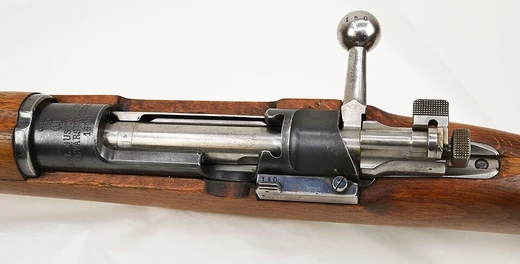
Anschütz 1827 Fortner
Straight-pull biathlon rifle dominant since the late 1980s.

The Anschütz 1827 Fortner is a straight-pull biathlon rifle that has set the standard for the sport since the late 1980s. Designed by Peter Fortner Jr. in collaboration with J. G. Anschütz, it is used by an estimated 97% of biathlon competitors worldwide, with roughly 7,000 units produced by 2007. The rifle’s action dates to 1984, when Fortner, after a conversation with Olympic gold medalist Peter Angerer, set out to create a rifle that could rival those used by Soviet and East German athletes. He patented the “Fortner action” within months, and the 1827 Fortner was introduced around that time. The action is manufactured under license by Fortner Waffen and sold under the Anschütz name.
The straight-pull mechanism uses seven hardened steel ball bearings positioned around the rear of the bolt. When the bolt handle is pushed forward, a locking sleeve forces these bearings outward into a continuous semi-round groove in the receiver, rather than into precisely machined concave recesses. Pulling the handle back retracts the sleeve, allowing the bearings to withdraw and the bolt to open. This semi-rigid locking system was patented in 1984, but the patent has since expired. The rifle’s lock time is about 1.7 milliseconds, and the total time from trigger activation to bullet exit is roughly 4 milliseconds. An optional firing pin buffer, sometimes called a “Dry Fire Donut,” can be installed to prevent damage during dry firing.
The barreled action, produced by Fortner Waffen, measures 730 mm and has remained largely unchanged over nearly 40 years. All accessories and parts, including triggers, are compatible across production years. Early models occasionally had non-nitrated barrels, but these are rare. Barrels are press-fitted, not threaded, and can be replaced by a competent gunsmith. Like other high-end .22 LR Anschütz barrels, the muzzle is choked, likely for better cold-weather performance. A safety catch on the receiver side is marked “S” (Sicherung) for safe and “F” (Feuer) for fire.
The Anschütz 5020 trigger has an adjustable pull weight from 90 to 650 grams and can be set as a single- or two-stage trigger. Factory stocks, produced by Anschütz, have evolved over time; current models feature an adjustable cheek rest and length of pull. Athletes sometimes use custom or aftermarket stocks from other brands, which may lack adjustability.
Quick Facts
- Is Ranged
- yes
- Origin
- Germany
- Designer
- Peter Fortner Jr.
- Design Date
- 1984
- Cartridge
- .22 LR (5.6×15mmR)
- Action
- Roller locked straight-pull
- Velocity
- 335 to 425 m/s
- Weight
- 3.7-4.0 kg
- Length
- 1040 mm
- Part Length
- 550 mm
- Sights
- 0.06 mrad target aperture sight
- Variants
- Comfort
Facts from the source article.
Lore & Background
Anschütz has been producing biathlon rifles since 1976. The design of the 1827 Fortner action dates back to 1984, when Peter Fortner was having beers with Peter Angerer from West Germany, who recently had taken the individual biathlon gold at the 1984 Winter Olympics. Angerer expressed that he wanted a rifle which could match those used by Soviet and East German competitors. Fortner took the challenge and within a few months developed and patented what became known as the 'Fortner action', with the 1827 Fortner introduced around 1984. The Fortner action is produced by Fortner Waffen under licence from Anschütz, and marketed as Anschütz rifles.
The straight-pull mechanism uses seven hardened steel ball bearings evenly positioned around the rear of the bolt as locking elements. When the bolt handle is pushed forward, it moves a locking piece called the bolt clamping sleeve forward, forcing the ball bearings out to lock into a negative recess in the receiver. There are no matching negative shaped recesses; instead there is a simple continuous semi-round groove machined for the ball bearings to lock into. The bolt can be classified as a semi-rigid type. The 1827 F has a lock time around 1.7 milliseconds, and a total time from trigger activation to bullet exit of around 4 ms. The barreled action is produced by Fortner Waffen and has a length of 730 mm. Barrels are not threaded but press-fitted to the receiver, and can be changed by a competent gunsmith. The muzzle is choked, presumably for better performance in cold weather. The action has a safety catch located on the side of the receiver, with 'S' indicating Sicherung (safety) and 'F' indicating Feuer (fire).
Reader's Guide
The Anschütz 1827 Fortner has been the dominant rifle in biathlon since the late 1980s, used by an estimated 97% of competitors worldwide. Its straight-pull action, designed by Peter Fortner Jr., allows the shooter to close the bolt using their thumb, enabling the index finger to get on the trigger blade faster than competing toggle rifles such as the Russian Izhmash 7-3 and 7-4 Series, which require around a 2.5 kilogram-force to cycle and can be cycled in under 1 second. The rifle's trigger, the Anschütz 5020, has an adjustable pull weight from 90 to 650 g and can function as a single or two stage trigger. The barreled action has remained largely unchanged for nearly 40 years, with all accessories and parts compatible across production years. The main improvement has been in the barrel, as some early models featured non-nitrated barrels, though these are rare. The 1827 F magazines are compatible with curved .22 LR magazines for the Anschütz 1400 and 1700 sporting series, as well as the magazine fed version of Anschütz 54 and 64 target actions, though biathlon-specific magazines have a special base plate for ease of use with gloves. The sight adjustment is most commonly clockwise with a click value of 0.06 mrad, translating to 3 mm at 50 meters.
Did You Know?
- The 1827 Fortner was designed after Peter Fortner had beers with Olympic gold medalist Peter Angerer, who wanted a rifle to match Soviet and East German competitors.
- The locking mechanism uses seven hardened steel ball bearings that lock into a continuous semi-round groove in the receiver.
- Anschütz barrels were used in production of some Izhmash Bi 7-3 biathlon rifles in the 1990s, designated BI-7-4A.
- The Anschütz 1727 F hunting rifle, produced since 2013, takes inspiration from the 1827 F but its parts are mostly not compatible.
More in Bolt-Action Rifles, Part 2 1-24
Spotted an error? Know more?
Reader corrections go straight into our review queue. Suggest an edit · How this site is sourced