Montagu's blenny
A small, scaleless blenny with a fleshy crest between its eyes.

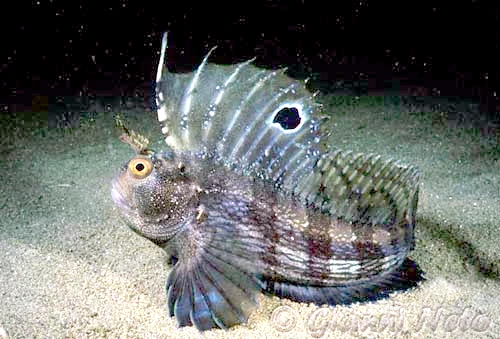
Montagu's blenny, also called the capuchin blenny, is a small, scaleless fish with an elongated body and a downward-pointing mouth. Its eyes sit on top of its head. It reaches up to 8.5 centimeters in total length. The background color is pale brown with olive-green vertical stripes and light blue spots. A single dorsal fin runs the length of the body, marked by a clear notch partway along. Between the eyes sits a fleshy, fringed crest—a feature that, in Britain and Ireland, sets it apart from other local blennies. This crest continues along the back as a series of short fleshy tentacles. Its large pectoral fins, used to grip rock surfaces, look almost like limbs. Atlantic individuals often have dark spots, while Mediterranean ones usually do not. When spawning, males turn uniformly dark or marbled, with a white upper lip.
This species lives in the northeastern Atlantic Ocean and the Mediterranean. Its Atlantic range stretches from southern Ireland and southern Great Britain down to Portugal and along West Africa as far as Guinea. It also appears in the Macaronesian islands: Madeira, the Azores, and the Canary Islands. It is found along all Mediterranean coastlines, into the Sea of Marmara, and the western Black Sea. It has been recorded on the central Turkish Black Sea coast, though its presence in the eastern Black Sea remains unconfirmed.
Montagu's blenny inhabits the mid-tide level of rocky intertidal zones, often on steep surfaces up to the surf zone. It prefers rock pools that are not thick with leafy seaweeds, especially those dominated by coralline algae. At low tide, it stays out of water, sheltering under rocks and seaweeds, and can breathe air. Juveniles are common in tidal pools and sometimes hide inside empty barnacle shells. This fish is omnivorous, feeding mainly on small invertebrates like acorn barnacles, but adults also scrape algae off rock surfaces. It is active mostly during the day, especially at high tide, and at night may sleep up to 40 centimeters above the water's surface.
Breeding occurs in summer, from May to August, in shallow, sometimes intertidal water. The male courts by rocking his head from side to side. The eggs are demersal and stick to the substrate with an adhesive filament. Males guard territories that include depressions, crevices, or holes made by piddocks.
Quick Facts
- Taxon
- Coryphoblennius galerita
Facts from the source article.
Lore & Background
Montagu's blenny has an elongated, scaleless body with eyes set on top of the head and a downward-pointing mouth. Its background colour is pale brown with olive-green vertical stripes and light blue spots. A single dorsal fin runs the length of the body with a noticeable notch. A fringed, fleshy crest between the eyes distinguishes it from other blennies in Britain and Ireland, and this crest continues along the dorsal surface as short fleshy tentacles. Large pectoral fins resemble limbs and are used to grip rock surfaces. Atlantic specimens often have dark spots compared to Mediterranean populations. During spawning, males become uniformly dark or marbled with a white upper lip.
Reader's Guide
Montagu's blenny is notable as the sole species in the genus Coryphoblennius, distinguished by its fleshy crest between the eyes. It occupies a specialized niche in the intertidal zone, preferring rocky shores with wave action and rock pools dominated by coralline algae. The species is omnivorous, feeding on small invertebrates such as acorn barnacles and scraping algae from rock substrates. It is capable of breathing air and shelters under rocks and seaweeds at low tide. Breeding occurs from May to August, with males guarding territories that include depressions, crevices, or piddock holes. Males guard egg masses from multiple females, fertilizing eggs during periodic quivers and fanning them for aeration. The larvae are planktonic and found in shallow coastal waters. The common name honors English naturalist George Montagu.
Did You Know?
- Montagu's blenny is the only species in the genus Coryphoblennius.
- It can sleep up to 40 cm above the water's surface at night.
More in Blennies 1-24
Spotted an error? Know more?
Reader corrections go straight into our review queue. Suggest an edit · How this site is sourced