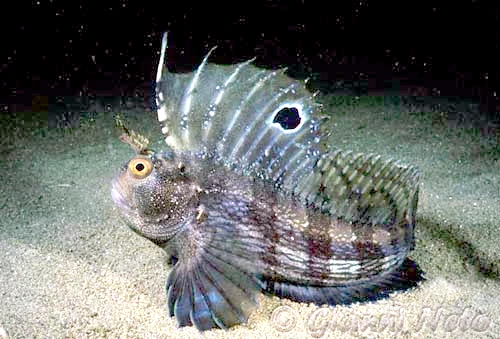
Chaenopsidae
Tropical blennies ranging from tiny to 30 cm, inhabiting worm tubes.

The Chaenopsidae is a family of percomorph marine fish in the order Blenniiformes, commonly known as pike-blennies, tube-blennies, and flagblennies. This strictly tropical family ranges from North to South America, with members also present in waters off Japan, Taiwan, and Korea. It includes 14 genera and 91 species, notable for containing both one of the largest blennies—the sarcastic fringehead (Neoclinus blanchardi) at 30 cm—and perhaps the smallest of all vertebrates, Acanthemblemaria paula, which measures just 1.3 cm as an adult.
Quick Facts
- Taxon
- Chaenopsidae
Facts from the source article.
Lore & Background
Chaenopsids have highly compressed bodies, some so elongated as to appear eel-like; they are scaleless and lack lateral lines. Their heads are rough and may be armed with spines. Dorsal fins typically have 17 to 28 spines, and anal fins have two spines. The habit of taking up home in abandoned worm tubes has earned some species the name 'tube-blenny'; many also inhabit empty clam shells, which serve as nesting sites, with males guarding the brood. Some species have dorsal fins significantly higher towards the head, explaining the name 'flagblenny'. Crustaceans make up the bulk of their diet. At least one Caribbean species, Emblemariopsis diaphana, forms a symbiotic relationship with the stony coral Meandrina meandrites.
Reader's Guide
The Chaenopsidae family is significant for its extreme size range, from the sarcastic fringehead (30 cm) to Acanthemblemaria paula (1.3 cm), which is considered perhaps the smallest of all vertebrates. Their ecological roles include occupying abandoned worm tubes and clam shells, with males guarding broods. The family's diet consists primarily of crustaceans. A notable symbiotic relationship exists between the Caribbean species Emblemariopsis diaphana and the stony coral Meandrina meandrites. Taxonomic uncertainty surrounds the family: some authorities argue that Chaenopsidae is not monophyletic if the genera Neoclinus and Stathmonotus are included, proposing that Stathmonotus be placed in Labrisomidae and that Neoclinus and Mccoskerichthys be placed in the tribe Neoclinini, with further study required to clarify relationships.
Did You Know?
- The family includes Acanthemblemaria paula, perhaps the smallest of all vertebrates, at just 1.3 cm as an adult.
- The largest chaenopsid is the sarcastic fringehead, Neoclinus blanchardi, reaching 30 cm in length.
- Some species are called 'tube-blennies' because they inhabit abandoned worm tubes.
Taxonomic Scope and Tropical Distribution
The blennioid family Chaenopsidae encompasses three commonly recognized groups of percomorph marine fish—pike-blennies, tube-blennies, and flagblennies—all classified within the order Blenniiformes. The family spans fourteen genera and ninety-one described species, a modest but ecologically diverse assemblage. Its geographic footprint is exclusively tropical: the core range stretches from the coastal waters of North America down through South America, while additional populations have been documented in the seas surrounding Japan, Taiwan, and the Korean Peninsula. This strictly warm-water distribution underscores the family's dependence on tropical marine environments, with no recorded presence in temperate or polar waters. The relatively compact number of genera compared to the species count suggests that several of these lineages have radiated within their tropical niches, producing a variety of forms adapted to different microhabitats across the Americas and the western Pacific. The family's simultaneous presence on both sides of the Atlantic and in the western Pacific makes it a notable example of tropical marine distribution spanning multiple ocean basins.
Morphology and an Extraordinary Size Spectrum
Chaenopsids display a striking range of body forms within a single family. Their bodies are highly compressed laterally, and in some lineages the elongation is so extreme that the fish take on an eel-like silhouette. All members are scaleless and completely lack lateral lines, distinguishing them from many other marine fish groups. The head region is characteristically rough-textured and, in several species, armed with spines that add to their defensive repertoire. The dorsal fin bears between seventeen and twenty-eight spines, while the anal fin carries just two. Perhaps the most remarkable aspect of chaenopsid morphology is the sheer breadth of the size spectrum. At the upper end stands the sarcastic fringehead, Neoclinus blanchardi, reaching thirty centimeters in length. At the opposite extreme sits Acanthemblemaria paula, an adult measuring a mere 1.3 centimeters, a size that may make it the smallest of all vertebrate animals. This nearly twenty-five-fold difference in body length within one family is extraordinary in the animal kingdom and highlights the remarkable morphological plasticity of the group.
Microhabitat Specialization and Daily Life
Many chaenopsids have built their ecological identity around the reuse of structures left behind by other organisms. Species that settle into abandoned worm tubes have earned the common name tube-blenny, while others favor empty clam shells, which double as both shelter and nesting platforms. In these shell-based nurseries, males take on the role of brood guardian, defending the eggs until the young are ready to disperse. A distinct morphological trait gives rise to the flagblenny label: in these species the dorsal fin rises to a noticeably greater height toward the head, creating a sail-like profile that likely aids in display or camouflage among vertical structures. Nutritionally, chaenopsids are predominantly crustacean feeders, with small invertebrates forming the bulk of their diet. This combination of structural dependence on invertebrate byproducts, parental investment by males, and specialized feeding makes the family a compelling case study in how small marine fish exploit the architectural remnants of benthic ecosystems to secure both shelter and reproductive success.
Symbiotic Partnerships and Taxonomic Uncertainty
One of the more unusual behavioral relationships documented in the family involves the Caribbean species Emblemariopsis diaphana, which forms a symbiotic association with the stony coral Meandrina meandrites. This partnership highlights the family's capacity for close ecological interdependence with sessile invertebrates, extending beyond simple shelter use into a more integrated biological relationship. On the taxonomic front, Chaenopsidae faces a significant unresolved question. Several authorities argue that the family, as currently circumscribed, is not monophyletic once the genera Neoclinus and Stathmonotus are included. These researchers propose transferring Stathmonotus to the family Labrisomidae and placing Neoclinus together with its close relative Mccoskerichthys into a separate tribal grouping, Neoclinini. The consensus is that additional phylogenetic work is needed before the true evolutionary relationships within this clade can be confidently resolved, leaving the family's boundaries in a state of active scientific debate.
Frequently Asked Questions
What is Chaenopsidae?
Chaenopsidae is a family of strictly tropical marine fish in the order Blenniiformes, comprising 14 genera and 91 recognized species. It is a warm-water group whose members are found across the Americas and parts of East Asia.
What are the common names for Chaenopsidae?
Fans and field guides typically refer to these fish as pike-blennies, tube-blennies, or flagblennies. Those nicknames nod to their elongated, predatory body shapes and their well-known habit of dwelling inside worm tubes on the seafloor.
How big can Chaenopsidae get?
The family covers a remarkable span: the sarcastic fringehead (Neoclinus blanchardi) reaches about 30 cm, making it one of the largest blennies known, while Acanthemblemaria paula is only 1.3 cm as an adult and may be the smallest vertebrate on the planet.
Where do Chaenopsidae live?
These tropical fish range from North to South American coastlines, with additional populations recorded around Japan, Taiwan, and Korea. Many species are closely associated with worm tubes in shallow marine habitats.
What is the sarcastic fringehead?
Neoclinus blanchardi is a standout member of the family, growing to roughly 30 cm and ranking among the biggest blennies in existence. It sits in the genus Neoclinus and is often the species fans picture when they think of Chaenopsidae.
More in Blennies 1-24
Spotted an error? Know more?
Reader corrections go straight into our review queue. Suggest an edit · How this site is sourced