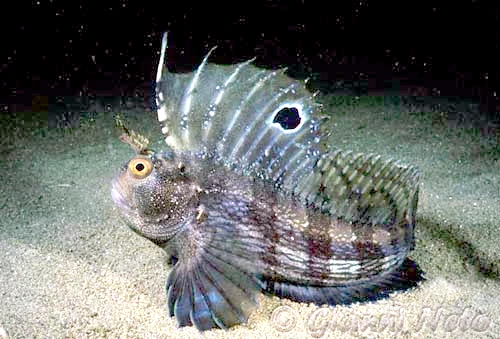
Cleaner fish
Cleaner fish remove parasites and dead tissue from other species.

Cleaner fish are fish that exhibit a specialist feeding strategy by providing a service to other species, referred to as clients, by removing dead skin, ectoparasites, and infected tissue from the surface or gill chambers. This cleaning symbiosis represents mutualism and cooperation, benefiting both parties, though the cleaner fish may sometimes consume mucus or tissue, creating a form of parasitism called cheating. Cleaner fish are found across the globe in fresh, brackish, and marine waters, with a concentration in the tropics due to high parasite density, and include species such as wrasse, cichlids, catfish, pipefish, lumpsuckers, and gobies.
- Obligate cleaner example
- Shark nose goby (Elacatinus evelynae) performs up to 110 cleanings per day
- Facultative cleaner examples
- Blue headed wrasse, noronha wrasse, goldsinny wrasse, sharp nose sea perch, lumpfish
- Aquaculture species
- Lumpfish (Cyclopterus lumpus) and ballan wrasse (Labrus bergeylta)
- Common parasites
- Gnathiidae and copepod species
- Hormones influencing behavior
- Arginine vasotocin, Isotocin, serotonin
Lore & Background
Cleaner fish are divided into two types: obligate full-time cleaners and facultative part-time cleaners, with strategies based on resources and local fish abundance. Obligate cleaners rely solely on cleaning for food and have a higher output, while facultative cleaners, such as the blue wrasse, are generalist foragers that clean as a diet supplement. Cleaning behavior takes place in pelagic waters and at designated cleaner stations, where clients congregate and perform specific movements to attract cleaners, and interactions are begun by the client and ended by the cleaner.
Reader's Guide
The specialized feeding behavior of cleaner fish has become a valuable resource in salmon aquaculture in Atlantic Canada, Scotland, Iceland, and Norway for preventing sea lice outbreaks, benefiting the economy and environment by minimizing chemical delousers. Cleaner fish are also notable for their neuroendocrine system, involving hormones arginine vasotocin, isotocin, and serotonin, which influence interaction durations, memory of clients, and the balance between honest cleaning and cheating. Conspicuous coloration, such as a brilliant blue stripe, is used by some cleaner fish, while other species mimic their behavior and phenotype to gain access to client tissue. The cleaning symbiosis does not break down despite cheating because the overall benefit to the larger fish outweighs any harm, and parasite abundance varies seasonally and spatially.
Did You Know?
- Cleaner fish can be obligate full-time cleaners or facultative part-time cleaners.
- The shark nose goby (Elacatinus evelynae) performs up to 110 cleanings per day.
- Lumpfish and ballan wrasse are cultured for salmon aquaculture to control sea lice.
- High serotonin increases cleaner fish motivation to interact with clients.
The Cleaning Symbiosis and Client Relationships
The bluestreak cleaner wrasse occupies a unique ecological niche as a mutualistic service provider on tropical coral reefs. Operating from fixed cleaning stations—often staffed by a pair of adults, a group of juveniles, or a dominant male with attendant females—the wrasse performs a distinctive greeting dance, undulating its rear end up and down, to attract approaching clients. Once a larger fish recognizes the wrasse by its lateral black stripe and movement patterns, it assumes a species-specific pose that grants the cleaner access to its skin, gills, and sometimes even its mouth. The wrasse then feeds on ectoparasites and dead tissue, gaining nutrition while the client receives a health benefit. This relationship varies geographically: in the Great Barrier Reef's tidal zones, the wrasse is a facultative cleaner that prefers coral over fish, and juveniles there bite clients more often than adults. In Egypt's Ras Mohamed Nature Reserve, however, the wrasse depends heavily on parasites from species like the brown surgeonfish, and clients with cleaner access show lower antibody responses, suggesting reduced need for active immunity. In regions where the wrasse is solely parasite-dependent, fish with access to cleaning services maintain measurably better body condition than those without.
Taxonomy and the Polyphyletic Puzzle
What was long considered a single species may actually be a complex of multiple closely related wrasses. Genetic analysis of Labroides dimidiatus populations revealed two monophyletic clades, with Indian Ocean individuals generally displaying different stripe widths than their western Pacific counterparts. Complicating the picture further, Japanese cleaner wrasses—despite their distinct appearance—cluster genetically within the same group as Indian Ocean fish, and the two clades overlap geographically around Papua New Guinea. Adding to the taxonomic uncertainty, two other recognized cleaner wrasse species, L. pectoralis and L. bicolor, were found nested inside the L. dimidiatus clade. This suggests the bluestreak cleaner wrasse as traditionally defined may be polyphyletic, effectively bundling several distinct species under one name. The species' range stretches from the Red Sea and Eastern Africa across the Indian Ocean to the western Pacific, including Fiji and French Polynesia. In 2015, researchers examining hundreds of hours of previously unused documentary footage recorded the wrasse from the Kermadec Islands Marine Reserve north of New Zealand, marking a notable range extension for what is already a taxonomically tangled group.
Mimicry and the Deception Economy
The bluestreak cleaner wrasse's reputation as a beneficial service provider has made it a target for evolutionary deception. The blenny Aspidontus taeniatus has evolved to imitate the cleaner's behavior, approaching larger fish not to remove parasites but to tear small pieces of flesh or skin, exploiting the client's expectation of a mutualistic interaction. Another deceiver, the bluestreak fangblenny Plagiotremus rhinorhynchos, mimics the appearance of juvenile cleaner wrasses—black bodies with an electric-blue line—so that adult cleaners tolerate its presence at cleaning stations. This proximity is presumably advantageous to the fangblenny, as it places the mimic in the midst of a concentrated gathering of potential prey. These mimics highlight how the cleaner wrasse's distinctive coloration and behavior patterns, which normally signal trustworthiness to client fish, have become exploitable signals in the reef ecosystem. The wrasse's wide longitudinal black stripe, white-to-blue body, and characteristic greeting dance are the very traits that both attract clients and make it a recognizable model for cheaters.
Reproduction, Sex Change, and Physical Form
The social and reproductive structure of the bluestreak cleaner wrasse centers on territorial dominance and a remarkable capacity for sex change. Males defend specific living territories against rival males, maintaining control over the females within their domain. This creates a hierarchical social unit at each cleaning station, where a dominant male presides over a group of females. The system incorporates a built-in succession mechanism: when the dominant male in a territory dies or is otherwise removed, one of the larger females is capable of changing sex to assume the male role and take control of that territory. This sex change ensures continuity of the cleaning station's leadership and the maintenance of the service that client fish depend upon. The wrasse's physical appearance also shifts with life stage: young individuals are black with an electric-blue line, while adults display the characteristic white body, sometimes slightly yellowish, with a bright blue front, a wide black longitudinal stripe running along the side and through the eye, and a black band that widens at the tail. Adults average around ten centimeters in length, reaching a maximum of about fourteen centimeters.
Frequently Asked Questions
What is a cleaner fish?
A cleaner fish is a specialist that earns its living by removing dead skin, ectoparasites, and infected tissue from other species known as clients. This cleaning symbiosis is fundamentally mutualistic, though some cleaners occasionally cheat by consuming mucus or healthy tissue.
Which species are famous cleaner fish?
The Shark nose goby (Elacatinus evelynae) stands out as an obligate cleaner, performing up to 110 cleanings per day. Facultative cleaners include the blue headed wrasse, noronha wrasse, goldsinny wrasse, sharp nose sea perch, and lumpfish.
Why are cleaner fish important to their ecosystem?
They maintain the health of aquatic communities by removing parasites like Gnathiidae and copepods from client fish, making them essential partners in reef and freshwater systems. Their cleaning behavior is regulated by hormones such as arginine vasotocin, isotocin, and serotonin.
Where do cleaner fish live?
They are found across the globe in fresh, brackish, and marine waters, with the densest populations in tropical regions where parasite loads are highest. In aquaculture, species like the lumpfish (Cyclopterus lumpus) and ballan wrasse (Labrus bergeylta) are specifically employed for this role.
Can a cleaner fish harm its client?
Although the relationship is primarily mutualistic, a cleaner may occasionally engage in what researchers call 'cheating' by consuming mucus or healthy tissue instead of just parasites and dead skin. This briefly shifts the interaction toward parasitism, yet the overall partnership remains beneficial to both parties.
More in Blennies 1-24
Spotted an error? Know more?
Reader corrections go straight into our review queue. Suggest an edit · How this site is sourced