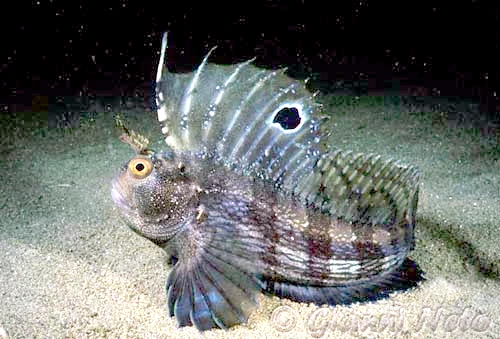
Blenniiformes
An order of percomorph fish including blennies and damselfish.

Blenniiformes is an order of percomorph fish belonging to the clade Ovalentaria, and it is the most diverse group within that clade. This order includes familiar fish like blennies and damselfish. The name comes from the Latin *blennius*, which traces back to the Ancient Greek *βλεννός* (*blennos*), meaning "mucus" or "slime"—a reference to the slippery coating often present on the scales of blenny fish. The earliest known member of this order is the stem-group damselfish *Chaychanus*, which dates to the Early Paleocene of Mexico. In terms of classification, most members of this group were originally placed in the Perciformes, as was common for many percomorphs. Earlier editions of *Fishes of the World* restricted Blenniiformes to blennies and their close relatives, leaving damselfishes, jawfishes, and surfperches as uncertain members of Ovalentaria. However, phylogenetic evidence shows that these families form a successive grade leading to blennies, so newer authorities like *Eschmeyer's Catalog of Fishes* now include them in this order. Some studies go further, also placing Cichliformes and Mugiliformes—the closest relatives based on phylogenetics—within Blenniiformes, though *Catalog of Fishes* does not follow this. The families recognized by *Eschmeyer's Catalog of Fishes* in the order Blenniiformes are: Family Pseudochromidae Müller & Troschel, 1849 - dottybacks, Family Plesiopidae Günther, 1861 - roundheads, Family Grammatidae Jordan, 1887 - gramma basslets, Family Opistognathidae Bonaparte, 1835 - jawfishes, Pomacentridae (damselfishes and anemonefishes), Embiotocidae (surfperches), and the suborder Gobiesocoidei, which contains Gobiesocidae (clingfishes). The suborder Blennioidei (blennies) includes Tripterygiidae (triplefins or threefin blennies), Blenniidae (combtooth blennies), Clinidae (kelp blennies), Labrisomidae (labrisomid blennies), Chaenopsidae (pikeblennies or tube blennies), and Dactyloscopidae (sand stargazers).
Quick Facts
- Taxon
- Blenniiformes
Facts from the source article.
Lore & Background
The earliest known member of Blenniiformes is the stem group-damselfish Chaychanus from the Early Paleocene of Mexico. The order's name is derived from the Latin blennius, which itself comes from the Ancient Greek βλεννός (blennos), meaning 'mucus' or 'slime,' referencing the slimy coating often found on the scales of blenny fish. As with many other percomorphs, most members of this group were originally placed in the Perciformes. Previously, Fishes of the World defined this order as restricted to blennies and their close relatives, placing several taxa such as damselfishes, jawfishes, and surfperches as indeterminate members of Ovalentaria. Phylogenetic evidence suggests that these families form a successive grade leading to blennies, leading to their inclusion in this order by newer authorities such as Eschmeyer's Catalog of Fishes. Some studies go further and also place Cichliformes and Mugiliformes within this order, though this is not followed by Catalog of Fishes.
Reader's Guide
Blenniiformes is notable as the most diverse group within the clade Ovalentaria, encompassing a wide range of fish families including dottybacks, roundheads, damselfishes, anemonefishes, surfperches, gramma basslets, jawfishes, clingfishes, and several groups of blennies such as triplefins, combtooth blennies, kelp blennies, labrisomid blennies, pikeblennies, and sand stargazers. The order's taxonomic history reflects broader shifts in percomorph classification: originally most members were placed in Perciformes, but phylogenetic evidence has reorganized them into a successive grade leading to blennies. This reclassification is adopted by Eschmeyer's Catalog of Fishes, though some studies extend the order further to include Cichliformes and Mugiliformes, a view not currently followed by that catalog. The earliest known fossil, Chaychanus from the Early Paleocene of Mexico, provides a temporal anchor for the group. The slimy coating that gives blennies their name is a characteristic feature of many species in the order.
Did You Know?
- The name Blenniiformes comes from the Ancient Greek βλεννός (blennos), meaning 'mucus' or 'slime,' referring to the slimy coating on blenny scales.
- Some studies place Cichliformes and Mugiliformes within Blenniiformes, but this is not followed by Eschmeyer's Catalog of Fishes.
A Name Born from Slime
The very name of this order carries a surprisingly tactile origin. Blenniiformes traces its roots back to the Latin word blennius, which in turn descends from the Ancient Greek blennos, a term meaning mucus or slime. This etymology is no mere linguistic curiosity; it points directly to a defining physical trait of the group's namesake fish. Blennies are often covered in a distinctive slimy coating on their scales, a characteristic so prominent that it gave the entire order its identity. The name thus encodes a sensory observation—something you could feel if you ran your fingers over a live specimen—into the formal taxonomic label. It is a rare case in ichthyology where the common, almost unglamorous quality of a fish's skin became the foundation for an entire order's identity, linking ancient Greek natural observation to modern systematic classification in an unbroken chain.
A Taxonomic Odyssey
For much of the twentieth century, the fish now recognized as Blenniiformes were scattered across the broad and heterogeneous order Perciformes, a grouping that lumped together many unrelated percomorph lineages. The classic reference Fishes of the World took a conservative approach, restricting the blenny order to blennies and their closest relatives while leaving damselfishes, jawfishes, and surfperches in a state of taxonomic limbo as indeterminate members of the wider clade Ovalentaria. The picture shifted dramatically as phylogenetic analyses accumulated. These studies revealed that the previously separated families actually form a successive grade, a branching sequence, leading ultimately to the blennies themselves. This evidence persuaded newer authorities, including Eschmeyer's Catalog of Fishes, to fold those families into Blenniiformes. Some researchers have pushed even further, arguing that Cichliformes and Mugiliformes, identified as the closest relatives of this group, should also be subsumed within it, though the Catalog of Fishes has not adopted that broader interpretation.
A Census of Diversity
Blenniiformes stands as the most diverse order within the percomorph clade Ovalentaria, a distinction reflected in the remarkable breadth of families it now encompasses. Beyond the well-known blennies and the colorful damselfishes and anemonefishes, the order shelters a wide array of lesser-known groups. Dottybacks and roundheads occupy their own families, while surfperches and jawfishes represent distinct lineages. The suborder Gobiesocoidei houses the clingfishes, and the suborder Blennioidei contains not just the combtooth blennies but also triplefins, kelp blennies, labrisomid blennies, pikeblennies, and sand stargazers. Each family carries its own formal taxonomic authority and date of description, stretching back to the early nineteenth century. Together, these lineages paint a picture of an order that is far more than its namesake: a sprawling assemblage of marine fish whose shared evolutionary heritage was only gradually unveiled through modern phylogenetic work.
Roots in the Paleocene
The fossil record of Blenniiformes, while still sparse, offers a tantalizing glimpse into the order's deep past. The earliest known member is Chaychanus, a stem group-damselfish whose remains were recovered from Early Paleocene deposits in Mexico. This single fossil is significant not merely for its age but for what it tells us about the order's origins. As a stem group-damselfish, Chaychanus sits at the base of the damselfish lineage, suggesting that the evolutionary radiation that would eventually produce the full diversity of Blenniiformes was already underway in the early Cenozoic, shortly after the mass extinction that ended the Cretaceous. The fact that this foundational specimen comes from Mexico also hints at the geographic context in which these lineages began to diversify. Combined with the phylogenetic evidence showing a successive grade of families leading to blennies, Chaychanus anchors the order's story in a specific time and place, giving researchers a concrete starting point from which to trace the subsequent branching of this remarkably diverse group.
Frequently Asked Questions
What is Blenniiformes?
Blenniiformes is an order of percomorph fish that sits within the clade Ovalentaria, where it is the most species-rich grouping. It encompasses familiar reef fish such as blennies and damselfish.
Where does the name "Blenniiformes" come from?
The name traces back to the Ancient Greek word *blennos*, meaning "mucus" or "slime," passed through Latin as *blennius*. It references the slippery mucus coating typically found on the scales of blenny fish.
What is the oldest known fossil of a Blenniiformes?
The earliest recognized member is *Chaychanus*, a stem-group damselfish from Early Paleocene deposits in Mexico. This fossil anchors the order's known evolutionary record in the early Cenozoic.
Which families fall under Blenniiformes?
The Eschmeyer Catalog of Fishes assigns numerous families to this order, including dottybacks (Pseudochromidae), roundheads (Plesiopidae), and gramma basslets (Grammatidae), among others. Together they form the most diverse assemblage within Ovalentaria.
Why is Blenniiformes considered important in fish systematics?
As the most diverse order in the Ovalentaria clade, it spans a wide array of reef-associated lineages that are central to coral and rocky-habitat ecology. Its broad taxonomic scope makes it a focal group for understanding percomorph diversification.
More in Blennies 1-24
Spotted an error? Know more?
Reader corrections go straight into our review queue. Suggest an edit · How this site is sourced