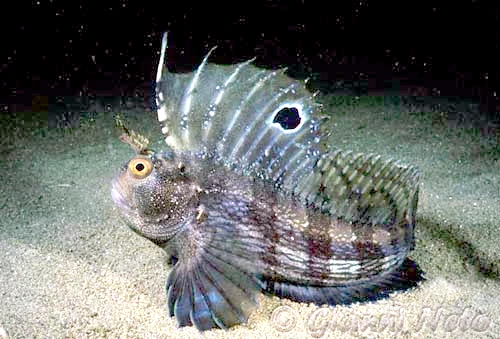
Petroscirtes
A genus of combtooth blennies with venomous species.

Petroscirtes, a genus of combtooth blennies, inhabits the Indian and western Pacific oceans. These fish are often found in coastal reefs and estuaries, typically at depths down to about 10 meters, though they can venture as deep as 15 meters. Their preferred habitats include sandy and weedy zones, especially among clumps of Sargassum or other seaweeds on coastal and lagoon reefs. Some species within this genus produce a venom that binds to opioid receptors, which has drawn scientific interest. For nesting, they use small-necked bottles, abandoned worm tubes, or shells. The genus currently comprises 11 recognized species, including the Arabian fangblenny, striped poison-fang blenny mimic, deceiver fangbelly, wolf fangbelly, floral blenny, twilight fangblenny, Thepas' sabretooth blenny, variable sabretooth blenny, and xestus sabretooth blenny, along with *Petroscirtes marginatus* and *Petroscirtes springeri*.
Quick Facts
- Taxon
- Petroscirtes
- Type Species
- Petroscirtes mitratus
- Type Species Authority
- Rüppell, 1830
Facts from the source article.
Lore & Background
Petroscirtes is a genus of combtooth blennies that inhabit the western Pacific and Indian oceans. Adults are typically found in coastal reefs and estuaries at depths of about 10 meters, though they can occur up to 15 meters deep, especially in sandy and weedy areas among clumps of Sargassum or other seaweeds in coastal and lagoon reefs. They also occupy nests inside small-necked bottles and abandoned worm tubes or shells.
Some species within this genus possess venom that interacts with opioid receptors, a characteristic that distinguishes them among blennies. The genus currently includes 11 recognized species, such as Petroscirtes ancylodon (Arabian fangblenny), Petroscirtes breviceps (Striped poison-fang blenny mimic), and Petroscirtes mitratus (Floral blenny), among others.
Reader's Guide
The genus Petroscirtes holds significance primarily due to the venom found in some of its species, which interacts with opioid receptors. This property makes it a subject of interest for biochemical and pharmacological studies, as such venom could provide insights into pain pathways or lead to novel compounds. The genus is also ecologically notable for its habitat preferences, occupying coastal reefs, estuaries, and weedy areas up to 15 meters deep, and for its unusual nesting behavior in small-necked bottles and abandoned worm tubes or shells. With 11 recognized species, including the Arabian fangblenny and the Striped poison-fang blenny mimic, Petroscirtes contributes to the diversity of combtooth blennies in the Indo-Pacific region. Its legacy lies in its unique venom chemistry and its adaptability to various microhabitats, though the article does not elaborate on broader impacts or conservation status.
Did You Know?
- Some Petroscirtes species have venom that interacts with opioid receptors.
- Adults are usually found in coastal reefs and estuaries to depths of about 10 meters.
- The genus contains 11 recognized species.
A Name in Honor of a Mentor
The specific epithet springeri carries a personal story behind its formal taxonomic weight. The species was named to honour Victor G. Springer, an American ichthyologist affiliated with the United States National Museum. Springer's contribution extended well beyond a single paper or specimen. He was the person who first introduced the eventual describer of this blenny to the entire family of blenniids, meaning that without his early guidance the researcher might never have turned attention toward this group of small reef fish at all. Springer went further still, actively suggesting the very line of study that would culminate in Smith-Vaniz formally describing Petroscirtes springeri. In a field where naming conventions can feel cold and purely systematic, this particular epithet stands as a warm acknowledgment of mentorship. It reminds readers that behind every new species description often lies a chain of personal relationships: a senior scientist pointing a junior colleague toward a promising question, and a collaborative spirit that turns curiosity into a lasting published record. The name Springer is thus woven into the identity of the fish itself, ensuring the mentor's influence endures in every future reference to this small Pacific blenny.
Physical Profile and Geographic Range
Petroscirtes springeri is a combtooth blenny, a member of the family of small reef fish distinguished by their characteristic tooth structure. This particular species reaches a maximum standard length of 7.7 centimetres, or approximately 3.0 inches, placing it firmly among the smaller inhabitants of its reef environment. Its documented geographic range is confined to coral reef habitats in the northwest Pacific Ocean, a broad and biodiverse stretch of marine territory. The association with coral reefs is a defining feature of this species' ecological setting, as these complex structures form the primary environment in which the blenny is found. The northwest Pacific location situates Petroscirtes springeri within a tropical to subtropical marine zone where coral communities are well established. At under eight centimetres in standard length, the fish occupies a modest physical niche within the broader reef fish assemblage. The combtooth dentition is a shared morphological trait across the blenny family, setting them apart from many other reef-associated fish groups. The fact that this species is documented specifically within coral reef settings in the northwest Pacific underscores its close association with that particular habitat type and geographic region.
The Discovery and the Mentorship Behind It
The formal description of Petroscirtes springeri by Smith-Vaniz did not emerge in a vacuum of isolated research. The trail leading to the species' recognition began with Victor G. Springer, an American ichthyologist based at the United States National Museum, who played a pivotal role in shaping the career trajectory of the eventual describer. Springer was the one who first introduced the researcher to the blenniids, effectively opening a door to an entire family of small reef fish that might otherwise have remained outside the scientist's focus. That initial introduction was not a one-time event; Springer continued to influence the direction of the work by specifically suggesting the study that would ultimately result in Smith-Vaniz describing this new species. The sequence of events reveals a classic pattern in taxonomic science: a senior figure identifies a promising area of inquiry, guides a colleague into that area, and then the colleague carries the investigation through to a formal description. The naming of the species after Springer is a direct acknowledgment of this intellectual lineage, preserving the collaborative, mentorship-driven nature of the work in the very name that future ichthyologists will use when referring to this small Pacific blenny.
A Small Species in a Vast Reef Community
Among the countless fish that inhabit the coral reefs of the northwest Pacific, Petroscirtes springeri represents one of the smaller, less conspicuous members of the blenny family. At a maximum of 7.7 centimetres in standard length, it is a fish that would be easy to overlook in the dense, three-dimensional architecture of a living reef. Yet its presence is a meaningful data point in the broader inventory of reef biodiversity in the region. As a combtooth blenny, it belongs to a family that is remarkably diverse in form and distribution, and the fact that a distinct species has been identified and described within the northwest Pacific coral reef zone adds to the known richness of that ecosystem. The species' restricted range to coral reef habitats in a specific oceanic region highlights how even small fish can be geographically and ecologically specialized. The documentation of Petroscirtes springeri, from Springer's initial mentorship through Smith-Vaniz's formal description, illustrates the ongoing work of ichthyologists in cataloguing the full spectrum of marine life, from the most charismatic large predators down to the tiny blennies that form an integral part of the reef's biological tapestry.
Frequently Asked Questions
Who is Petroscirtes?
Petroscirtes is a genus of combtooth blennies comprising eleven species that roam the Indian and western Pacific oceans. These small reef-dwellers favor shallow coastal waters and are commonly spotted among seaweed beds on lagoon reefs.
What are Petroscirtes's powers or special abilities?
Certain members of this genus produce a venom that binds to opioid receptors, making them one of the few fish families known to carry a neuroactive toxin. This trait has drawn considerable attention from researchers studying marine pharmacology.
Where does Petroscirtes live?
These blennies hang around sandy and weedy stretches of coastal and lagoon reefs, often tucking into clumps of Sargassum or other seaweeds. They typically stay in shallower water around ten meters deep but can occasionally be found at fifteen meters, and they also appear in estuarine environments.
How does Petroscirtes raise its young?
Rather than building an open nest, a male Petroscirtes guards his eggs inside a small enclosed space such as a narrow-necked bottle, an abandoned worm tube, or a shell. This tucked-away strategy helps shield the developing fry from open-water predators.
Why is Petroscirtes important to science?
The genus is a key subject of study because its opioid-binding venom offers a rare window into how marine organisms evolve neuroactive compounds. Understanding this toxin could inform future research into pain management and receptor biology.
More in Blennies 1-24
Spotted an error? Know more?
Reader corrections go straight into our review queue. Suggest an edit · How this site is sourced