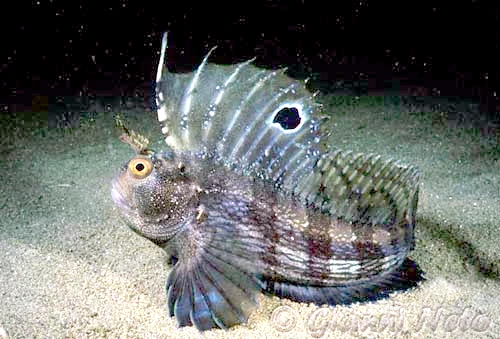
Threefin blenny
Small, colorful reef fish with a three-part dorsal fin.

The family Tripterygiidae includes about 150 species of small, perch-like marine fish, commonly called threefin or triplefin blennies. They live in tropical and temperate waters across the Atlantic, Pacific, and Indian Oceans, spread across 30 genera. Their scientific name comes from the Greek *tripteros*, meaning "with three wings."
These fish have the elongated body typical of blennies, but their dorsal fin is split into three separate sections—the first two of which are spiny. Their pelvic fins are small and slender, located under the throat with a single spine, while the anal fin may have one or two spines. The pectoral fins are notably large, and the tail fin is rounded. The largest species, the New Zealand topknot (*Notoclinus fenestratus*), reaches 20 cm in total length; most others stay under 6 cm.
Many threefin blennies are brightly colored, often as camouflage, which makes them popular in home aquariums. They are demersal fish, spending most of their time on or near the bottom among coral and rocks. They prefer shallow, clear waters with plenty of sunlight, such as lagoons and seaward reefs. Nervous by nature, they dart into rock crevices at the first sign of danger.
These fish are diurnal and territorial. In many species, males and females look different—a trait called sexual dichromatism—with females being duller in color. Some males also have an extended second dorsal fin. Their diet consists mainly of small invertebrates.
- Family
- Tripterygiidae
- Number of species
- about 150
- Number of genera
- 30
- Largest species
- Notoclinus fenestratus (New Zealand topknot) at 20 cm total length
- Typical size
- most species do not exceed 6 cm
- Diet
- small invertebrates
- Habitat
- shallow, clear waters with sun exposure, such as lagoons and seaward reefs
Lore & Background
Threefin blennies have an elongated, typical blenny form but differ from their relatives by having a dorsal fin separated into three parts, the first two of which are spinous. Their small, slender pelvic fins are located underneath the throat and possess a single spine; the large anal fin may have one or two spines. The pectoral fins are greatly enlarged, and the tail fin is rounded. Many threefin blennies are brightly coloured, often for reasons of camouflage, and these species are popular in the aquarium hobby. As demersal fish, they spend most of their time on or near the bottom on coral and rocks. They are typically found in shallow, clear waters with sun exposure, such as lagoons and seaward reefs; nervous fish, they retreat to rock crevices at any perceived threat. Threefin blennies are diurnal and territorial; many species exhibit sexual dichromatism, with the females drab compared to the males. The second dorsal fin is also extended in the males of some species. Small invertebrates comprise the bulk of their diet.
Reader's Guide
Threefin blennies are notable for their distinctive three-part dorsal fin, which gives them their common name and sets them apart from other blennies. Their bright coloration, often serving as camouflage, makes them popular in the aquarium hobby. As demersal fish, they play a role in reef ecosystems, spending most of their time on or near the bottom among coral and rocks. Their nervous, territorial behavior and tendency to retreat to crevices at threats highlight their adaptation to shallow, sunlit reef environments. The family includes about 150 species across 30 genera, with the largest species, the New Zealand topknot, reaching 20 cm, while most others are under 6 cm. Sexual dichromatism, with drab females and more colorful males, and extended second dorsal fins in some males, are characteristic of many species. Their diet of small invertebrates places them as micro-predators within their habitats.
Did You Know?
- The family name Tripterygiidae derives from the Greek tripteros meaning 'with three wings'.
- The largest threefin blenny is the New Zealand topknot, Notoclinus fenestratus, at 20 cm total length.
- Many species exhibit sexual dichromatism, with females drab compared to males.
Taxonomic Scope & Nomenclature
The family Tripterygiidae encompasses roughly 150 species distributed across 30 genera, making it a remarkably diverse group within the blenniiform order of small percomorph marine fish. The family name itself carries a vivid etymological root, drawn from the Greek word tripteros, which translates to "with three wings"—a direct reference to the distinctive tripartite dorsal fin that sets these fish apart from other blenny relatives. Taxonomically, the family is split into two subfamilies. The smaller Notoclininae, established by Fricke in 2009, contains just two genera: Brachynectes and Notoclinus. The far larger Tripterygiinae, described by Whitley in 1931, houses the remaining twenty-eight genera. The historical record of genus descriptions spans nearly two centuries, from Tripterygion, named by Risso in 1827, through to Matanui, described by Jawad and Clements as recently as 2004. This breadth of discovery underscores how much of the family's diversity was only formally recognized in the modern era. The family's geographic range stretches across tropical and temperate waters of the Atlantic, Pacific, and Indian Oceans.
Morphology & Distinguishing Anatomy
Threefin blennies share the elongated body plan characteristic of blennies, yet several anatomical features distinguish them from closely related families. The most defining trait is the dorsal fin, which is divided into three distinct sections; the first two of these are armed with spines, a configuration that gives the family its evocative Greek-derived name. Beneath the throat, a pair of small, slender pelvic fins sits, each bearing a single spine. The anal fin, by contrast, is notably large and may carry either one or two spines. Perhaps most striking are the pectoral fins, which are greatly enlarged relative to the body, and the caudal fin, which takes a broadly rounded shape. In terms of size, the overwhelming majority of species remain modest, typically not exceeding six centimeters in total length. The exceptional outlier is the New Zealand topknot, Notoclinus fenestratus, which reaches twenty centimeters—more than triple the size of most of its kin. Many species also display vivid coloration, though this brightness often serves a functional purpose of camouflage rather than mere ornamentation.
Habitat, Daily Rhythm & Defensive Behavior
As demersal fish, threefin blennies anchor their lives to the seafloor, spending the majority of their time on or immediately above coral structures and rocky substrates. Their preferred environments are shallow, clear waters that receive ample sunlight, with lagoons and seaward reefs representing the most typical settings. Across all three major oceans where the family occurs, these habitat preferences remain consistent. Behaviorally, threefin blennies are strictly diurnal, conducting their activities during daylight hours, and they defend their spaces with a strong territorial instinct. They are also notably nervous creatures; at any perceived threat, they bolt into rock crevices, using the complex architecture of their reef environment as a refuge. This combination of territoriality and skittishness shapes their social dynamics, as individuals maintain personal space while remaining alert to potential danger. Their reliance on structured, sunlit habitats means they are particularly visible to observers and divers, making them among the more frequently encountered reef fish in tropical and temperate waters alike.
Sexual Dimorphism, Feeding & the Aquarium Trade
Reproductive biology in threefin blennies is marked by pronounced sexual dichromatism in many species. Males typically display the brighter, more elaborate coloration, while females appear comparatively drab and muted. In certain species, males also extend their second dorsal fin, adding an additional visual display element that likely plays a role in courtship or territorial signaling. On the dietary front, threefin blennies are primarily invertebrate feeders, with small invertebrates making up the bulk of their intake. This feeding strategy is well suited to their demersal lifestyle, as they forage among the crevices and surfaces of coral and rock where such prey is abundant. Beyond their natural ecology, the vivid coloration that many species exhibit—coloration that in the wild often functions as camouflage—has made them highly sought after in the aquarium hobby. Their small size, manageable temperament in captivity, and striking appearance have established them as popular choices among reef-keeping enthusiasts, bridging the gap between their wild reef habitat and the glass walls of a home aquarium.
Frequently Asked Questions
What is a Threefin blenny?
Rather than a single fish, the Threefin blenny refers to the entire family Tripterygiidae, a group of roughly 150 small, perch-like marine species distributed across 30 genera. The name derives from the Greek word tripteros, meaning 'with three wings,' a reference to their signature three-part dorsal fin.
What are Threefin blenny's most recognizable features?
They share the elongated body plan common to blennies but stand out with a dorsal fin divided into three separate sections, the first two of which carry spines. Their pelvic fins are notably small and slender, positioned beneath the throat and armed with a single spine.
How big do Threefin blenny get?
The vast majority of species in this family stay under 6 cm in total length. The one notable exception is the New Zealand topknot (Notoclinus fenestratus), which can reach 20 cm and is the largest member of the group.
What does a Threefin blenny eat?
Members of this family are small invertebrate feeders, picking out tiny crustaceans, worms, and other minute animals from reef and rocky substrates.
Where can you find Threefin blenny in the wild?
They are distributed across tropical and temperate waters in all three major oceans—the Atlantic, Pacific, and Indian—making them one of the most geographically widespread blenny families.
More in Blennies 1-24
Spotted an error? Know more?
Reader corrections go straight into our review queue. Suggest an edit · How this site is sourced