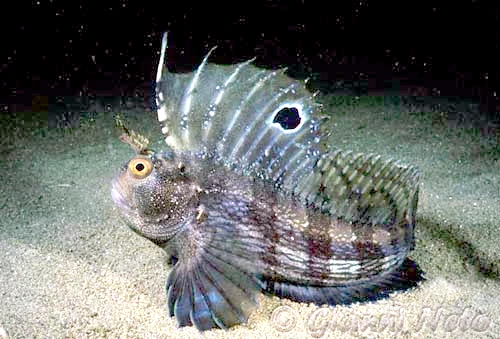
Labrisomid
Small, stocky blennies of tropical Atlantic and Pacific waters.

Labrisomids, commonly known as scaly blennies, are a family of small, marine percomorph fish. They belong to the blennioid group and are found mainly in the tropical Atlantic and Pacific Oceans, with around 110 species spread across 15 genera. While they are stockier than most blennies, their bodies are still elongated. Their dorsal fins have more spines than soft rays—sometimes lacking soft rays entirely—and their pelvic fins are long and thin. Like many blennies, they have whisker-like cirri on their heads and napes. Their scales may be cycloid or absent, and many species are brightly colored. The largest species, *Labrisomus philippii*, reaches 35 cm in length, but most are much smaller.
These fish are benthic, staying in shallow coastal waters down to about 10 meters, and spend most of their time on or near the bottom. They inhabit both sandy and rocky substrates, sometimes around reefs or in seagrass beds. Shy by nature, labrisomids retreat into crevices when threatened. Their diet consists mainly of crustaceans, gastropods, brittle stars, and sea urchins.
Two genera, *Xenomedea* and *Starksia*, are noted for being ovoviviparous—they retain eggs inside the oviduct for safe development. However, only *Starksia* species have gonopodia, modified anal fins used for copulation. Some researchers consider the family Labrisomidae to be paraphyletic.
The genera currently included in this family are: *Alloclinus*, *Auchenionchus*, *Brockius*, *Calliclinus*, *Cottoclinus*, *Cryptotrema*, *Dialommus*, *Exerpes*, *Gobioclinus*, *Haptoclinus*, *Labrisomus*, *Malacoctenus*, *Nemaclinus*, *Paraclinus*, *Starksia*, and *Xenomedea*.
Quick Facts
- Taxon
- Labrisomidae
Facts from the source article.
Lore & Background
Labrisomids are benthic fish that spend most of their time on or near the bottom, staying within shallow coastal regions to depths around 10 m. They frequent both sandy and rocky substrates, sometimes at reefs or amongst beds of seagrass. These fish are shy and will retreat into crevices if threatened. Their diet consists largely of crustaceans, gastropods, brittle stars, and sea urchins.
Like many other blennies, labrisomids have whisker-like structures called cirri on their heads and napes. Their scales may be cycloid or absent, and many species are brightly coloured. The largest species is Labrisomus philippii at 35 cm in length, though most are far smaller.
Two genera of labrisomid are noted for ovoviviparity: Xenomedea and Starksia both retain eggs within their oviducts, where they develop in safety. However, only Starksia species possess gonopodia, modified anal fins used as a copulatory organ. Some workers have found that the Labrisomidae is paraphyletic.
Reader's Guide
The Labrisomidae family, comprising about 110 species in 15 genera, represents a significant group of small blennioid fish primarily distributed in tropical Atlantic and Pacific waters. Their ecological role as benthic predators of crustaceans, gastropods, brittle stars, and sea urchins places them within shallow coastal food webs. Their shy, crevice-seeking behavior influences their interactions with predators and habitat use. The family's reproductive diversity is notable: two genera, Xenomedea and Starksia, exhibit ovoviviparity, with Starksia uniquely possessing gonopodia for copulation. This variation in reproductive strategy, alongside the paraphyletic status noted by some workers, highlights ongoing taxonomic questions within the group. The presence of cirri, variable scalation, and bright coloration in many species contribute to their distinctiveness among blennies. The largest species, Labrisomus philippii, reaches 35 cm, but most are much smaller, emphasizing their generally diminutive size. Their preference for depths around 10 m and substrates including sand, rock, reefs, and seagrass beds underscores their adaptability within coastal environments.
Did You Know?
- Labrisomids are also called scaly blennies.
- The largest labrisomid species is Labrisomus philippii at 35 cm.
Morphology and Visual Diversity
Labrisomids, commonly known as scaly blennies, occupy a distinctive niche among percomorph marine fish. While they share the elongated body plan typical of blennioids, they tend to appear stockier than their blenny relatives. Their dorsal fin is dominated by spines that outnumber the soft rays, and in some species those soft rays are entirely absent. The pelvic fins, by contrast, are notably long and slender, giving the fish a distinctive silhouette. Like many of their blenny kin, labrisomids sport whisker-like appendages called cirri along their heads and napes. Their skin may bear cycloid scales or be largely scaleless, and many species display vivid, bright coloration. Size varies considerably across the family: the vast majority are quite small, but Labrisomus philippii stands out as the largest member, reaching 35 centimetres in length. Altogether, the family encompasses roughly 110 species distributed across 15 genera, making it a moderately diverse group within the broader blennioid assemblage.
Coastal Life and Feeding Habits
Labrisomids are creatures of the shallow tropics, found predominantly in the Atlantic and Pacific Oceans. They are firmly benthic, spending the bulk of their lives on or very near the seafloor in coastal waters that rarely extend beyond ten metres in depth. Their preferred substrates are varied: sandy flats, rocky outcrops, coral reefs, and dense beds of seagrass all serve as suitable habitat. Despite their small size and bright coloration, these fish are notably shy. When they sense a threat, their instinct is to slip into nearby crevices rather than flee into open water. Their diet reflects their bottom-dwelling lifestyle, consisting largely of small invertebrates they can find on the substrate. Crustaceans, gastropods, brittle stars, and sea urchins all feature prominently in their meals. This combination of restricted depth range, substrate preference, and cautious temperament makes labrisomids a quintessentially coastal group, perfectly adapted to the dynamic interplay of sand, rock, and vegetation that characterizes tropical shorelines.
Reproductive Strategies and the Gonopodium Question
Among the roughly 110 species of labrisomid, two genera stand out for their unusual approach to reproduction. Xenomedea and Starksia are both recognised as ovoviviparous, meaning the female retains her eggs inside her oviducts, where the young develop and are ultimately born as free-swimming juveniles rather than as externally fertilised eggs. This internal incubation offers the developing offspring a degree of safety that broadcast spawning cannot provide. However, a critical distinction separates the two genera in terms of mating anatomy. Only species within Starksia possess a gonopodium, a modified anal fin that functions as a copulatory organ for internal fertilisation. Xenomedea, despite sharing the ovoviviparous strategy, lacks this specialised structure. This asymmetry raises interesting questions about the evolutionary pathways that led each genus to internal development, and it underscores how reproductive morphology can diverge even among closely related blennioids that have converged on a similar brooding strategy.
Taxonomic Composition and Systematic Uncertainty
The family Labrisomidae is currently organised into fifteen genera, a number that reflects both the diversity of the group and the ongoing work of ichthyologists to sort out its relationships. The oldest genus name in the group is Labrisomus, described by Swainson in 1839, while the most recently added is Cottoclinus, erected by McCosker, Stephens, and Rosenblatt in 2003. Between those two endpoints, the genera span nearly two centuries of taxonomic description, with names such as Auchenionchus, Calliclinus, Gobioclinus, and Malacoctenus all traced back to Gill in 1860. Other genera carry the names of researchers like Hubbs, Böhlke, Springer, and Jordan, reflecting the international and collaborative nature of the field. Despite this seemingly well-ordered arrangement, the family's taxonomic integrity is not beyond question. Some workers have concluded that Labrisomidae, as currently circumscribed, is paraphyletic, meaning it does not include all descendants of a single common ancestor. This finding suggests that the group may need to be restructured, potentially splitting or merging genera to reflect true evolutionary relationships.
Frequently Asked Questions
What is a Labrisomid?
Labrisomids, commonly called scaly blennies, are a family of small, stocky marine fish within the blennioid group. They are recognizable for their elongated bodies, whisker-like cirri on the head and nape, and long, thin pelvic fins.
How many Labrisomid species exist?
The family Labrisomidae contains roughly 110 species distributed across 15 genera. The biggest member is Labrisomus philippii, which can grow to about 35 cm.
Where do Labrisomids live in the wild?
They inhabit shallow coastal waters of the tropical Atlantic and Pacific Oceans, generally ranging from the surface down to around 10 meters deep.
What distinguishes Labrisomids from other blennies?
Their dorsal fins are dominated by spines with few or no soft rays, and their bodies are noticeably stockier than those of typical blennies. Scales, when present, are cycloid, and some species lack them entirely.
What is the largest Labrisomid species?
Labrisomus philippii holds that title at roughly 35 cm, making it a standout among the otherwise small scaly blennies.
More in Blennies 1-24
Spotted an error? Know more?
Reader corrections go straight into our review queue. Suggest an edit · How this site is sourced