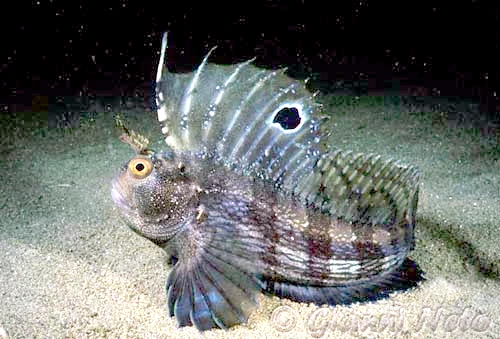
Lucayablennius zingaro
The only known member of its genus, the arrow blenny.

The arrow blenny (*Lucayablennius zingaro*) is a chaenopsid blenny that lives in coral reefs across the Bahamas, the Caribbean, and the western central Atlantic. It is the sole species in its genus. Adults reach a maximum length of 5.7 cm (2.2 in).
This fish inhabits coastal coral reefs from the western Yucatán Peninsula north to the Florida Keys and south to the eastern tip of South America. Its depth range spans 13 to 106 meters (43 to 348 ft).
The arrow blenny has a distinctive appearance: an elongated, pointed snout used for catching prey. Its body is cinnamon red or brown, fading to yellow toward the tail. Three stripes run along the body—one white stripe along the top of the head to the base of the dorsal fin, and one on each side from the front of the eyes to the base of the caudal fin; these side stripes start white and fade to yellow. Black spots appear in two clusters: three on the rear of the dorsal fin and two on the rear of the anal fin. The tail is always held in a curve, so that it faces the same direction as the head, allowing the fish to catch small currents in the water column.
Quick Facts
- Taxon
- Lucayablennius zingaro
Facts from the source article.
Lore & Background
The arrow blenny is described as truly unique among blennies in appearance. It has an elongated pointed snout used for catching prey. Its coloration is typically cinnamon red or brown, fading to yellow toward the tail. It bears three stripes: one white stripe on the top center of the head ending at the base of the dorsal fin, and one on each side starting at the front of the eyes and running to the base of the caudal fin; both side stripes start white and fade to yellow. Black spots are present—three on the rear of the dorsal fin and two on the rear of the anal fin. The tail is always held at a curve, facing the same direction as the head, which allows the fish to catch small currents in the water column.
Reader's Guide
The arrow blenny is significant as the sole member of the genus Lucayablennius, making it a distinct lineage within the chaenopsid blennies. Its unique tail morphology—permanently curved so that the tail faces the same direction as the head—is a specialized adaptation for exploiting small water currents in its coral reef habitat. The species' elongated snout further distinguishes it as a predator. Its range extends across the western central Atlantic, from the Florida Keys to the eastern tip of South America, and it occupies depths between 13 and 106 meters. The original description by Böhlke in 1957 established the genus, and a subsequent note in 1958 addressed a name change. The arrow blenny remains the only recognized species in its genus, underscoring its evolutionary and ecological distinctiveness.
Did You Know?
- The arrow blenny is the only known member of its genus, Lucayablennius.
- Its depth range is typically 13 to 106 meters (43 to 348 ft).
More in Blennies 1-24
Spotted an error? Know more?
Reader corrections go straight into our review queue. Suggest an edit · How this site is sourced