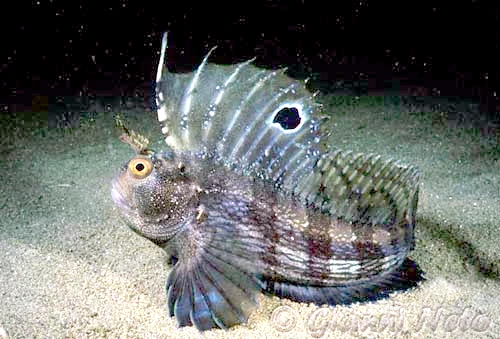
Climacoporus navalis
Monotypic clinid from South African tide pools.

Climacoporus navalis, called the fleet klipfish, is a clinid species living in subtropical Atlantic waters off South Africa’s coast, where it is common in rock pools. It is the sole member of its genus. The fish reaches up to 7 centimeters total length.
Its body is elongate and moderately compressed, with a slightly convex head profile and a short caudal peduncle. Above the eyes sit a pair of prominent, flattened, palmate tentacles. The mouth has thick lips, with a band of smaller teeth behind the front row in both jaws and a curved tooth band on the vomer. The dorsal fin is low and even, lacking cirri on spine tips; the first four spines are more widely spaced than the rest. The third pelvic fin ray is reduced or absent. Front nostril cirri are small, flap-like, and slightly notched below the tip. Fin counts: dorsal spines 33–38, rays 0–1; anal spines 2, rays 22–24; pectoral rays 12; ventral spines 1, rays 2–3. Gill rakers number (1–2)+5. Vertebrae are 15+(27–29). The lateral line has about 80 double pores. Body depth is 5–6.25 times in standard length; head length is 4–5.25 times in standard length; eye diameter is 3–4 times in head length. Caudal peduncle length and depth each measure 25–33.5% of head length.
Coloration varies: reddish or maroon-brown, or yellow-brown to greenish, with irregular darker green or brown streaks, mottling, or bars, and sometimes a cream belly. The head is green or reddish brown. An oval dark ocellus with a pale border sits between the lateral line start and the second or third dorsal spine. A dark band crosses the caudal fin base, followed by two narrower bands and a few irregular spots. The anal fin edge is pale.
The species occurs from Still Bay to Port St. Johns. The name *navalis* means “of or relating to ships,” referencing the first specimen’s capture location—a ship in Simon’s Town harbour.
Quick Facts
- Taxon
- Climacoporus navalis
Facts from the source article.
Lore & Background
The fleet klipfish was first described from a specimen caught on a ship in Simon's Town harbour, which inspired its specific epithet 'navalis', meaning 'of or relating to ships'. The body is elongate and moderately compressed, with a slightly convex head profile and a short caudal peduncle. A pair of prominent, transversely flattened, palmate tentacles sit above the eyes, and the mouth has thick lips with a band of smaller teeth behind the front row in both jaws, plus a curved band on the vomer. The dorsal fin is low and even, without cirri at the spine tips, and the first four spines are more widely spaced than the rest. The third ray of the pelvic fin is reduced or absent, and the cirri on the front nostrils are small and flap-like. Coloration varies from reddish or maroon-brown to yellow-brown or greenish, with irregular darker streaks, mottling, or bars, and sometimes a cream belly. A distinctive oval dark ocellus with a pale border lies between the start of the lateral line and the second or third dorsal spines, and the caudal fin has a dark base band followed by two narrower bands and irregular spots. The anal fin edge is pale.
Reader's Guide
Climacoporus navalis is significant as the sole member of its genus, representing a distinct lineage within the clinids. Its restricted distribution along the South African coast from Still Bay to Port St. Johns, and its abundance in rock pools, highlight its ecological role in subtropical intertidal zones. The species' morphological features, such as the palmate tentacles, reduced pelvic fin ray, and unique coloration with an ocellus, distinguish it from other clinids. The etymology ties its discovery to a ship in Simon's Town harbour, adding historical context to its collection. As a monotypic genus, it underscores the diversity of South African marine life and the importance of tide pool habitats. The detailed fin and vertebral counts, along with gill raker and lateral line pore data, provide a basis for taxonomic identification and comparison with related species.
Did You Know?
- It is the only known member of its genus, Climacoporus.
- It has a pair of prominent, transversely flattened, palmate tentacles above the eyes.
- The species can reach a maximum length of 7 cm (2.8 in) TL.
More in Blennies 1-24
Spotted an error? Know more?
Reader corrections go straight into our review queue. Suggest an edit · How this site is sourced