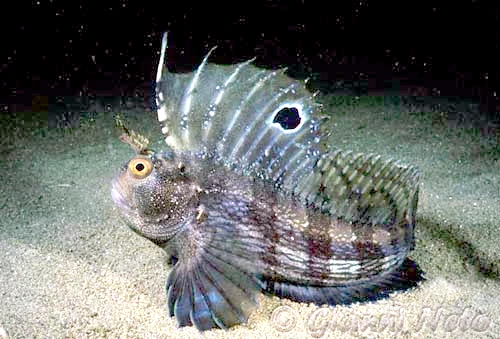
Cirrhibarbis
The only known member of its genus, a South African clinid.

Cirrhibarbis is a genus of clinid fish known as the barbelled klipfish, represented solely by the species Cirrhibarbis capensis. It is notable for being the only member of its genus and is found in subtropical waters of the Atlantic Ocean around South Africa.
Quick Facts
- Taxon
- Cirrhibarbis capensis
Facts from the source article.
Lore & Background
Cirrhibarbis capensis, the barbelled klipfish, is a clinid endemic to South Africa. It is rare west of Cape Point to Lamberts Bay but common from False Bay to East London. Sightings occur mostly in False Bay, from Fish Hoek to Batsata rock, including the wreck of the Clan Stuart and at Windmill and A-Frame. It is rarer on the Atlantic seaboard but has been seen at the V&A waterfront off Oceana Powerboat club and along the Sea Point coast. Depths range from close to the surface to about 15 m; juveniles have been seen in very shallow water (1 m or less) at the Knysna Heads, and extreme juveniles and young specimens were found in shallow water, under rocks, and in rock pools.
The species preys primarily on benthic crustaceans, mostly amphipods and isopods. Adults are mainly sublittoral; juveniles are plentiful under stones in rockpools. In deeper water, most adult specimens were seen at night, in areas with plenty of shelter between and under boulders. The etymology of the name capensis refers to the Cape region where it was originally caught.
Reader's Guide
The barbelled klipfish is significant as the sole representative of the genus Cirrhibarbis, making it a distinct lineage within the clinids. Its distribution is limited to South African waters, with a notable concentration in False Bay, where it is commonly observed by divers. The species exhibits a wide range of color variation, from reddish marbled with brown, green, or yellow to pinkish, grey, or greenish mottled, and even milky white in juveniles. A distinctive roundish white blotch bisected by a narrower black blotch behind the head at the start of the lateral line is present in most specimens. The fish is characterized by multiple barbels on the upper jaw and chin, as well as prominent tentacles above the eyes and at the nostrils. Its dorsal fin spines bear clusters of small cirri. The species reaches up to 350 mm in length and is primarily a predator of benthic crustaceans. Its habitat preferences shift with age: juveniles occupy shallow rock pools, while adults are sublittoral and often nocturnal, seeking shelter among boulders.
Did You Know?
- Cirrhibarbis capensis is the only known member of its genus.
- It has a row of 3 plain barbels at the front of the upper jaw and 8 barbels on the chin.
- Juveniles can be milky white with longitudinal black stripes and red fins.
More in Blennies 1-24
Spotted an error? Know more?
Reader corrections go straight into our review queue. Suggest an edit · How this site is sourced