Märzen
A Bavarian lager traditionally served at Munich Oktoberfest.

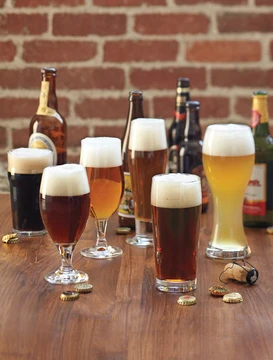
Märzen, also called Märzenbier (meaning "March beer" in German), is a type of lager that comes from Bavaria, Germany. Its body ranges from medium to full, and its color can be pale, amber, or dark brown. This beer was the traditional brew served at Munich's Oktoberfest. Within the European Union, the term "Oktoberfestbier" is a protected geographical indication, reserved only for Märzen brewed in Munich. In Germany, Oktoberfestbier is also known as Festbier or Wiesnbier.
The history of Märzen likely goes back to before the 1500s in Bavaria. A brewing law from 1553 restricted beer production to the period between September 29 (St. Michael's Day) and April 23 (St. George's Day), because hot summer temperatures raised the risk of off-flavors from uncontrolled fermentation. Brewed in March, this beer had moderate hopping, balanced malt, and a slightly higher alcohol content to help it survive the months when new brewing was banned (April 24 to September 28). It was stored in cellars packed with ice and straw to lager until autumn. The original Märzen was described as dark brown, full-bodied, and bitter, often kept in the cellar until late summer and then served at Oktoberfest. In Germany and Austria, common names for it include Märzenbier, Wiener Märzen, Festbier, and Oktoberfestbier.
Today, Märzen is uncommon in Germany, mostly found in the south, often in varieties that highlight its Oktoberfest link, such as Paulaner's "Oktoberfest Bier." In Austria, however, Märzen is the most popular beer style, though it is lighter in color and taste, roughly matching a Bavarian Helles or Export. This change stems from Austrian post-war price controls on essential food and drink. Märzenbier was chosen for its festive reputation and high pre-war price, but brewers reduced its malt and alcohol content to keep it profitable at the new, lower price.
Compared to a Bavarian pale lager, traditional Märzen has a fuller body, a sweeter flavor, and often less hop bitterness. Its alcohol content typically falls between 5.1% and 6.0% ABV. The Austrian version is light in color, body, and flavor balance, making it the country's most popular beer style. Austrian Märzenbiers often use caramel malts for extra sweetness, while others overlap stylistically with Munich-style Helles. Czech brewers have made Märzen-style beer—called březňák or marcovní (March beer)—since the 1400s.
- Alcohol by volume
- 5.1–6.0%
- Origin
- Bavaria, Germany
- Colour range
- pale through amber to dark brown
- Body
- medium to full
- Traditional serving event
- Munich Oktoberfest
Lore & Background
Märzen has its origins in Bavaria, probably before the 16th century. A Bavarian brewing ordinance decreed in 1553 that beer may be brewed only between 29 September (St. Michael's Day or Michaelmas) and 23 April (St. George's Day or Georgi), as high summertime temperatures were more likely to cause off-flavoured beer due to elevated ambient fermentation temperatures. Märzen was brewed in March, with moderate and balanced hopping levels, malt and slightly higher alcohol content that would allow the beer to last while brewing new beer was forbidden from 24 April to 28 September. The beer was then allowed to lager in ice and straw filled beer cellars until autumn. The original Märzen was described as 'dark brown, full-bodied, and bitter'. The beer was often kept in the cellar until late in the summer, and then served at the Oktoberfest. Common names for Märzen in Germany and Austria include Märzenbier, Wiener Märzen, Festbier and Oktoberfestbier.
Reader's Guide
Märzen is now a rarity in Germany and is mainly found in the South, often in varieties that explicitly refer to its association with Oktoberfest, such as the 'Oktoberfest Bier' from the Paulaner brewery. In Austria, however, Märzen is the name given to the most popular type of beer, but the Austrian Märzen is lighter in color and taste and corresponds, more or less, to a Bavarian Helles or Export beer. The reason for this has to do with Austrian post-war regulations which limited the prices of essential food and drink products. Märzenbier was a preferred variety due to its reputation as a festive drink and its high pre-war price, but brewers reduced its malt and alcohol content in order to maintain its profitability at its newly limited price. In comparison to a Bavarian pale lager, the traditional Märzen style is characterised by a fuller body, and a sweeter and often less hoppy flavour. The Austrian style is light in colour, body and flavour balance, and is the most popular beer style among the beers in Austria. Austrian Märzenbiers often use caramel malts that impart a sweeter flavour than their German counterparts; other Austrian Märzen overlap stylistically with Munich-style Helles. Brewers in the Czech Republic have been producing Märzen style beer, called březňák or marcovní (March beer), since the 15th century. Today's equivalents are legally defined as 14° lagers called světlé speciální pivo (light special beer), polotmavé speciální pivo (half-dark special beer), and tmavé speciální pivo (dark special beer). In Lithuania, Švyturys produces a Märzen style beer called Baltijos. Żywiec, a Polish brewery, produces a Märzen style lager called piwo lager typu marcowe (March type lager beer), or simply 'Marcowe'.
Did You Know?
- A 1553 Bavarian brewing ordinance restricted brewing to between 29 September and 23 April.
- In Austria, Märzen is the most popular beer style, but is lighter in color and taste than the traditional version.
More in Beer Styles, Part 2 1-24
Spotted an error? Know more?
Reader corrections go straight into our review queue. Suggest an edit · How this site is sourced