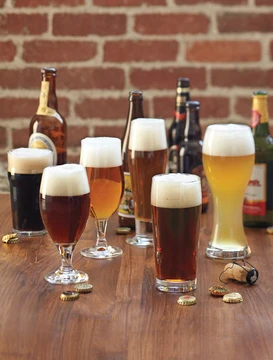
Kentucky common beer
A highly carbonated, fresh ale from pre-Prohibition Louisville.

Jeremybrooks · CC BY-SA 4.0
Kentucky common beer was a popular ale style brewed in and around Louisville, Kentucky, from the 1850s until Prohibition. Locals called it dark cream common beer, cream beer, or simply common beer. It was a top-fermented ale, krausened to up to 10% carbonation, and served fresh, mostly on draft. By 1913, an estimated 80% of all beer consumed in Louisville was this style, and many area breweries made nothing else.
Before refrigeration, brewers relied on winter ice to cool their beer, but the Louisville area rarely had enough ice. As European immigrants poured into the city in the mid-1800s, demand for beer rose. Common beer was fermented warm like an ale and aged very little—if at all—before serving, so it didn’t need cold storage. (This is similar to California common or steam beer, which arose from the same lack of refrigeration.) The low overhead made it cheap, and it became a favorite among working-class drinkers.
Some assume Kentucky common was a sour beer, based on a 1906 description. But brewing records show mash lengths and hopping rates that would have prevented sour mashing, since the bacteria used for that—*Lactobacillus delbrueckii* and *L. hordei*—are sensitive to hops and lack the HorA gene. The same 1906 work identified rod-shaped bacteria in the beer, likely *Lactobacillus plantarum*, which tolerates hops and lives in contaminated barrels. Any sourness would have been incidental, not a defining trait.
As of 2014, the style is rarely available, though brewers occasionally revive it. Examples include New Albanian Brewing Company’s Phoenix Kentucky Komon, Local Option’s Kentucky common ale from Chicago, Avenues Proper’s Bluegrass Brown in Salt Lake City, a one-off called Yee Haw Magee Kentucky Common from Abe Erb, and Falls City Brewing Company’s Kentucky Common at its brew house. Darkness Brewing in Bellevue, Kentucky, makes Bellevue Common. Upstate Brewing Company in New York has Common Sense, and Keg & Lantern in Brooklyn brews Commie’s Kentucky Common. Iron Duke Brewery in Ludlow, Massachusetts, produces The Common. Ten Mile Brewing in Signal Hill, California, offers Hidden Hollow. Level Crossing Brewing in Salt Lake City has You-Tah Uncommon. Sawstone Brewing Co. in Morehead, Kentucky, brews Kentucky Common.
- Origin
- Louisville, Kentucky area
- Period of popularity
- 1850s until Prohibition
- Estimated local consumption in 1913
- 80% of beer consumed in Louisville
- Original gravity
- 1.040-1.050
- Average bitterness
- 27 IBU
- Typical ingredients
- 6-row barley, 25-30% corn grits, 1-2% each caramel/caramel malts and black malt
- Typical production time
- 6 to 8 days from mash in to keg
Lore & Background
Before modern refrigeration, most breweries depended on ice cut the previous winter for producing beer. The Louisville area usually did not have the weather conditions to produce enough ice for this. With an influx of European immigrants into Louisville during the mid-19th century, there was an increased demand for beer in the area. Common beer was fermented at higher temperatures like an ale, but was aged for a very short period of time if at all before being consumed, thus eliminating any need to keep it cool. This kept overhead costs down and made it inexpensive to purchase, so it was very popular among working-class people.
Assumptions that Kentucky Common was a sour beer are based on a description written in 1906; however, based on brewing records, the mash lengths and hopping rates would have made sour mashing impossible as Lactobacillus delbruekii and Lactobacillus hordei used in sour mashing are both hop sensitive. Nonetheless, the bacteria identified in the beer was described as “rod shaped”, which would indicate Lactobacillus, but it would more likely have been Lactobacillus plantarum, which is hop tolerant and inhabits contaminated cooperage. The slight souring would have been incidental, even if widespread, and not a defining feature of the style.
The beer was typically kegged and served relatively young. It was an easy-drinking, slightly sweet, dark amber to light brown ale.
Reader's Guide
Kentucky common beer represents a significant chapter in American brewing history, arising from practical necessity in a region lacking natural ice for cold storage. Its popularity was immense locally—by 1913, four out of five beers consumed in Louisville were of this style, and many breweries dedicated their entire production to it. The style's low cost and quick turnaround made it a working-class staple. After Prohibition, it became rarely brewed commercially, and as of 2014, it was not generally available. However, occasional revival attempts have occurred, with breweries such as New Albanian Brewing Company, Local Option, Avenues Proper, Falls City Brewing Company, Darkness Brewing, Upstate Brewing Company, Keg & Lantern, Iron Duke Brewery, Ten Mile Brewing, Level Crossing Brewing, Sawstone Brewing Co., Ferguson Brewing Company, Tampa Bay Brewing Company, Shadow Puppet Brewing, Steeplejack Brewing Company, Four Fathers Brewing, Ghost Brewing Company, Hops Brewery, Dispensaire microbrewery, Crusader Brewing, and Trellis Brewing producing versions. In 2021, the Brewers Association added the style to its updated Beer Style Guidelines, recognizing its historical importance. The style's legacy is also tied to the ongoing debate about its sourness, with the article noting that any souring was incidental, not a defining feature.
Did You Know?
- Kentucky common beer was also known locally as dark cream common beer, cream beer, or common beer.
- In 1913, an estimated 80% of beer consumed in Louisville was of this type.
- The beer was typically produced in 6 to 8 days from mash in to keg.
- The style was added to the Brewers Association Beer Style Guidelines in 2021.
Roots in New France and the British Colonies
Beer's presence in what is now Canada traces to the seventeenth century, when European settlers brought the craft to a climate well suited to brewing before refrigeration existed. Yet New France's colonists initially preferred imported wine and brandy. The first commercial attempt, a brewery Louis Prud'homme opened in Montreal in 1650, failed. In 1668, Intendant Jean Talon, aiming to limit French wine and spirit imports, founded La brasserie de Roy in Quebec City. That venture also collapsed after Talon returned to France in 1672 and import limits were raised. In the gap, settlers developed both alcoholic and non-alcoholic spruce beer. Following the British takeover, garrison troops became a steady customer base, each soldier entitled to six pints per day and favoring ales over lagers. British Loyalists fleeing the newly independent United States added further demand. Over subsequent decades, foundational breweries took root: Molson in Montreal (1786), Keith in Halifax (1820), Carling and Labatt in London (1840, 1847), Oland in Halifax (1867), and O'Keefe in Toronto (1891). Molson's endures as the oldest continuously operating brewing enterprise in the country.
Prohibition, Liquor Boards, and the Beer Parlour
Between 1878 and 1928, provincial and federal temperance legislation shuttered nearly three quarters of Canadian breweries. Prince Edward Island endured the longest ban, from 1901 to 1948, while Ontario's Temperance Act ran from 1916 to 1927. Despite the brewing sector's economic weight and the large working-class clientele that depended on its products, no provincial government reversed its prohibition stance. Once the bans lifted, alcohol sales remained tightly controlled through government liquor boards and publicly owned retail stores in each province. Public drinking often returned to communities only years after prohibition ended. In that constrained environment, beer parlours — also called taverns — proliferated. These establishments had no bar, served no meals, and seated patrons at café tables where beer arrived by the glass. Patrons could not move between tables or stand with a drink. Many parlours were sex-segregated, with a men's room and a separate 'ladies and escorts' room. Often the sole legal drinking venue in a town, these parlours are widely credited with cementing beer's status as Canada's national drink.
Consolidation, Foreign Ownership, and Market Dominance
By the 1960s, post-prohibition consolidation had concentrated Canada's brewing industry into a handful of dominant players. Globalization then reshaped the landscape further: the three largest producers — Labatt, Molson, and Sleeman — were acquired by or merged with foreign companies. The result left Moosehead, holding an estimated 3.8 percent of the domestic market in 2016, as the largest fully Canadian-owned brewer. Even so, domestically brewed products commanded an 85 percent share of the Canadian market in 2015, and beer remained the country's most popular alcoholic beverage by both volume and dollar value. The pale lager, officially termed North American Style Lager by the Canadian Brewing Awards, dominated the style rankings. In 2016, Budweiser was the best-selling brand, with many of its products actually manufactured within Canada. The annual Canadian Brewing Awards, which uses blind taste-testing to identify the nation's finest beers, continues to recognize both craft and large-scale producers, though most winners tend to come from smaller operations.
The Craft Renaissance and a Shifting Market
While overall beer sales have been sluggish in both volume and revenue, the craft brewing segment has experienced rapid expansion. Licensed breweries in Canada doubled from 310 in 2010 to 640 by 2015, yet only about 30 of those qualified as large operations producing over 7.5 million litres annually. Craft brewing appeals to a broader demographic than traditional mass-market beers, which have historically targeted young males — men consume an estimated 71.5 percent of beer by volume. Revenue growth for beer makers averaged just 1.3 percent per year between 2011 and 2016, with projections of only 0.4 percent per annum for the following five years. Volume rose a mere 1.7 percent annually over the prior decade, with domestic beer contributing 1.1 percent of that increase and imports accounting for the rest. Beer's share of the alcohol market by dollar value slipped from 47.9 percent to 42 percent over ten years, largely displaced by wine's rising popularity. Imported beer volume, meanwhile, grew at an average annual rate of 6.0 percent between 2004 and 2014.
Gallery
Frequently Asked Questions
What is Kentucky common beer?
It was a dark, top-fermented ale brewed primarily in and around Louisville, Kentucky, from the 1850s through Prohibition. Locals knew it by names like "dark cream common beer" or simply "common beer."
What did Kentucky common beer taste like and what went into it?
Built on 6-row barley with 25–30% corn grits, it sat at roughly 1.040–1.050 original gravity and carried about 27 IBU of bitterness. Small doses of caramel and black malts (1–2% each) gave it its dark color and a touch of roasted depth.
Why was Kentucky common beer so dominant in Louisville?
The region rarely produced enough winter ice to keep lager beers cold, so brewers leaned into a top-fermented ale that did not depend on heavy refrigeration. By 1913 an estimated 80% of all beer consumed in Louisville was this style, and many area breweries made nothing else.
How was Kentucky common beer served?
Brewers krausened the ale in the cask to push carbonation up to around 10%, giving it a very lively, fizzy mouthfeel. It was intended to be drunk fresh and was served almost exclusively on draft rather than bottled.
What happened to Kentucky common beer?
Prohibition in 1920 shut down production and effectively erased the style along with the small Louisville breweries that had specialized in it. It has not seen a broad commercial revival, leaving it as one of America's lost regional ale types.
More in Beer Styles, Part 2 1-24
Spotted an error? Know more?
Reader corrections go straight into our review queue. Suggest an edit · How this site is sourced