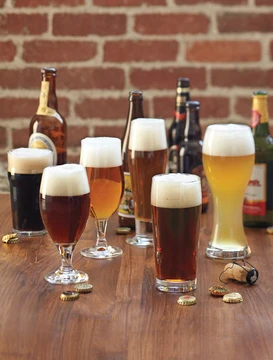
American amber ale
An amber-coloured pale ale with American hops and low diacetyl.

Xtad · CC BY-SA 4.0
American amber ale belongs to the pale ale family. It gets its color—anywhere from light copper to light brown—from a mix of pale malt with some amber malt and occasionally crystal malt. Just a bit of crystal or other colored malt is added to the standard pale ale base to darken it slightly. In North America, brewers use American hop varieties, but the bitterness level varies, and very few examples are notably hoppy. Diacetyl is either barely noticeable or completely absent in this style.
- Colour range
- light copper to light brown
- Hop character
- American-variety hops, varying bitterness, very few particularly hoppy
- Diacetyl
- barely perceived or absent
- Malt components
- pale ale base with amber malt and sometimes crystal malt
Lore & Background
The term 'amber ale' emerged in the United Kingdom in the late 19th century, with Collier Brothers of London applying for the UK trademark of The Amber Ale in 1876. It was described as a 'pure delicately hopped Pale Ale' positioned between their light bitter and IPA. The trademark was maintained through changes in ownership until it expired in 2002. Since the expiry of the trademark, some traditional British bitters have been rebranded as amber ales, in some cases to distinguish them from golden ales sold under the same brand.
In North America, the term 'amber ale' is used for pale ales brewed with a proportion of amber malt and sometimes crystal malt to produce an amber colour. American-variety hops are used with varying degrees of bitterness, though very few examples are particularly hoppy. Diacetyl is barely perceived or is absent in an amber ale. The style is close to the American pale ale (APA), though amber ales are darker and maltier due to the use of crystal malts.
Reader's Guide
American amber ale occupies a place within the broader pale ale family, distinguished by its colour and malt profile. The source article notes that in North America, the term is used for pale ales brewed with a proportion of amber malt and sometimes crystal malt, producing an amber colour generally ranging from light copper to light brown. A small amount of crystal or other coloured malt is added to the basic pale ale base to achieve this darker colour. American-variety hops are used, but bitterness varies and very few examples are particularly hoppy. Diacetyl is barely perceived or absent. The style is close to the American pale ale, though amber ales are darker and maltier due to the use of crystal malts. The article also notes that since the expiry of the Collier Brothers trademark in 2002, some traditional British bitters have been rebranded as amber ales, in some cases to distinguish them from golden ales sold under the same brand. This shows the term's flexibility across different brewing traditions.
Did You Know?
- The trademark for The Amber Ale expired in 2002.
- American amber ales use American-variety hops with varying bitterness, but very few are particularly hoppy.
- Diacetyl is barely perceived or absent in an amber ale.
The Name and Its Legacy
The designation amber ale carries a lineage that stretches back to the Collier Brothers of London, who secured a UK trademark for The Amber Ale in 1876. Their product was described as a "pure delicately hopped Pale Ale," deliberately positioned between their light bitter and their India pale ale. That trademark endured through multiple changes in brewery ownership before finally expiring in 2002. In the years following its lapse, several traditional British bitters were rebranded under the amber ale label, sometimes simply to set themselves apart from golden ales sharing the same brand name. In North America, the term is still considered emerging, applied to pale ales that incorporate a proportion of amber malt and occasionally crystal malt to shift the colour toward the copper and light-brown end of the spectrum. The broader pale ale family itself traces its name to England around 1703, when beers made from malts dried with high-carbon coke began to be distinguished by their lighter hue from the darker brews that had dominated before. What began as a single London trademark has thus evolved into a loosely defined category that brewers on both sides of the Atlantic continue to shape.
Brewing Character and Flavor
American amber ale is built on a pale ale base into which a small quantity of amber or crystal malt is introduced, pushing the final colour from pale gold into the light copper to light brown range. The hop treatment is where the style reveals its American identity: American-variety hops are employed, but the bitterness they contribute varies widely from one example to the next, and very few amber ales are notably hop-forward. This sets them apart from the more assertively hopped American pale ale while still keeping them within the broader pale ale family. A defining quality of a well-made amber ale is the near-total absence of diacetyl, meaning the beer should taste clean and free of the buttery off-flavour that can plague other ales. The overall effect is a maltier, slightly darker cousin of the standard pale ale, one that sits comfortably between a light bitter and an India pale ale in terms of body and intensity. Because the style is still emerging in North America, brewers have considerable latitude in how much crystal malt they add and how prominently they feature the hop, which is why the range of tastes and strengths within the category remains broad.
Positioning Within the American Ale Spectrum
Within the American brewing landscape, amber ale occupies a specific niche between the lighter, more hop-driven American pale ale and the richer, stronger India pale ale. American pale ales typically land around five percent alcohol by volume and are defined by their prominent use of American hops, most often Cascade, giving them a clean, assertive hop character. Amber ales share that hop lineage but dial back the bitterness, allowing the added crystal and amber malts to create a maltier, darker profile. The boundaries between these styles can blur, particularly as brewers experiment with hop quantities and malt bills, but the general rule holds: where an APA leads with hop, an amber ale leads with a slightly deeper malt colour and a gentler hop presence. The style also draws from the broader pale ale tradition, in which different brewing practices and hop levels have always produced a wide spectrum of taste and strength. In this way, American amber ale is less a rigidly codified recipe and more a descriptive zone on the spectrum between golden pale ale and the darker, more robust bitters of the British tradition.
A Global Term, an American Expression
The label amber ale is not unique to the United States. It is an emerging term in Australia, Belgium, the Netherlands, and France, where the equivalent word is ambrée. In France, the designation can refer to a beer that is amber in colour regardless of fermentation method, and examples range from Vienna lagers such as Pelforth and Fischer to bières de garde like Jenlain ambrée. In Australia, pale ales developed around the 1990s tend to run about six percent alcohol and feature local hop varieties such as Galaxy. The North American expression of the style, however, is distinguished by its reliance on American-variety hops and its positioning as a maltier, darker variant of the pale ale base. The broader pale ale family, whose name first appeared in England around 1703 for beers made from coke-dried malts, has always encompassed a wide range of tastes and strengths depending on local brewing practices. American amber ale is thus one regional voice within a much larger, multilingual conversation about what it means to brew a beer that is neither quite golden nor quite brown, neither fully malt-driven nor fully hop-driven.
Gallery
Frequently Asked Questions
Who is American amber ale?
American amber ale is a member of the pale ale family, essentially a standard pale ale recipe with a small addition of amber or crystal malt to nudge the color darker. It occupies the middle ground between a straightforward pale ale and a heavier amber ale.
What gives American amber ale its signature look?
The color spans from light copper to light brown, produced by layering pale malt with a modest amount of amber malt and, in some cases, a touch of crystal malt on top of the usual pale ale base. Only a small quantity of these colored malts is needed to shift the hue.
What is American amber ale's hop profile like?
Brewers in North America rely on American hop varieties, but the bitterness level swings from batch to batch. Very few examples in this style are notably hop-forward, so the hop presence is usually a supporting note rather than the star.
Why is American amber ale important to the beer landscape?
It gives brewers and drinkers a familiar, approachable middle step: the malt backbone of a pale ale with just enough color and a hint of caramel to feel distinct without becoming a full amber ale. Its flexibility in bitterness and hop intensity makes it one of the most widely produced and consumed American-style ales.
More in Beer Styles, Part 2 1-24
Spotted an error? Know more?
Reader corrections go straight into our review queue. Suggest an edit · How this site is sourced