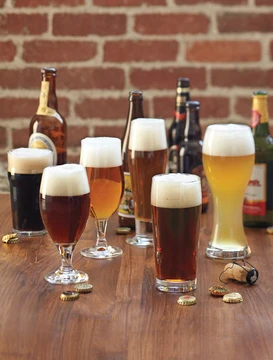
American pale ale
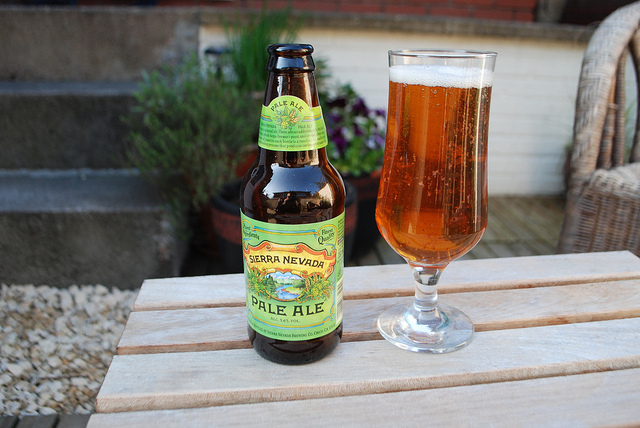
American pale ale: a hoppy ale developed in the US around 1980.

justgrimes · CC BY-SA 2.0
American pale ale (APA) is a pale ale style that emerged in the United States around 1980. It typically has an alcohol content of about 5% abv and features generous amounts of American hops, most often Cascade. What sets an APA apart from British or European pale ales is mainly the use of these American hops, since American beers generally employ a cleaner yeast and American two-row malt. The style is similar to American IPA, but IPAs have a higher alcohol content and more aggressive hopping. It also resembles amber ale, though ambers are darker and maltier because they include crystal malts.
- Abv
- around 5%
- Hops
- significant quantities of American hops, typically Cascade
- Origin
- United States
- Development period
- around 1980
- Related styles
- American India Pale Ale (IPA) and amber ale
Lore & Background
Anchor Liberty Ale, a 6% abv ale originally brewed by Anchor Brewing Company as a special in 1975 to commemorate Paul Revere's midnight ride in 1775, was seen by Michael Jackson as the first modern American ale. Fritz Maytag, the owner of Anchor, visited British breweries in London, Yorkshire and Burton upon Trent, picking up information about robust pale ales, which he used when he made his American version using just malt rather than the malt and sugar combination common in brewing at that time, and making prominent use of the American hop, Cascade. The beer was popular and became a regular in 1983.
Jack McAuliffe of the New Albion Brewing Company was brewing his New Albion Ale by 1976, inspired by the ales he had tasted in Scotland. The beer was vigorously hopped with American Cascade hops, refermented in the bottle, and not straw in color – all qualities the popular beer style of the time, i.e. pale lagers, did not possess. While the company brewed for fewer than 6 years at only 7.5 barrels per week, it inspired many more pioneers and imitators.
The first brewery to successfully commercialize the use of significant quantities of American hops in the style of APA was the Sierra Nevada Brewing Company, which brewed the first experimental batch of Sierra Nevada Pale Ale in November 1980, distributing the finished version in March 1981. Another pioneer of the hoppy American pale ale was Bert Grant of Yakima Brewing.
Reader's Guide
The American pale ale emerged from a period of experimentation in the late 1970s and early 1980s, when brewers like Fritz Maytag, Jack McAuliffe, and the Sierra Nevada Brewing Company sought to create ales that contrasted with the pale lagers then popular. Anchor Liberty Ale, first brewed in 1975 as a special, was seen by Michael Jackson as the first modern American ale, using only malt and Cascade hops. New Albion Ale, brewed by 1976, was vigorously hopped and bottle-refermented, qualities that inspired later brewers. Sierra Nevada Pale Ale, first experimental batch in November 1980 and distributed in March 1981, was the first to successfully commercialize significant quantities of American hops in the APA style. Bert Grant of Yakima Brewing also pioneered the hoppy American pale ale. The style's use of American hops, particularly Cascade, became its defining characteristic, setting it apart from British and European pale ales. The APA's boundaries blur with the stronger, more assertively hopped American IPA, and with amber ale, which is darker and maltier due to crystal malts. The style's development marked a shift in American brewing toward hop-forward ales.
Did You Know?
- Jack McAuliffe's New Albion Ale, brewed by 1976, was vigorously hopped with American Cascade hops and refermented in the bottle.
- Sierra Nevada Brewing Company brewed the first experimental batch of Sierra Nevada Pale Ale in November 1980 and distributed the finished version in March 1981.
- Fritz Maytag visited British breweries in London, Yorkshire and Burton upon Trent to gather information about robust pale ales.
Roots in English Brewing History
The pale ale family traces its name back to early eighteenth-century England, where around 1703 brewers began applying the label to beers made from malt dried using high-carbon coke. That technique of coke roasting had actually been in use since 1642, but it took several decades before the resulting lighter-coloured beer earned its own distinct name. By 1784, the style had crossed the ocean, with advertisements in the Calcutta Gazette touting light and excellent pale ale to colonial audiences. A fascinating linguistic shift occurred by 1830: while breweries still marketed their products as pale ale, everyday drinkers had taken to calling the same beers bitters, a term likely chosen to set these noticeably hopped ales apart from milder, less hop-forward styles like porters and milds. This English foundation, built on a pale malt base, an emphasis on hop character, and a golden-to-amber colour range, became the template that American brewers would later reinterpret and amplify in their own regional style.
The Pioneering Era: From Anchor to Sierra Nevada
The modern American pale ale story is often anchored to 1975, when Anchor Brewing Company released Liberty Ale, a six-percent special brewed to mark the bicentennial of Paul Revere's famous ride. Beverage writer Michael Jackson later identified this beer as the first modern American ale. The driving force behind it, owner Fritz Maytag, had spent time touring British breweries in London, Yorkshire, and Burton upon Trent, absorbing the character of robust English pale ales. Back home, he made a deliberate departure from the malt-and-sugar blending common in American brewing of that era, relying solely on malt and foregrounding the Cascade hop. By 1983 the beer had become widely available. Yet the title of first true American pale ale arguably belongs to Sierra Nevada Brewing Company, which brewed its experimental batch in November 1980 and distributed the finished product in March 1981, using significant quantities of American hops under the specific pale ale name. Other early pioneers included Jack McAuliffe at New Albion Brewing and Bert Grant at Yakima Brewing, all pushing the hoppy, malt-forward profile that would define the style.
Defining the American Profile
What sets an American pale ale apart from its British or European cousins is not a single ingredient but a combination of choices that collectively sharpen the hop character. The style typically sits around five percent alcohol by volume and leans heavily on American-grown hops, with Cascade being the most iconic variety. American brewers also tend to employ a cleaner-fermenting yeast and American two-row malt, which together create a canvas that lets the hop profile speak more clearly than the softer, more malt-dominant British approach. The result is a beer noticeably more assertive in its hop expression than a traditional English pale ale. The boundaries between American pale ale and its close relatives are fluid: an American IPA shares much of the same DNA but pushes both strength and hop intensity further, while an amber ale overlaps in structure but gains a darker, maltier character from the addition of crystal malts. In short, the American pale ale occupies a middle ground, hop-forward enough to be distinctive yet restrained enough to remain approachable.
The Global Pale Ale Family
American pale ale does not exist in isolation; it is one thread in a global tapestry of pale ale variants. In Britain, the Collier Brothers of London trademarked The Amber Ale in 1876, positioning it as a delicately hopped pale ale between their light bitter and IPA; after that trademark expired in 2002, some traditional bitters were rebranded as amber ales. In Australia, pale ales developed around the 1990s, running closer to six percent and showcasing local Galaxy hops. France's Nord-Pas-de-Calais region contributed the bière de garde, a farmhouse pale ale traditionally brewed in winter and spring to sidestep summer yeast problems, then cellared for later enjoyment. In Belgium, Duvel became one of the most widely recognised blonde ales in the country. Meanwhile, in the United Kingdom, John Gilbert of Hop Back Brewery crafted Summer Lightning in 1989, a golden ale that won multiple awards and inspired a wave of imitators as breweries sought to compete with pale lagers. Each of these variants shares the pale malt foundation but diverges in hop choice, colour, fermentation tradition, and cultural context.
Gallery

Frequently Asked Questions
Who is American pale ale?
American pale ale is a hop-forward, pale-colored ale that was born in the United States around 1980. It typically sits right around 5% ABV and is defined by a generous dose of American hop varieties, with Cascade being the go-to choice.
What are American pale ale's signature traits?
Its main 'superpower' is the heavy use of American hops—usually Cascade—layered over a clean yeast profile and American two-row malt. This combination gives it a bright, citrusy hop character that sets it apart from the softer, more restrained British and European pale ales.
How does American pale ale compare to American IPA and amber ale?
American IPA is its bolder sibling, packing a higher ABV and a more aggressive, resinous hop assault, while amber ale plays the maltier, darker role thanks to added crystal malts. APA threads the middle path: hoppy but sessionable, pale but not as one-note as an IPA.
Where and when did American pale ale enter the scene?
The style developed in the United States around 1980, riding the early wave of the domestic craft-beer movement. Brewers began reaching for locally grown hop varieties and a cleaner fermentation profile, which gave the beer its distinctly American identity.
Why is American pale ale important to the craft-beer canon?
It cemented the idea that American beer could be defined by its own hop character rather than by imitating British templates. By standardizing on domestic hops like Cascade and a crisp, clean base, APA became a foundational style that paved the way for the broader IPA and craft-ale boom that followed.
More in Beer Styles, Part 2 1-24
Spotted an error? Know more?
Reader corrections go straight into our review queue. Suggest an edit · How this site is sourced