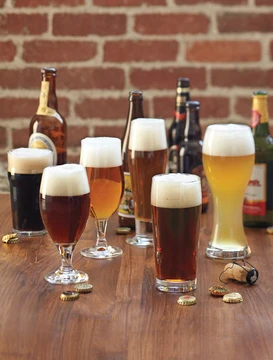
Dortmunder Export
A pale lager with a soft, rounded character.

Alf van Beem · CC0
Dortmunder Export is a pale lager with a soft texture, first made in 1873 by the Dortmunder Union brewery in Dortmund, Germany. Its style was shaped by the Pilsner lager from Plzeň. Following World War II, Export became the most popular beer type in Germany, holding that position until 1970, when Pils took over. Its popularity has seen a modest recovery since hitting a low point in the late 1990s. In 2008, Export accounted for just under 10% of beer sales in German shops.
In his 1969 book *A Treatise on Lager Beers*, Fred Eckhardt argued that Dortmunder is a distinct pale lager style. Later writers Michael Jackson and Roger Protz followed this idea, though they were hesitant to define exactly what makes it unique. Brewers outside Germany who produce a beer they call Dortmunder typically aim for a pale lager with a soft, rounded character.
- Originally brewed by
- Dortmunder Union
- Location
- Dortmund, Germany
- Year originally brewed
- 1873
- Most popular in germany until
- 1970
- Market share in 2008
- just under 10% of beer sold in German shops
Lore & Background
After World War II, Export was the most popular type of beer in Germany until 1970, when it was supplanted by Pils. Its fortunes have revived a little since its low point of the late 1990s. In 2008, just under 10% of the beer sold in German shops was Export.
Fred Eckhardt in A Treatise on Lager Beers, published in 1969, set out the view that Dortmunder is a distinctive enough pale lager to be classed as a separate beer style. Michael Jackson and Roger Protz continued the trend, although with a certain faint heart, uneasy at pinning down exactly the distinctive nature of the beer.
Brewers outside of Germany who brew beers they term Dortmunder will tend to brew a pale lager with a soft, rounded character.
Reader's Guide
Dortmunder Export's significance lies in its historical dominance as the most popular beer type in Germany after World War II, a position it held until 1970 when Pils supplanted it. Its revival since the late 1990s, though modest, is noted, with just under 10% of German shop beer sales in 2008. The style's legacy is marked by debate: Fred Eckhardt in 1969 argued it is a distinctive pale lager worthy of its own classification, while later writers Michael Jackson and Roger Protz were uneasy about pinning down its exact nature. This uncertainty persists, and brewers outside Germany who label a beer as Dortmunder typically produce a pale lager with a soft, rounded character, reflecting the style's original soft texture. The beer's identity remains tied to its Dortmund origin and its influence from Pilsner lager, yet its precise defining traits continue to elude consensus.
Did You Know?
- Dortmunder Export was originally brewed by Dortmunder Union in 1873.
- It was the most popular type of beer in Germany after World War II until 1970.
- In 2008, just under 10% of beer sold in German shops was Export.
- Fred Eckhardt argued in 1969 that Dortmunder is a distinctive enough pale lager to be a separate style.
German Roots and Lithuanian Identity
The brewery traces its origins to 1784, when merchant J. W. Reincke established a brewing operation in Klaipėda, a port city that carried the German name Memel for much of its history. The Reincke family, drawn from a lineage of merchant seamen, left a lasting mark: their coat of arms featured a sea eagle that still adorns the brewery's emblem to this day. In the nineteenth century, the Reincke operation merged with the brewery of landowner Theodor Preuss, and the combined enterprise became the dominant beer producer in the town, crafting Bock, Bavarian, and Porter styles. The Porter earned a gold medal at the 1883 Klaipėda International Business Fair. After wartime destruction in 1944, the facility was rebuilt and renamed Švyturys, resuming production in 1946. What makes this heritage particularly relevant to the Dortmunder/European Export style is that the brewery still employs old German brewing technology—vertical and horizontal fermentation containers that shape the beer's taste and aroma in ways no other major Lithuanian brewery replicates.
The Birth of a Champion
In 1995, brewmaster Džuljeta Armonienė formulated what would become the brewery's most internationally recognized product: Švyturys Ekstra, classified in the Dortmunder/European Export category. The beer quickly established itself as a benchmark within the Lithuanian market and went on to accumulate a remarkable string of international accolades. At the World Beer Cup in the United States, it claimed silver in 2000 in the Dortmunder/European Export division, then upgraded to gold in 2001 in the Dortmunder category. A gold medal followed at the 2004 Stockholm beer festival in the Lager category. The pinnacle arrived in 2012, when Švyturys Ekstra took the Gold Award at the World Beer Cup, cementing its status as the most decorated Lithuanian beer. The brewery's 2012 production plan called for 34 million litres, the vast majority of which was this Extra lager. The consistent success across multiple competitions and categories speaks to a recipe that balances the crisp, clean profile expected of the European Export style with distinctive local character.
Crossing Borders
Švyturys Ekstra's international journey accelerated in 2004, when regular exports to the United States commenced. Today, the brewery's beers reach more than twenty countries across several continents, including Australia, Canada, the United Kingdom, France, Italy, Spain, Sweden, Norway, Denmark, Finland, Estonia, Latvia, Poland, Russia, Ukraine, Belarus, Georgia, Cyprus, Iceland, Ireland, Israel, and the Netherlands. This global footprint is supported by infrastructure investments made after Carlsberg A/S acquired the majority of shares in 1999, funding substantial renewals of production facilities. In 1996, a new filtering system—described as the most modern in the beer industry at the time—was installed. By 1998, the brewery had become the first in Lithuania to reorganize its production processes to meet international quality standards, a step that enabled the beer to satisfy export regulations while preserving its Lithuanian character. The 2001 merger with Utenos Alus created Švyturys-Utenos Alus, further consolidating production capacity under the Carlsberg umbrella through Baltic Beverages Holding.
A Living Tradition
The Švyturys brewery occupies a unique position in Lithuanian brewing: it is the only one among the country's largest facilities to still use vertical and horizontal brewing containers, a practice inherited from its German-era origins. This method is credited with facilitating the development of distinctive taste and aroma profiles that set its products apart. The brewery's portfolio spans a wide range of styles beyond the Dortmunder/European Export core—Hefeweizen, Märzen, Pilsner, Bock, Scottish Ale, English Pale Ale, Stout, and a Honey Lager limited edition—demonstrating a breadth that reflects both its Germanic roots and its Lithuanian identity. In 2004, a premium lager called Jubiliejinis 1784 was brewed using the Kräusening process to mark the brewery's anniversary. A 2004 AC Nielsen survey found that 96 percent of respondents regarded Švyturys as the finest beer made in Lithuania, while 83 percent considered it a product worthy of national pride. The sea eagle from the Reincke family crest still watches over the operation, linking two and a half centuries of continuous brewing in one of the Baltic's oldest port cities.
Gallery
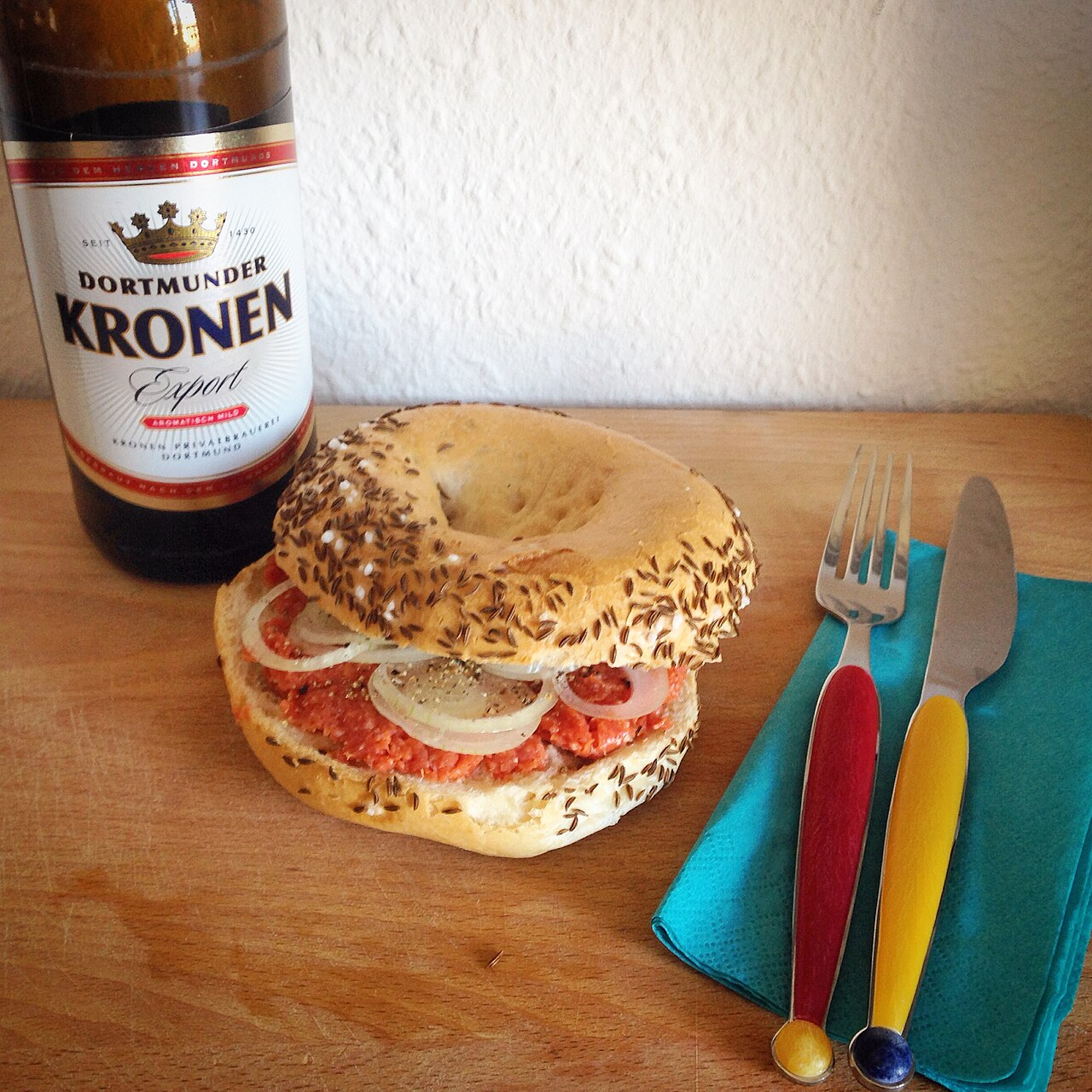
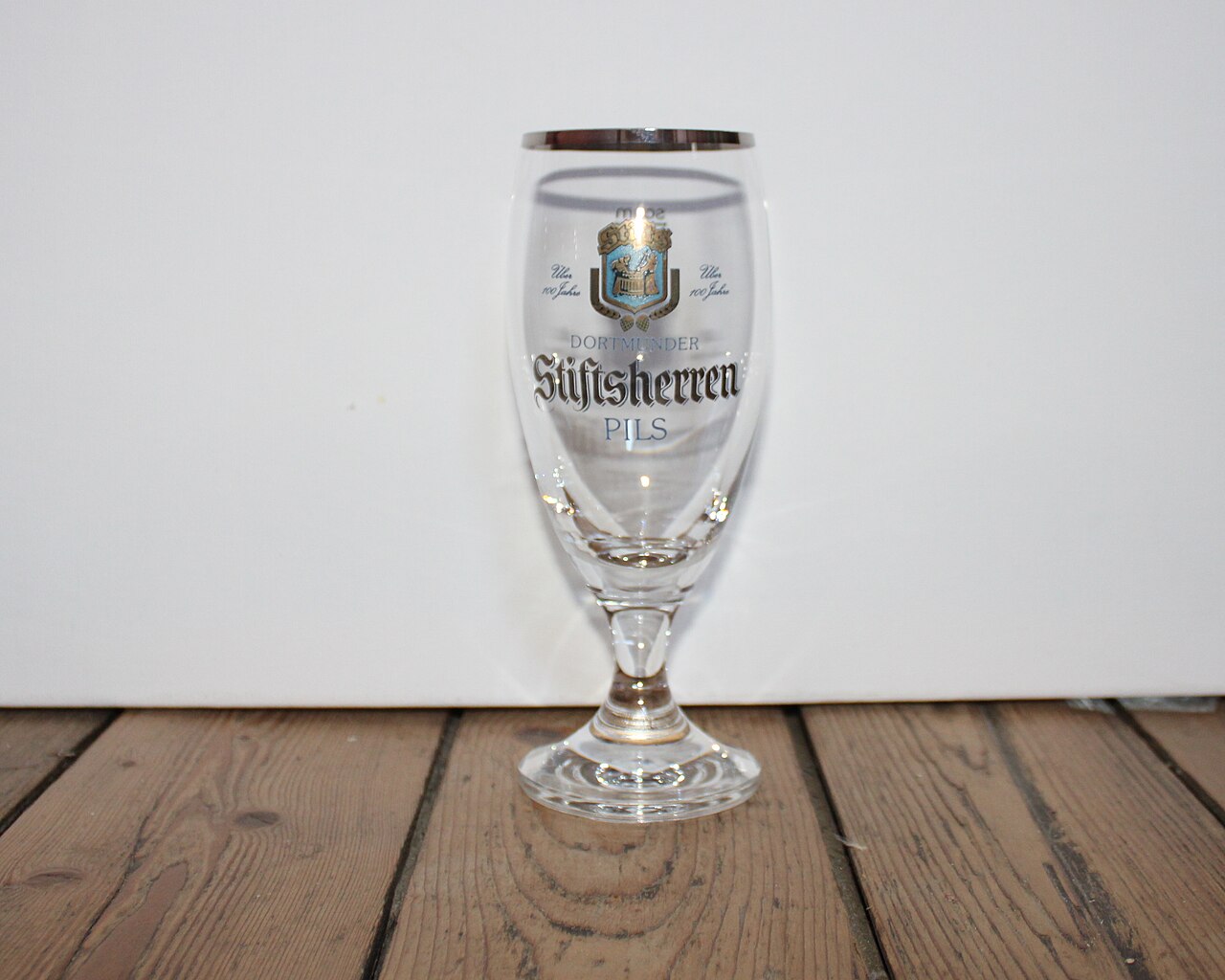
Frequently Asked Questions
Who is Dortmunder Export?
Dortmunder Export is a pale lager style that first emerged in 1873 from the Dortmunder Union brewery in Dortmund, Germany. It developed its character by drawing inspiration from the Pilsner lager tradition out of Plzeň.
What are Dortmunder Export's defining traits?
It is known for a soft, rounded mouthfeel with a pale color, giving it a gentler profile than many other lagers. Fred Eckhardt argued in his 1969 treatise that it deserves recognition as its own distinct style rather than just a variant of Pilsner.
Why is Dortmunder Export important to beer history?
It held the position of Germany's most popular beer type for roughly 25 years after WWII, making it a defining drink for a generation of German drinkers. Its rise and fall also illustrates how consumer preferences shifted from softer lagers toward the crisper Pils style.
What's Dortmunder Export's connection to Pilsner?
The style was directly shaped by the Pilsner lager from Plzeň, inheriting its pale, clean character while developing a softer texture of its own. That same Pilsner eventually overtook Export in German popularity in 1970, effectively ending its reign.
More in Beer Styles, Part 2 1-24
Spotted an error? Know more?
Reader corrections go straight into our review queue. Suggest an edit · How this site is sourced