Erbi Txakur
A critically endangered Basque scenthound traditionally used for hare hunting.

BorzayaChortaja · CC BY-SA 4.0
The Erbi Txakurra is a Spanish breed of scenthound originating in the provinces of Álava and Bizkaia in the Basque Autonomous Community in northern Spain. It is one of five Basque breeds of dog and one of fourteen animal breeds native to the País Vasco, traditionally used for hunting hare but now more frequently used for wild boar, roe deer, or occasionally foxes. The breed is critically endangered, with fewer than fifty examples recorded in 2009.
Quick Facts
- Country
- Spain
- Note
- recognised in regional and national legislation
Facts from the source article.
Lore & Background
The Erbi Txakurra originates in the Basque provinces of Álava and Bizkaia, where it was the traditional hare-hunting dog of Basque hunters; its name means 'hare dog'. It is one of five Basque dog breeds, alongside the Basque Shepherd Dog, the Pachón de Vitoria, the Villano de Las Encartaciones, and the Villanuco de Las Encartaciones. All but the Pachón de Vitoria are indigenous to the Basque Autonomous Community and were recognized as traditional Basque breeds by government decree in 2001. The breed was also among the fourteen indigenous animal breeds included in the rural development plan for the País Vasco for 2007–2013.
Reader's Guide
The Erbi Txakurra holds significance as a traditional Basque scenthound deeply tied to the region's hunting heritage. Its name, meaning 'hare dog', reflects its original purpose, though changes in prey availability have shifted its use toward wild boar, roe deer, and foxes. As one of only five Basque dog breeds and one of fourteen native animal breeds in the País Vasco, it represents a distinct genetic and cultural resource. Its critically endangered status—fewer than fifty examples in 2009—places it among the most seriously endangered breeds of the Basque Country, alongside the Villanuco de Las Encartaciones. The breed's medium size, muscular build, and short pale orange-brown coat with white markings distinguish it from similar hounds like the Sabueso Español. Conservation efforts, including its inclusion in regional development plans, highlight the importance of preserving this unique breed for its historical and ecological value.
Did You Know?
- The name Erbi Txakurra means 'hare dog' in Basque.
- It is one of five Basque breeds of dog, all but one indigenous to the Basque Autonomous Community.
- In 2009 there were fewer than fifty examples of the breed.
- It was traditionally used for hunting hare, but now is mainly used for wild boar.
Origins & Cultural Identity
The Erbi Txakurra is a scenthound whose roots are deeply embedded in the northern Spanish landscape of the Basque Autonomous Community, specifically the provinces of Álava and Bizkaia. Its very name translates to "hare dog," a direct reflection of the role it was bred to fulfil for generations of local hunters. The breed occupies a distinguished place within Basque canine heritage, standing as one of only five recognised Basque dog breeds alongside the Basque Shepherd Dog, the Pachón de Vitoria, the Villano de Las Encartaciones, and the Villanuco de Las Encartaciones. It also belongs to a broader group of fourteen indigenous animal breeds native to the País Vasco. In 2001, a government decree formally acknowledged the Erbi Txakurra and its fellow Basque breeds, with the exception of the Pachón de Vitoria which is not indigenous to the Autonomous Community, as traditional varieties. Its cultural significance was further cemented when it was included among the fourteen native animal breeds featured in the rural development plan for the País Vasco covering the period from 2007 to 2013.
Physical Characteristics & Breed Distinction
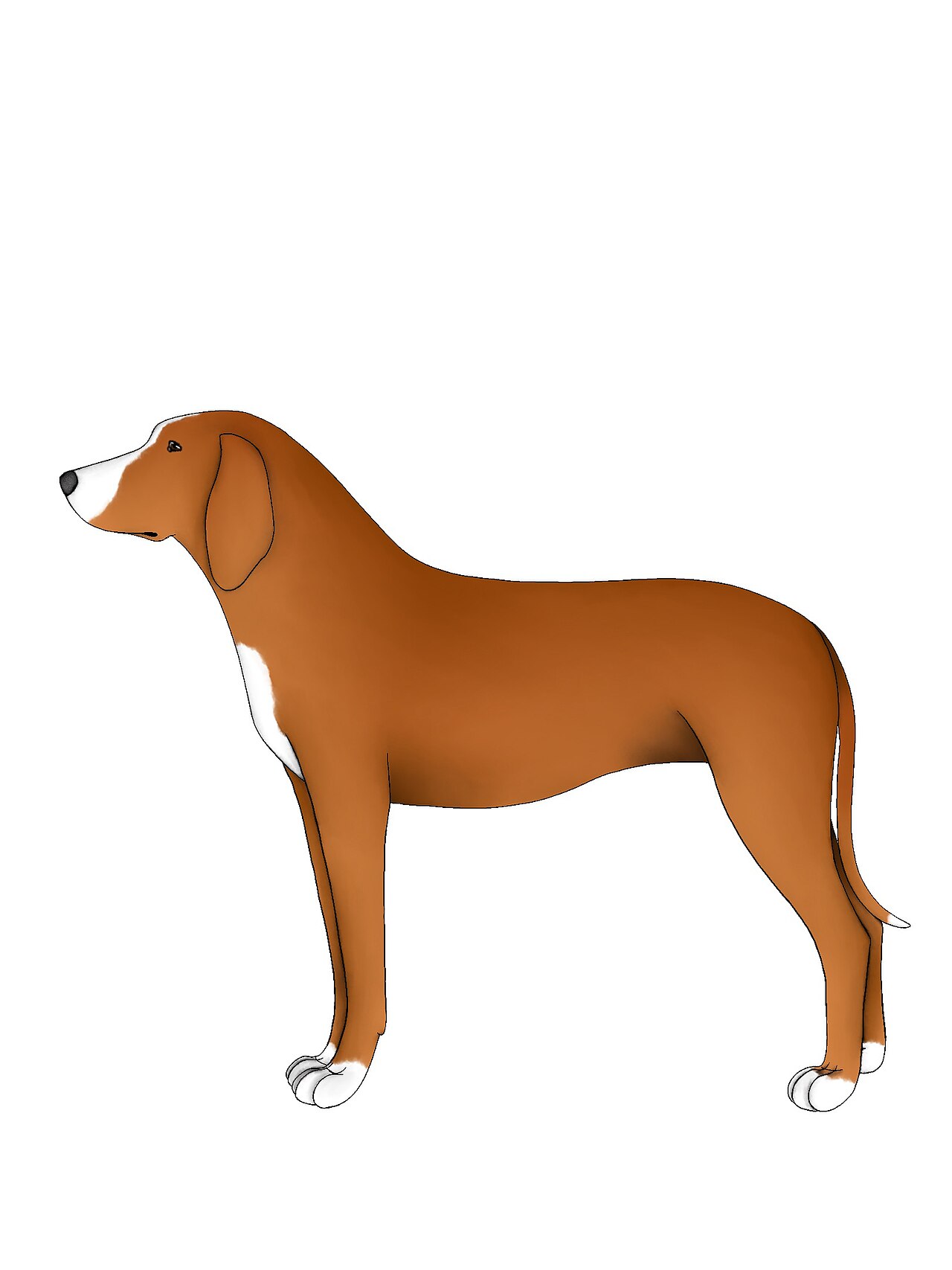
The Erbi Txakurra presents as a medium-sized hound with a build that sets it apart from its closest relative, the Sabueso Español. While it is somewhat smaller in stature than the Sabueso, it compensates with a noticeably more muscular frame and lacks the elongated ears characteristic of that breed. Its coat is short and lies close to the body, displaying a uniform pale orange-brown base colour. Irregular white markings break this otherwise solid palette, typically appearing on the face, across the chest, on the paws, and at the tip of the tail. The nose and palate carry distinct pigmentation, and the eyes are a warm chestnut-brown. These features combine to give the Erbi Txakurra a compact, athletic appearance suited to the sustained tracking work it was bred for. The overall impression is one of a sturdy, well-proportioned scenthound whose physical traits reflect a working heritage rather than ornamental breeding.
Hunting Role & Adaptation
For centuries, the Erbi Txakurra served as the quintessential hare-hunting companion of Basque hunters, a role so central to its identity that the breed's very name—literally "hare dog"—encapsulates this purpose. Its scenthound instincts and muscular medium build made it exceptionally well-suited to tracking the swift, elusive hare across the varied terrain of Álava and Bizkaia. However, as hare populations in the Basque Country dwindled to scarcity, the breed's primary quarry effectively disappeared from the landscape. In response, the Erbi Txakurra proved remarkably adaptable, shifting its focus to larger and more challenging game. It is now most frequently employed in the hunt for wild boar, a pursuit demanding greater endurance and tenacity. On occasion, it is also put to work tracking roe deer or foxes, demonstrating the versatility of its nose and drive. This transition from a single-prey specialist to a multi-game hound reflects both the ecological changes in its homeland and the enduring utility of the breed's innate tracking abilities.
Critical Endangerment & Conservation
The Erbi Txakurra stands as one of the most critically endangered dog breeds in the entire Basque Country. By 2009, fewer than fifty individual examples of the breed remained in existence, a number that underscores how close the breed has come to extinction. Alongside the Villanuco de Las Encartaciones, it represents the most severely threatened canine variety in the region. Despite this dire situation, institutional recognition has provided a measure of protection. In 2001, a government decree formally acknowledged the Erbi Txakurra as a traditional Basque breed, placing it alongside the Basque Shepherd Dog, the Villano de Las Encartaciones, and the Villanuco de Las Encartaciones as indigenous varieties of the Autonomous Community. Furthermore, the breed was included among the fourteen native animal varieties featured in the rural development plan for the País Vasco spanning 2007 to 2013, signalling that its preservation was considered part of the broader agricultural and cultural landscape of the region. Yet with fewer than fifty dogs remaining, the window for meaningful conservation action remains narrow and urgent.
Gallery
Frequently Asked Questions
What is the Erbi Txakur?
The Erbi Txakur (Erbi Txakurra) is a Spanish scenthound breed native to the Basque region. It counts as one of five dog breeds originating in the País Vasco and has long served as a working hunting dog.
Where does the Erbi Txakur come from?
The breed traces its roots to the provinces of Álava and Bizkaia in the Basque Autonomous Community of northern Spain.
What was the Erbi Txakur traditionally bred to hunt?
It was originally developed to track hares by scent. In more recent decades, owners have increasingly turned the breed toward larger quarry such as wild boar, roe deer, and the occasional fox.
What does an Erbi Txakur look like?
The coat comes in a uniform pale orange-brown base, typically broken up by irregular white markings that vary from dog to dog.
Is the Erbi Txakur endangered?
Yes — the breed is classified as critically endangered, with fewer than fifty individuals on record as of 2009, making it one of the rarest working dog breeds in Spain.
More in Basque domestic animal breeds 1-20
Spotted an error? Know more?
Reader corrections go straight into our review queue. Suggest an edit · How this site is sourced