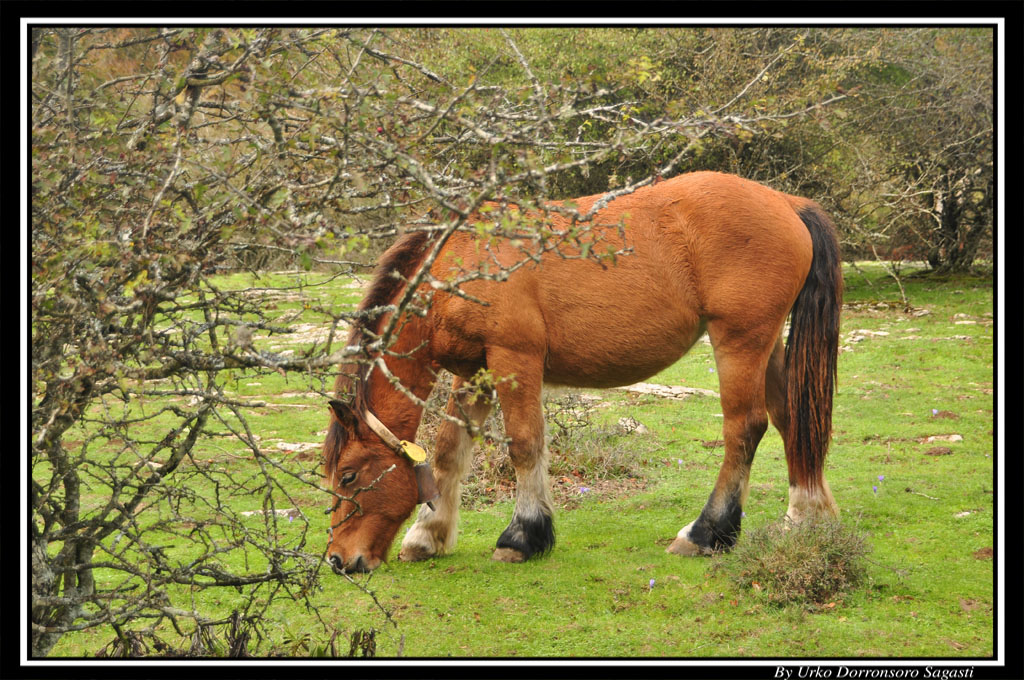
Burguete horse
Spanish horse breed from Navarre, reared for horsemeat.

Urko Dorronsoro · CC BY-SA 2.0
The Burguete, known in Spanish as *Caballo Burguete* or *Caballo de Raza Burguete* and in Basque as *Aurizko zaldia*, is a horse breed native to the Spanish autonomous community of Navarre in the northeast of the country. It belongs to the group of autochthonous breeds at risk of extinction, as listed in Spain’s *Catálogo Oficial de Razas de Ganado de España*. The breed’s primary purpose is meat production. Its name, in both Basque and Spanish, comes from the municipality of Burguete—Auritz. The Burguete is one of four Basque horse breeds, alongside the Jaca Navarra, the Pottoka, and the Euskal Herriko Mendiko Zaldia (Basque Mountain Horse).
The breed originated from crossing local Basque mares of the Jaca Navarra type with foreign stallions from the Trait Breton, Postier Breton, and Percheron breeds, and later with Ardennes and Comtois stock. Official recognition came in 1979, when the Spanish government added it to the *Catálogo Oficial de Razas de Ganado de España*. A breeders’ association, the *Asociación de Criadores de Raza Equina Burguete de Navarra*, formed in 1998 and gained recognition from the Government of Navarre the following year, along with authorization to maintain the breed’s stud-book.
The Burguete is found only in Navarre. Its original area in the northeast includes the municipalities of Auritz/Burguete and Isaba, as well as the settlements of Villanueva de Arce/Hiriberri-Artzibar in Arce and Arrieta/Artzibar in Auñamendi. Its range later spread into northwestern Navarre, covering the comarca of Barranca, the municipality of Larráun in the Norte de Aralar comarca, and the Améscoas—specifically Améscoa Baja in Estella Oriental and the former region of Améscoa Alta to the north. In 2019, there were 1,532 breeding mares and 307 active stallions. By the end of 2022, the total population reached 7,317 head, comprising 6,064 mares and 1,317 stallions, with registered breeding stock at 365 stallions and 4,001 mares (a total of 4,366). In 2023, DAD-IS reported the breed’s conservation status as “at risk/vulnerable.”
Physically, the Burguete is solidly built and somewhat brachymorphic: its body length exceeds its height at the withers. The coat is either bay or chestnut.
The breed is raised mainly for horsemeat; for this purpose, mares are sometimes bred to Comtois or Auxois stallions instead of Burguete stallions.
Quick Facts
- Country
- Spain
- Use
- horsemeat · conservation grazing · draught work
Facts from the source article.
Lore & Background
The Burguete derives from cross-breeding of indigenous Basque mares of Jaca Navarra type with foreign stallions of the Trait Breton, Postier Breton and Percheron breeds, and later with Ardennes and Comtois stock. It received recognition from the national government of Spain in 1979, when it was included in the Catálogo Oficial de Razas de Ganado de España. The name of the breed, both in Basque and in Spanish, is derived from that of the municipio of Burguete – Auritz in northeastern Navarre. A breeders' association, the Asociación de Criadores de Raza Equina Burguete de Navarra, was established in 1998, and in 1999 was recognised by the Government of Navarre and authorised to keep the stud-book for the breed. The Burguete is distributed only in Navarre. In north-eastern Navarre, its area of origin, it is associated with the municipios of Auritz/Burguete and Isaba, as well as the settlements of Villanueva de Arce/Hiriberri-Artzibar in the municipio of Arce and Arrieta/Artzibar in the municipio of Auñamendi. Its range later expanded into north-western Navarre, where it is associated with the comarca of Barranca, with the municipio of Larráun in the comarca of Norte de Aralar, and with the Améscoas – the municipio of Améscoa Baja in the comarca of Estella Oriental and the former administrative region of Améscoa Alta to the north. In 2019 there were 1532 breeding mares and 307 active stallions; At the end of 2022 the total population numbered 7317 head, consisting of 6064 mares and 1317 stallions; the registered breeding stock numbered 365 stallions and 4001 mares, for a total of 4366. In 2023 the conservation status of the breed was reported to DAD-IS as 'at risk/vulnerable'.
Reader's Guide
The Burguete horse is significant as one of four Basque horse breeds and as an autochthonous Spanish breed in danger of extinction. Its development through cross-breeding of indigenous Jaca Navarra mares with foreign draft breeds such as Trait Breton, Postier Breton, Percheron, Ardennes, and Comtois reflects historical agricultural and economic needs in Navarre. Recognized officially in 1979, the breed is primarily reared for horsemeat, though it is also used for draught work and conservation grazing in northern Navarre. The establishment of a breeders' association in 1998 and a stud-book in 1999 helped formalize conservation efforts. Despite a population of over 7,300 head in 2022, its conservation status remains 'at risk/vulnerable' as of 2023, highlighting ongoing challenges for its preservation. The breed's limited distribution solely within Navarre and its association with specific municipios underscore its regional importance.
Did You Know?
- Its name in both Basque and Spanish derives from the municipio of Burguete – Auritz.
- The breed was officially recognized by the Spanish national government in 1979.
- In 2023, its conservation status was reported as 'at risk/vulnerable' to DAD-IS.
Origins and the Making of a Breed
The Burguete horse traces its lineage to a deliberate cross-breeding program in Navarre, where indigenous Basque mares of the Jaca Navarra type were mated with foreign stallions from the Trait Breton, Postier Breton, and Percheron breeds, with later introductions of Ardennes and Comtois stock. This hybridization produced a distinct type that eventually earned formal recognition. In 1979, the Spanish national government included the breed in the Catálogo Oficial de Razas de Ganado de España, cementing its status as an autochthonous breed. The breeders' community formalized its stewardship in 1998 with the founding of the Asociación de Criadores de Raza Equina Burguete de Navarra, which received government authorization in 1999 to maintain the official stud-book. The breed's name, in both Spanish (Caballo Burguete) and Basque (Aurizko zaldia), derives directly from the municipio of Burguete–Auritz in northeastern Navarre, anchoring its identity to a specific place.
Geographic Range and Conservation Status
The Burguete is found exclusively within the autonomous community of Navarre, making it one of the most geographically restricted horse breeds in Spain. Its heartland lies in north-eastern Navarre, where it is traditionally associated with the municipios of Auritz/Burguete and Isaba, as well as the settlements of Villanueva de Arce/Hiriberri-Artzibar and Arrieta/Artzibar. Over time, its range extended into north-western Navarre, reaching the comarca of Barranca, the municipio of Larráun in Norte de Aralar, and the Améscoas region, including Améscoa Baja and the former Améscoa Alta. Despite this modest expansion, the breed remains vulnerable. In 2019, the population stood at 1,532 breeding mares and 307 active stallions. By the end of 2022, the total population reached 7,317 head, with registered breeding stock of 4,366 animals. In 2023, its conservation status was reported to DAD-IS as at risk or vulnerable, and it is listed among autochthonous breeds in danger of extinction.
Build, Purpose, and Working Life
Physically, the Burguete presents as a solidly built, somewhat brachymorphic horse—its body length exceeds its height at the withers, giving it a compact, powerful frame. The coat comes in either bay or chestnut. Its primary economic role is as a source of horsemeat, a purpose that shapes breeding decisions across the region. For meat production, mares are sometimes crossed with Comtois or Auxois stallions rather than pure Burguete males, a practice that prioritizes carcass traits over breed purity. Beyond the meat industry, the Burguete still serves in draught work, reflecting its heritage as a cross-bred working animal descended partly from heavy French breeds. In northern Navarre, the breed also plays an ecological role through conservation grazing, where its foraging helps maintain open landscapes. This multipurpose utility—meat, draft, and land management—underscores why the breed has persisted in a region where purely ornamental or sport horses would struggle to justify their upkeep.
Place Among Basque Breeds and Cultural Identity
The Burguete occupies a distinct niche among the four recognized Basque horse breeds, alongside the Jaca Navarra, the Pottoka, and the Euskal Herriko Mendiko Zaldia, also known as the Basque Mountain Horse. While the Jaca Navarra represents the indigenous Basque mare type that contributed to the Burguete's own creation, the Pottoka and Basque Mountain Horse serve different traditional roles in the wider Basque cultural landscape. The Burguete's identity is inseparable from Navarre: it is the only one of the four Basque breeds whose entire geographic range falls within a single autonomous community. Its dual naming—Caballo Burguete in Spanish and Aurizko zaldia in Basque—reflects the bilingual character of the region and the specific municipio of Burguete–Auritz from which it takes its name. The breed's listing as an autochthonous breed in danger of extinction, combined with the dedicated stud-book maintained by its 1998-established breeders' association, signals a collective commitment to preserving a living piece of Navarrese agricultural heritage that bridges Basque indigenous stock and French heavy-horse genetics.
Gallery
Frequently Asked Questions
What is the Burguete horse?
It is a native horse breed from Navarre in northeastern Spain and one of the four recognized Basque horse breeds. The name comes from the small municipality of Burguete, called Auritz in Basque.
What is the Burguete horse bred for?
Its main agricultural role is horsemeat production, which sets it apart from other Basque horses typically kept for riding or draft work. The breed was officially entered into Spain's livestock catalog in 1979.
What colors do Burguete horses come in?
The breed is found in either bay or chestnut coat colors. It is classified as a Spanish autochthonous horse breed native to the Navarre region.
Where can you find Burguete horses?
They are native to the Navarre autonomous community in the northeast of Spain. The breed takes its name directly from the municipality of Burguete (Auritz in Basque) within that area.
Is the Burguete horse endangered?
Yes — as of 2023 it is listed as at risk or vulnerable in Spain's official catalog of livestock breeds. It is grouped among autochthonous breeds considered to be at risk of extinction.
More in Basque domestic animal breeds 1-20
Spotted an error? Know more?
Reader corrections go straight into our review queue. Suggest an edit · How this site is sourced