Betizu
Semi-feral Basque cattle, endangered and steeped in myth.

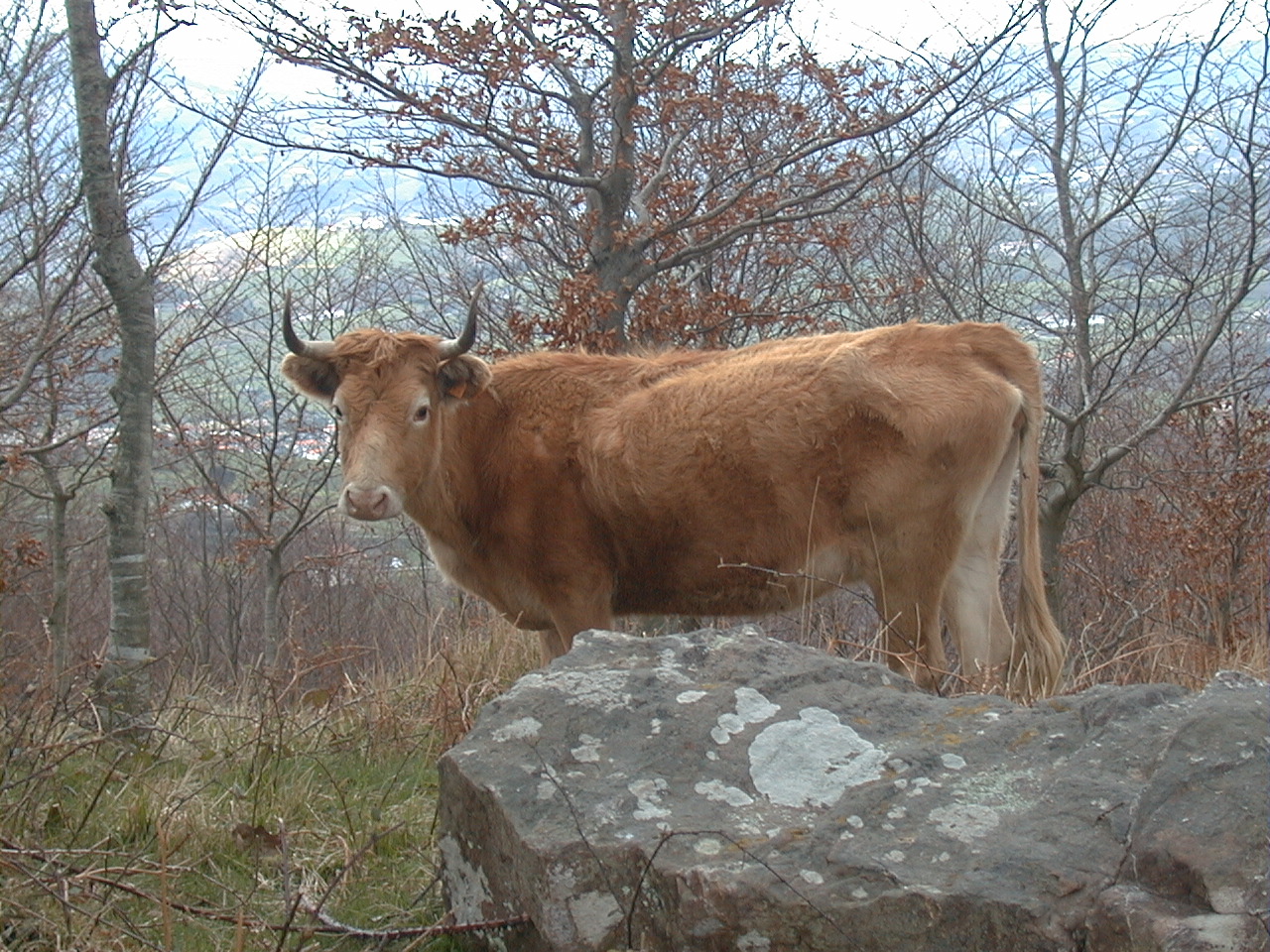
Jose Maria Plazaola Erostarbe · CC BY-SA 3.0
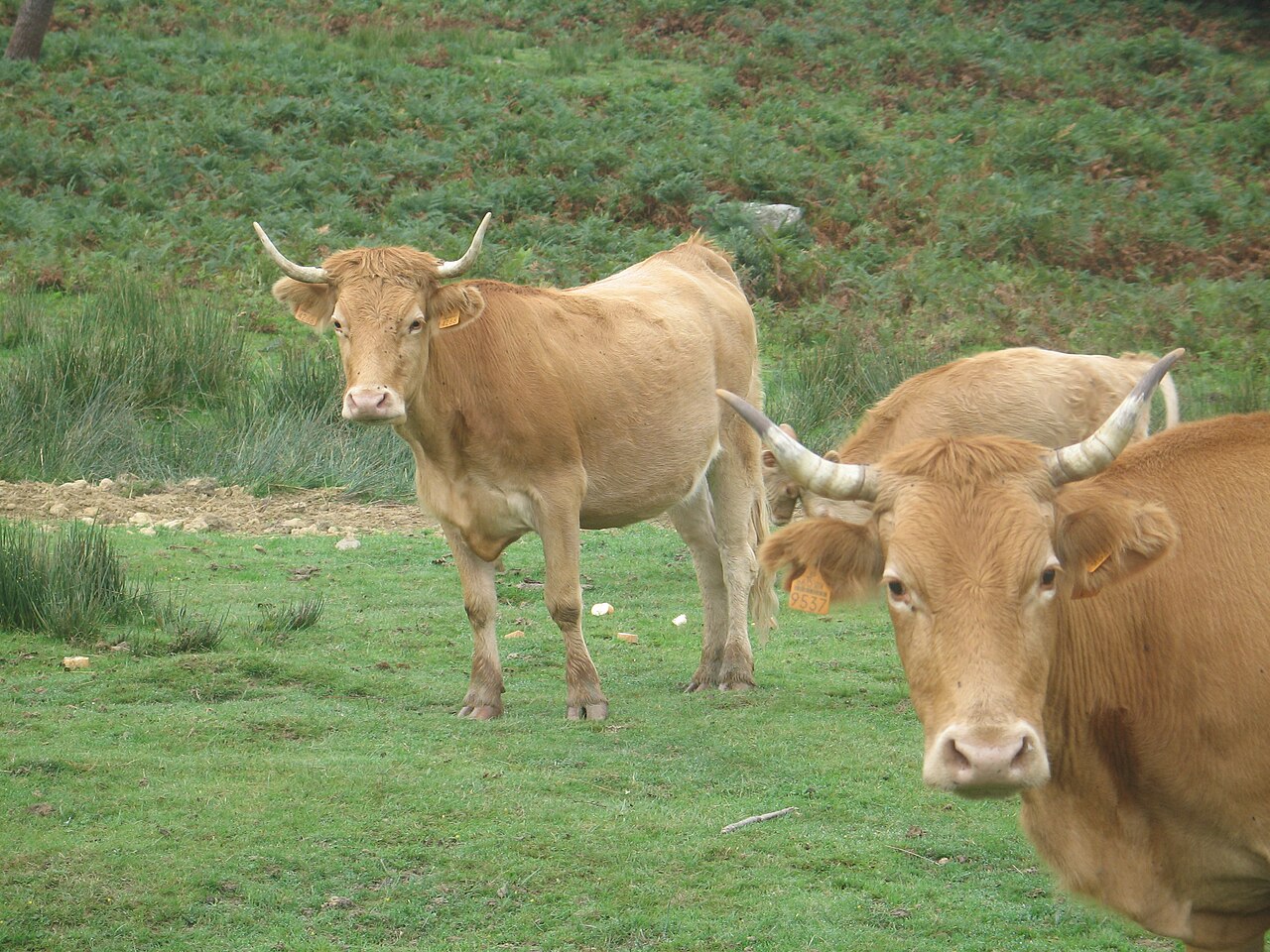
The Betizu is a small, semi-feral mountain cattle breed found in the Basque Country, on both the Spanish and French sides. It is listed as endangered by Spain’s agriculture ministry and by the Conservatoire des Races d’Aquitaine in France. Alongside the Albera, Monchina, and Raço di Biòu, it is one of the few semi-feral cattle populations left in Europe.
Its origins are unknown. The name comes from the Basque *behi izua*, meaning “elusive cow,” setting it apart from the *etxebehi*, or “house cow.” In Basque mythology, it appears as Zezengorri (“red bull”), the guardian of the goddess Mari’s treasure. Some believe the Betizu is a remnant of an ancient Pyrenean breed adapted to harsh mountain terrain; others think it may descend from cattle lost or escaped during seasonal transhumance.
By the early 2000s, the breed was endangered. In 2003, Navarre officially listed it as such, and the regional government established a conservation herd at the Sastoia estate in Urraúl Alto, later managed by the Instituto Navarro de Tecnologías e Infraestructuras Agroalimentarias. In 2013, the Navarre population was estimated at 254, while fewer than 150 were thought to live in Aquitaine. By 2023, Spain reported 1,267 head, including 688 cows and 50 bulls registered in the herd-book across 41 herds; France reported 80–100 head. Spain’s conservation status is “at risk/endangered,” while France’s is “at risk/critical.”
Quick Facts
- Country
- Spain · France
- Distribution
- Bizkaia · Gipuzkoa · Nafarroa · Labourd, Pyrénées-Atlantiques
- Standard
- [https: · www.mapa.gob.es/es/ganaderia/temas/zootecnia/of344-2014librogenealogicobetizu_tcm30-117417.pdf Gobierno de Navarra] (in Spanish)
- Use
- meat · vegetation management
- Maleweight
- 400-500 kg
- Femaleweight
- 300-350 kg
- Coat
- russet brown
- Horn
- horned
- Subspecies
- taurus
Facts from the source article.
Lore & Background
The origins of the Betizu are unknown. The name derives from the Basque 'behi izua', meaning 'elusive cow', distinguishing it from the etxebehi or 'house cow'. It appears in Basque mythology as Zezengorri ('red bull'), guardian of the treasure of the goddess Mari. Some believe it is the remnant of an ancient Pyrenean cattle population adapted to marginal mountain terrain, while others suggest it may derive from animals lost or escaped during annual transhumance.
Reader's Guide
The Betizu represents a rare link to ancient Pyrenean cattle and a living element of Basque cultural heritage. Its semi-feral existence in mountainous terrain highlights a traditional pastoral landscape now largely vanished. The breed's endangered status—listed in Navarre in 2003 and later in France as 'at risk/critical'—prompted conservation efforts, including a government herd at Sastoia in Urraúl Alto. By 2023, Spain reported 1267 head, while France had only 80–100, underscoring the fragility of the population. The Betizu's significance lies not only in its genetic uniqueness but also in its mythological role as Zezengorri, guardian of the goddess Mari's treasure, embedding it in Basque identity. Its survival depends on continued conservation, as it remains one of Europe's few semi-feral cattle breeds, alongside the Albera, Monchina, and Raço di Biòu.
Did You Know?
- In 2023, Spain reported 1267 head of Betizu, while France reported only 80–100 head.
- The Betizu is one of a small number of semi-feral cattle populations in Europe.
Origins and Mythological Roots
The true ancestry of the Betizu remains unresolved, and two competing explanations account for its existence in the high mountains. One theory holds that the breed is the surviving remnant of an ancient Pyrenean cattle population that had already adapted to endure in marginal, high-altitude terrain. The other offers a more prosaic origin: the animals may simply have been lost or escaped during the annual transhumance movements that shaped Basque pastoral life for generations. The very name betizu, drawn from the Basque phrase behi izua meaning "elusive cow," captures the sense of cattle that slipped beyond the control of their herders. The breed also occupies a distinctive place in Basque mythology, where it is identified with Zezengorri, the "red bull" who served as guardian of the treasure belonging to the goddess Mari. This mythological association sharply distinguishes the Betizu from the etxebehi, or "house cow," the domesticated cattle that lived alongside human settlements, and reinforces the perception that the Betizu belongs to a wilder, more untamed sphere of Basque cultural memory.
A Rare Semi-Feral Niche in Europe
The Betizu occupies a zoological niche that is vanishingly rare on the European continent: it is one of only a handful of semi-feral cattle populations still in existence. Its closest counterparts in this unusual category are the Albera of the Pyrenees, the Monchina of Cantabria, and the Raço di Biòu of the Camargue. Unlike the overwhelming majority of European cattle, which have been fully domesticated and confined to managed pastures or barns, the Betizu persists in a semi-feral state across the rugged, mountainous landscapes of the Basque Country, straddling the border between Spain and France. These small cattle have adapted to survive in marginal high-altitude terrain where conventional agriculture is impractical, feeding and breeding with minimal human intervention. Their compact build and hardiness are well suited to steep, rocky slopes. This semi-feral condition is not a mere behavioral quirk but a defining characteristic of the breed's identity, one that sets it apart from the fully managed herds dominating modern European livestock farming and that makes its conservation both more complex and more urgent than for many other endangered cattle breeds.
Conservation Efforts and Population Trajectory
The Betizu's precarious numbers have drawn the attention of agricultural authorities on both sides of the Pyrenees. Spain's Ministerio de Agricultura, Pesca y Alimentación and France's Conservatoire des Races d'Aquitaine have both formally classified the breed as endangered, acknowledging that without active intervention the population could vanish. In Navarre, the breed was officially listed as endangered in 2003, prompting the regional government to establish a dedicated conservation herd at the finca of Sastoia in Urraúl Alto, within the comarca of Lumbier. Management of that herd was subsequently transferred to the Instituto Navarro de Tecnologías e Infraestructuras Agroalimentarias, a body focused on agricultural technology and infrastructure. Population figures illustrate both the fragility and the slow recovery of the breed: in 2013, Navarre held an estimated 254 head while Aquitaine had fewer than 150. By 2023, Spain reported a total of 1,267 head, including 688 cows and 50 bulls formally registered in the herd-book across 41 herds, while France's numbers had declined to an estimated 80 to 100 animals. Spain's conservation status is listed as "at risk/endangered," whereas France's carries the more alarming "at risk/critical" label.
A Single Breed Governed by Two Nations
The Betizu's range is split by the international boundary between Spain and France, a geographic reality that complicates every dimension of its management and long-term survival. In Spain, the breed is concentrated in the mountainous parts of the Basque Country, with Navarre playing a particularly prominent role through its formal conservation programs and herd-book registration system. In France, the population is found in the mountainous regions of Aquitaine, where the Conservatoire des Races d'Aquitaine oversees its status. The two countries have adopted different conservation designations for the same breed: Spain rates it "at risk/endangered" while France assigns the more severe "at risk/critical" label, reflecting the smaller and more vulnerable French population of just 80 to 100 head as of 2023. This transnational distribution means that any meaningful conservation strategy must account for the breed's presence on both sides of the border, yet the institutional frameworks, registration systems, and funding mechanisms differ between the two nations. The Betizu thus exists as a single biological and cultural entity that is, in practical terms, governed by two separate administrative systems, each with its own priorities and resources for preserving this elusive mountain cattle.
Gallery

Frequently Asked Questions
What is the Betizu?
The Betizu is a small, semi-feral cattle breed native to the mountainous regions of the Basque Country, found on both the Spanish and French sides. It stands out as one of the very last semi-feral cattle populations remaining anywhere in Europe.
What does the name 'Betizu' actually mean?
The name derives from the Basque phrase *behi izua*, which translates to 'elusive cow.' This deliberately sets the breed apart from the *etxebehi*, or 'house cow,' underscoring its wild, hard-to-catch character.
How many Betizu are left and what is their conservation status?
As of 2023, Spain's herd-book records roughly 1,267 head spread across 41 herds, while France holds only about 80 to 100 animals. Both Spain's agriculture ministry and France's Conservatoire des Races d'Aquitaine classify the breed as endangered.
What is the Betizu's connection to Basque mythology?
In Basque myth the breed is linked to Zezengorri, the 'red bull' who serves as guardian of the goddess Mari. This mythological role reinforces the breed's cultural identity as something wild and sacred rather than merely a farm animal.
What makes the Betizu different from other European cattle breeds?
Unlike most modern cattle that are fully domesticated and confined to farms, the Betizu retains a semi-feral lifestyle in rugged mountain terrain. Alongside the Albera, Monchina, and Raço di Biòu, it represents one of the last semi-feral cattle populations left on the continent.
More in Basque domestic animal breeds 1-20
Spotted an error? Know more?
Reader corrections go straight into our review queue. Suggest an edit · How this site is sourced