Ultraviolet astronomy
Observing the hot, energetic universe in ultraviolet light.

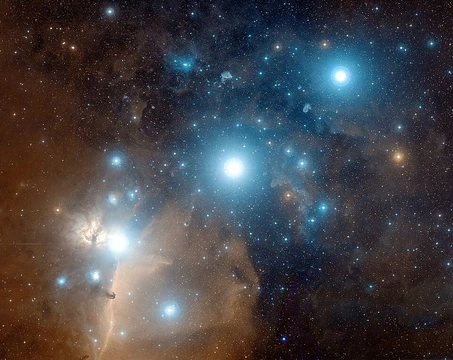
Ultraviolet astronomy is the observation of electromagnetic radiation at ultraviolet wavelengths between approximately 10 and 320 nanometres. Ultraviolet light is not visible to the human eye, and most of it is absorbed by Earth's atmosphere, so observations must be performed from the upper atmosphere or from space. The ultraviolet universe looks quite different from the familiar stars and galaxies seen in visible light, as UV radiation is the signature of hotter objects, typically in the early and late stages of their evolution.
- Wavelength range
- 10 to 320 nanometres
- First major telescope
- Orbiting Astronomical Observatory (#2: 1968-1973; #3: 1972-1981)
- Longest running mission
- International Ultraviolet Explorer (115-320 nm, 1978–1996)
- Notable pioneers
- George Robert Carruthers, Robert Wilson, Charles Stuart Bowyer
- Recent major telescopes
- Hubble Space Telescope and FUSE
Lore & Background
Ultraviolet line spectrum measurements (spectroscopy) are used to discern the chemical composition, densities, and temperatures of the interstellar medium, and the temperature and composition of hot young stars. UV observations can also provide essential information about the evolution of galaxies and can discern the presence of a hot white dwarf or main sequence companion in orbit around a cooler star. Most stars are relatively cool objects emitting much of their radiation in visible or near-infrared, so in ultraviolet light most stars would fade, while very young massive stars and very old stars and galaxies near their birth or death would be visible. Clouds of gas and dust would block vision in many directions along the Milky Way.
Space-based solar observatories such as SDO and SOHO use ultraviolet telescopes (called AIA and EIT, respectively) to view activity on the Sun and its corona. Weather satellites such as the GOES-R series also carry telescopes for observing the Sun in ultraviolet. The Hubble Space Telescope and FUSE have been the most recent major space telescopes to view the near and far UV spectrum of the sky, though other UV instruments have flown on smaller observatories such as GALEX, as well as sounding rockets and the Space Shuttle. Pioneers in ultraviolet astronomy include George Robert Carruthers, Robert Wilson, and Charles Stuart Bowyer.
Reader's Guide
Ultraviolet astronomy is notable because it reveals phenomena invisible to the human eye and largely blocked by Earth's atmosphere, requiring space-based or high-altitude observation. The article lists numerous ultraviolet space telescopes, from the Far Ultraviolet Camera/Spectrograph on Apollo 16 (April 1972) to the International Ultraviolet Explorer (1978–1996) and the Hubble Space Telescope (various instruments from 1990 onward). These missions have enabled spectroscopy to determine chemical composition, densities, and temperatures of the interstellar medium, as well as the temperature and composition of hot young stars. UV observations also provide essential information about galaxy evolution and can detect hot companions orbiting cooler stars. The article notes that most stars are cool and emit little UV, so the ultraviolet sky is dominated by hot objects in early or late evolutionary stages. Solar observatories like SDO and SOHO, and weather satellites like GOES-R, use UV telescopes to monitor solar activity. Planetary spacecraft such as Cassini, MESSENGER, New Horizons, Juno, and MAVEN have carried UV instruments to study other worlds. The legacy of ultraviolet astronomy is a deeper understanding of the hot, energetic universe and the life cycles of stars and galaxies.
Frequently Asked Questions
Who is Ultraviolet astronomy?
Ultraviolet astronomy is the branch of observational astronomy dedicated to studying electromagnetic radiation between roughly 10 and 320 nanometres. Because Earth's atmosphere absorbs nearly all UV light, these observations must be carried out from high-altitude platforms or orbiting spacecraft.
What are Ultraviolet astronomy's powers and role?
UV astronomy reveals the hottest, most energetic objects in the cosmos, including young stars still in formation and dying stars in their final evolutionary stages. It paints a dramatically different picture of the universe compared to visible-light imaging, highlighting regions of intense radiation that the human eye can never detect.
Who are Ultraviolet astronomy's key pioneers?
George Robert Carruthers, Robert Wilson, and Charles Stuart Bowyer are widely credited as foundational figures who designed and flew early UV space missions. Their work led directly to the Orbiting Astronomical Observatory program and later to the long-running International Ultraviolet Explorer, which operated from 1978 through 1996.
Why is Ultraviolet astronomy important?
UV observations are essential for understanding stellar lifecycles, because ultraviolet emission is the hallmark of extremely hot matter in both the birth and death phases of stars. Without it, astronomers would miss critical details about how galaxies assemble and how stellar populations evolve over time.
More in Astrophotography, Part 2 1-24
Spotted an error? Know more?
Reader corrections go straight into our review queue. Suggest an edit · How this site is sourced