Solar gravitational lens
Theoretical method using the Sun as a gravitational lens for exoplanet imaging.

NASA · Public domain
The solar gravitational lens (SGL) is a theoretical method of using the Sun as a large lens via gravitational lensing. It is considered one of the best methods to directly image habitable exoplanets, offering brightness amplification of up to a factor of ~10^11 (at 1 μm) and extreme angular resolution (~10^-10 arcsec).
- Brightness amplification
- ~10^11 (at 1 μm)
- Angular resolution
- ~10^-10 arcsec
- Focal distance
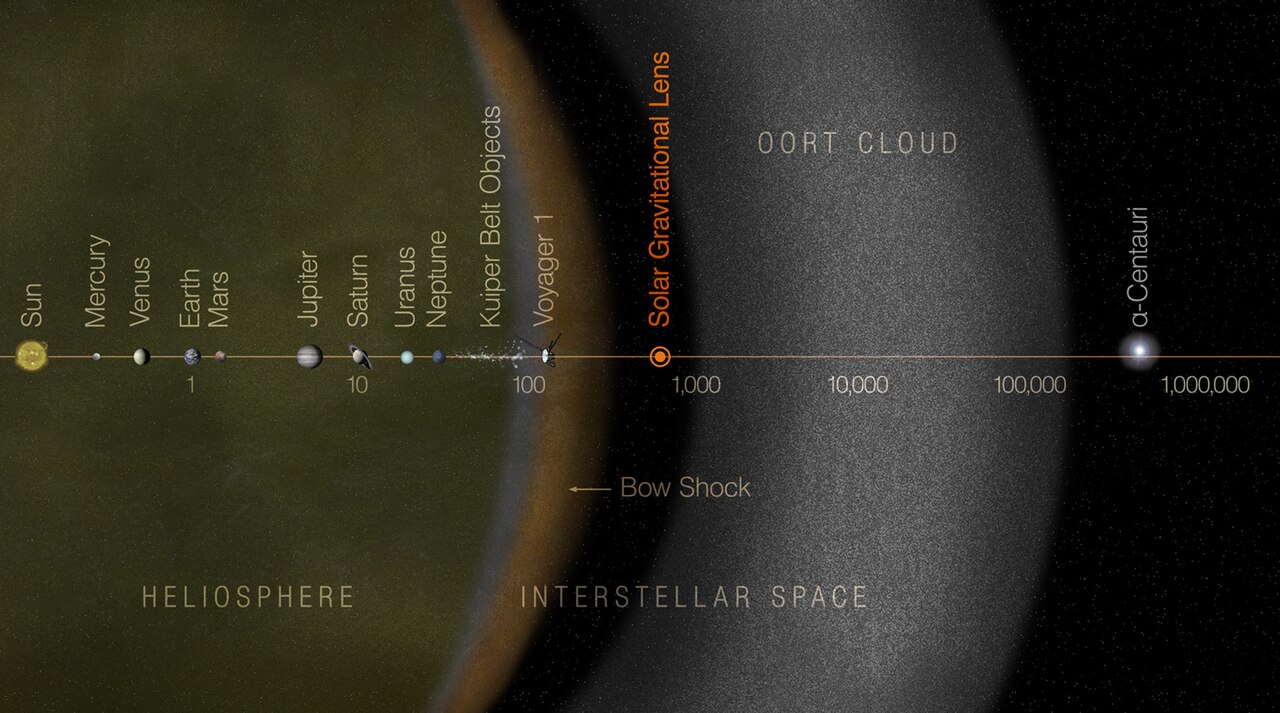
- approximately 542 AU from the Sun
- Predicted by
- Albert Einstein in 1936
- First proposed as lens
- Von R. Eshleman in 1979
- Probe proposal
- SETIsail / FOCAL proposed to ESA in 1993
- Exoplanet resolution
- ~25 km-scale surface resolution at 30 pc (98 ly) in 6 months
Lore & Background
Albert Einstein predicted in 1936 that rays of light from the same direction that skirt the edges of the Sun would converge to a focal point approximately 542 AU from the Sun. A probe positioned at this distance could use the Sun as a gravitational lens for magnifying distant objects on the opposite side of the Sun, with the probe's location shifting as needed to select different targets. In 1979, Von R. Eshleman was the first author proposing to use the Sun as a large lens.
The Sun's gravitational field bends light more prominently the closer it gets to the Sun. Light rays passing on opposite sides of the Sun meet at a focal point, forming a series of points along a line extending from the star through the Sun's center. However, the solar corona has an active and dynamic atmosphere, and beams of light passing close to the Sun are affected by the particles of the atmosphere. A probe called SETIsail and later FOCAL was proposed to the ESA in 1993, but is expected to be a difficult task. If a probe does pass 542 AU, magnification capabilities of the lens will continue to act at farther distances, as rays that come to a focus at larger distances pass further away from the distortions of the Sun's corona.
Reader's Guide
The solar gravitational lens is significant because it offers a theoretical path to directly image habitable exoplanets with extreme resolution. In 2020, NASA physicist Slava Turyshev presented his idea of direct multi-pixel imaging and spectroscopy of an exoplanet with a solar gravitational lens mission. His proposal was selected for Phase III of the NIAC 2020 (NASA Institute for Advanced Concepts). Turyshev proposes to use realistic-sized solar sails (~16 vanes of 103 m²) to achieve the needed high velocity at perihelion (~150 km/sec), reaching 547 AU in 17 years. The lens could reconstruct the image of an exoplanet 30 pc (98 ly) away with ~25 km-scale surface resolution in 6 months of integration time, enough to see surface features and signs of habitability. The legacy of the concept builds on Einstein's 1936 prediction and Eshleman's 1979 proposal, though the mission remains a difficult task. The SGL is considered one of the best methods for directly imaging habitable exoplanets, despite the challenges of reaching the required focal distance and dealing with coronal distortions.
Did You Know?
- Albert Einstein predicted the solar gravitational lens focal point at approximately 542 AU from the Sun in 1936.
- Von R. Eshleman was the first author to propose using the Sun as a large lens, in 1979.
- Slava Turyshev's 2020 NIAC Phase III proposal aims to reach 547 AU in 17 years using solar sails.
Roots in Relativistic Astrophysics
The Solar gravitational lens concept finds its theoretical home within relativistic astrophysics, a subdiscipline that examines how the effects of both special and general relativity manifest in astrophysical settings. Within this framework, gravitational lensing sits alongside other phenomena such as gravitational waves and black holes as a key area of investigation. The discipline operates at the intersection of fundamental physics and celestial observation, seeking to understand how the curvature of spacetime predicted by general relativity bends the path of light passing near massive bodies. As a branch of theoretical astrophysics, it relies on mathematical models and computational methods to develop predictions about how light behaves in the presence of extreme gravitational fields. The Solar gravitational lens, as an application of these principles to our own star, represents one of the most accessible yet most extreme manifestations of relativistic effects within the Solar System, connecting the abstract mathematics of spacetime curvature to a tangible object at the center of our planetary neighborhood.
The Sun as a Gravitational Actor
In the taxonomy of astronomical objects, the Sun occupies a singular position as the central body of the Solar System. Solar physics, as a dedicated branch of astronomy, focuses specifically on the Sun and its interaction with the remainder of the Solar System and interstellar space. This interaction encompasses the gravitational influence the Sun exerts on planets, moons, comets, asteroids, and Kuiper belt objects, as well as the electromagnetic and particle exchanges that shape the local environment. When considered as a gravitational lens, the Sun's mass becomes the defining parameter that determines how background light is deflected and magnified. The Sun's role extends beyond merely hosting a planetary system; it is the gravitational anchor that structures the entire local environment, from the inner rocky worlds to the distant small Solar System bodies. Understanding the Sun's gravitational field in the context of lensing requires integrating knowledge from solar physics with the broader principles of relativistic astrophysics, bridging the study of a single star with the universal laws governing spacetime.
Observational Methodology and Instrumentation
The practical pursuit of detecting and characterizing a Solar gravitational lens effect falls squarely within the domain of observational astronomy, the branch concerned with recording data from celestial objects using telescopes and other astronomical apparatus. Observational astronomy is further subdivided by the wavelength ranges of the detectors employed, spanning from radio astronomy above 300 micrometers through submillimetre, infrared, optical, ultraviolet, X-ray, and gamma-ray bands, down to cosmic ray and neutrino detection. Each of these windows offers a different perspective on the same physical phenomenon, and the Solar gravitational lens would, in principle, be observable across multiple of these regimes. The empirical and scientific methods that define astronomy as a natural science demand that any claimed lensing effect be measured, replicated, and subjected to rigorous analysis. Techniques such as photometry, which measures the brightness of celestial objects through various filters, and spectroscopy, which examines the spectral signatures of astronomical objects, would be essential tools in confirming and quantifying the lensing signal and distinguishing it from other sources of variability or contamination.
A Discipline in Context
The Solar gravitational lens does not exist in isolation; it is embedded within astronomy, a field that simultaneously functions as an academic discipline with dedicated departments, curricula, and degrees, as a recognized branch of the natural sciences, and as a space science field with its own specialized societies and journals. As a natural science, astronomy seeks to elucidate the rules governing the natural world through empirical methods, and the gravitational lensing of light by the Sun is precisely the kind of phenomenon that tests and extends those rules. The field also intersects with biology through astrobiology, with chemistry through astrochemistry, and with other domains through archaeoastronomy. The study of the Solar gravitational lens thus draws on the full breadth of astronomical expertise, from the computational astrophysics needed to model the lensing geometry, to the astrometry required to track precise positional changes, to the high-energy astrophysics that informs our understanding of extreme environments. It is a problem that no single subdiscipline can own, demanding a synthesis across the many branches that together constitute the modern study of the universe beyond Earth.
Gallery
Frequently Asked Questions
What is the Solar Gravitational Lens?
The Solar Gravitational Lens is a theoretical imaging technique that exploits the Sun's mass to bend and focus incoming light, effectively turning our star into a natural optical element. Albert Einstein first predicted the underlying effect in 1936, and Von R. Eshleman later framed it as a usable lens in 1979.
How much brightness amplification does the SGL provide?
At a wavelength of one micrometer, the lens can boost the apparent brightness of a distant source by roughly a factor of 10 to the 11th power. That extraordinary gain is what makes direct imaging of faint, Earth-like exoplanets theoretically feasible.
Where is the focal region of the Solar Gravitational Lens located?
The focal zone begins at about 542 astronomical units from the Sun, placing it far beyond Neptune's orbit. Any spacecraft designed to exploit the lens would have to travel to that distance or farther to sit within the focused beam.
Has anyone proposed a real mission to use the SGL?
Yes. In 1993 a lightweight probe concept called SETIsail (also referred to as FOCAL) was submitted to the European Space Agency with the goal of reaching the focal region and imaging objects at extreme range. The design relied on a thin sail to keep the spacecraft small enough to fit through the narrow focal channel.
Why is the SGL considered so important for exoplanet photography?
It delivers an angular resolution on the order of 10 to the minus 10th arcseconds, far surpassing what any conventional telescope can resolve. Paired with its enormous brightness gain, it is widely regarded as one of the most promising routes to directly photograph habitable exoplanets.
More in Astrophotography, Part 2 1-24
Spotted an error? Know more?
Reader corrections go straight into our review queue. Suggest an edit · How this site is sourced