Submillimetre astronomy
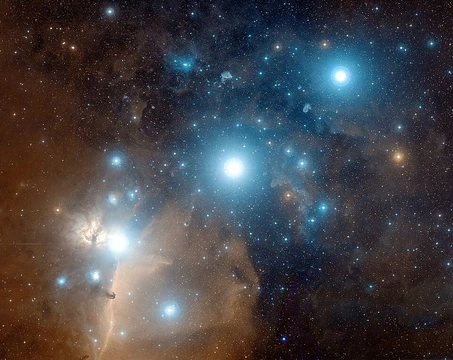
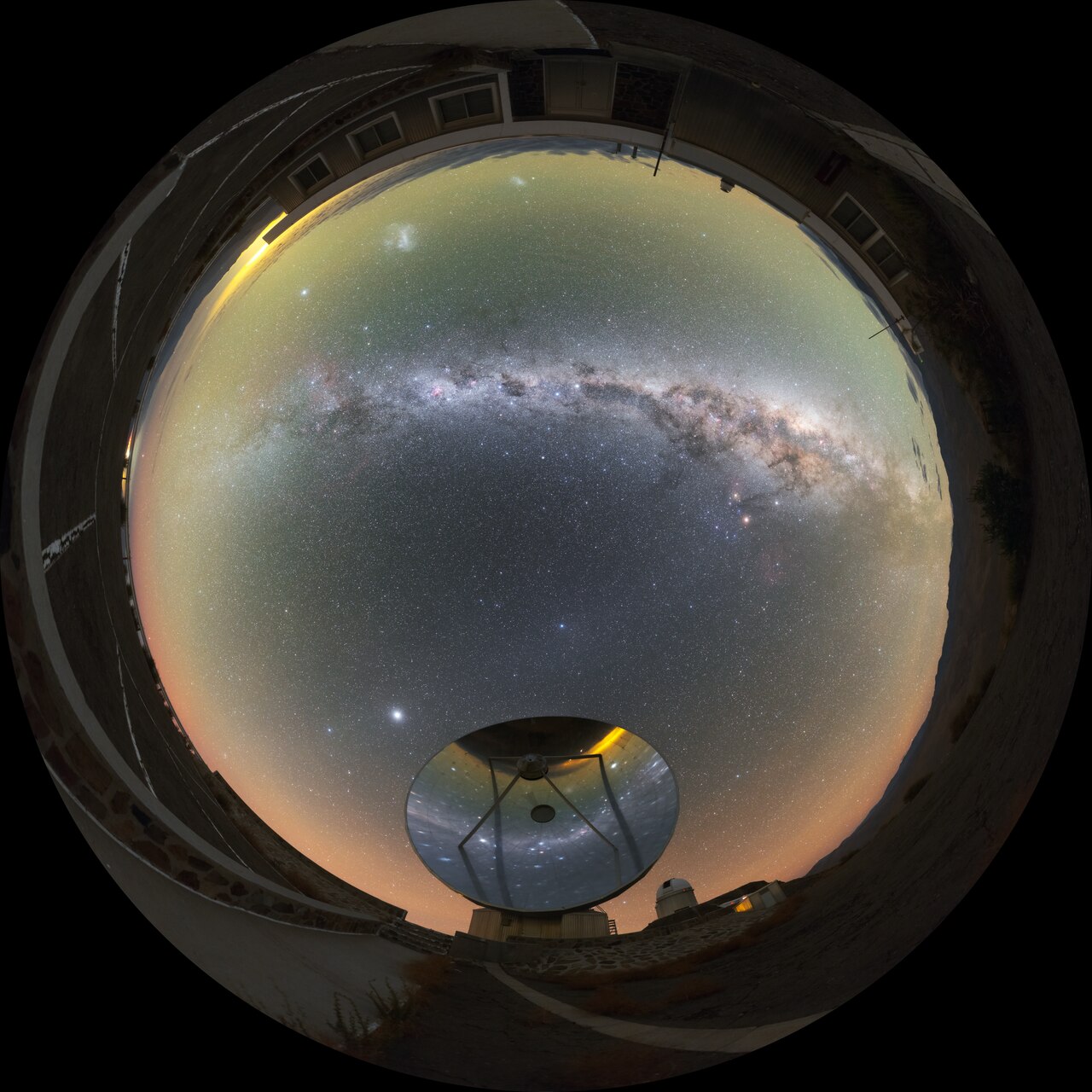
Submillimetre astronomy traces cold gas and dust across the universe.

ESO/ P. Horálek · CC BY 4.0
Submillimetre astronomy is the branch of observational astronomy conducted at submillimetre wavelengths (terahertz radiation), placed between the far-infrared and microwave wavebands, typically between a few hundred micrometres and a millimetre. It is notable because interstellar dust absorbs up to half of all radiation emitted by stars and galaxies, re-emitting it in the far-infrared and submillimeter bands, making submillimeter observations key to understanding the universe.
- Largest ground telescope
- James Clerk Maxwell Telescope (Mauna Kea)
Lore & Background
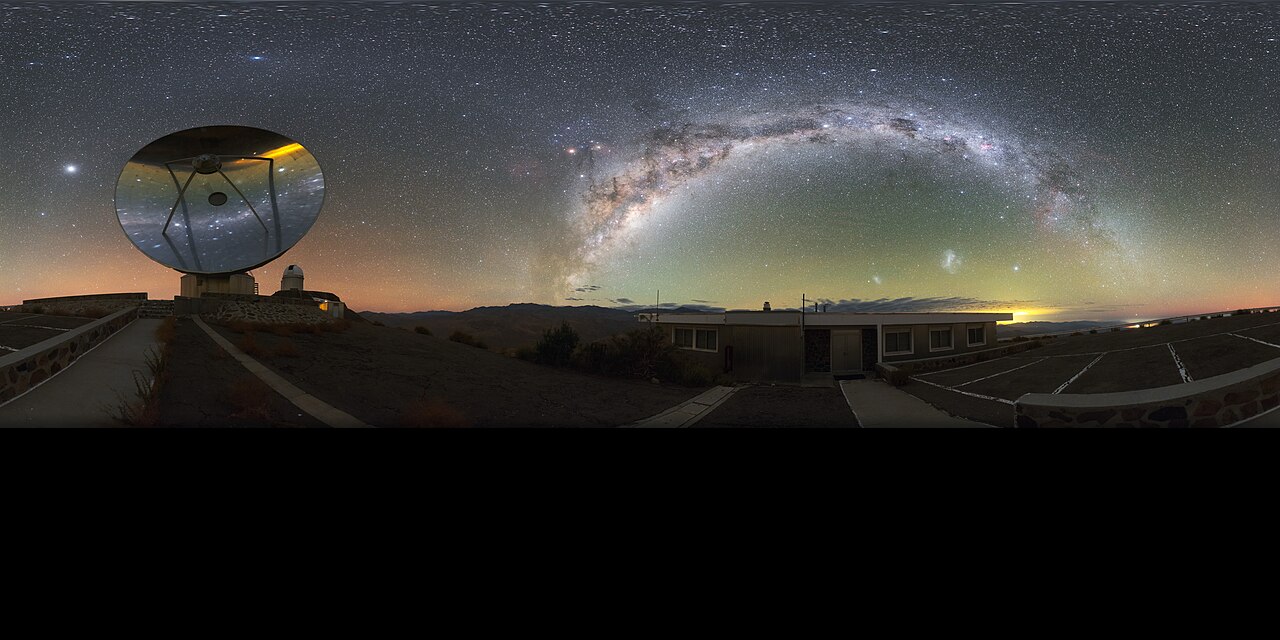
Submillimetre observations trace emission from gas and dust, including CI, CO, and CII lines, from sources such as molecular clouds, dark cloud cores, protoplanetary discs, dusty starburst galaxies, AGN environments, and secondary anisotropies in the cosmic microwave background. The Event Horizon Telescope, which produced the first image of a black hole in 2020 using radio and far-infrared observations, also conducts VLBI observations within the submillimeter regime at 870μm. Ground-based observations are limited by atmospheric water vapour absorption, requiring dry, cool, stable sites. Key sites include Mauna Kea, Llano de Chajnantor, the South Pole, and Hanle in India. The Llano de Chajnantor site hosts APEX, the largest submillimetre telescope in the southern hemisphere, and ALMA, the world's largest ground-based astronomy project. The Submillimeter Array (SMA) on Mauna Kea consists of eight 6-metre telescopes. Stratospheric platforms like BLAST and SOFIA have also been used. Space-based observations avoid atmospheric absorption. The first submillimeter telescope in space was the Soviet BST-1M on Salyut-6. SWAS, launched in 1998, targeted molecular clouds and dark cloud cores. The Herschel Space Observatory, launched in 2009, operated from an orbit around L2 and studied far infrared and submillimetre wavebands, focusing on galaxy origins and formation.
Reader's Guide
Submillimetre astronomy is significant because it traces the cold universe—gas and dust that absorb and re-emit up to half of all stellar and galactic radiation. It has been used to constrain models of planetary, stellar, and galactic formation and evolution. By studying foreground elements of the cosmic microwave background and environments around supermassive black holes, submillimetre astronomy can constrain models of quantum gravity and investigate the role of gravitational waves and relativistic neutrinos in the early Universe. Recent findings have measured the Sunyaev–Zeldovich effect in galaxy clusters, proving the existence of hot intracluster medium. The legacy of submillimetre astronomy includes the Event Horizon Telescope's black hole image at 870μm, and ongoing projects like ALMA and the upcoming CCAT-prime (FYST) wide-field survey telescope, scheduled for first light in 2026. Space missions such as Herschel have advanced understanding of galaxy origins, while SWAS provided data on molecular clouds and cometary water production.
Did You Know?
- Submillimetre wavelengths are often quoted in 'microns', the old name for micrometre.
- The Event Horizon Telescope conducted VLBI observations at 870μm to produce the first image of a black hole.
- The largest existing submillimetre telescope, the James Clerk Maxwell Telescope, is also located on Mauna Kea.
Position in the Electromagnetic Spectrum
Submillimetre astronomy occupies a defined band of the electromagnetic spectrum, spanning wavelengths from 200 micrometres up to 1 millimetre. This places it in a transitional zone between radio astronomy, which extends above 300 micrometres, and infrared astronomy, which covers the 0.7 to 350 micrometre range. As one of several wavelength-based subdisciplines of observational astronomy, it is distinguished primarily by the specifications of the detectors it employs and, more specifically, the particular range of wavelengths those instruments are engineered to capture. The full suite of such subdisciplines stretches from gamma-ray astronomy at wavelengths below 0.01 nanometres, through X-ray, ultraviolet, optical, and infrared regimes, into the submillimetre band and onward into radio astronomy. Beyond the traditional electromagnetic framework, cosmic ray astronomy and neutrino astronomy extend observational reach into entirely different particle domains, underscoring how submillimetre astronomy represents one carefully calibrated window into the radiation emitted by the cosmos.
Role Within Observational Astronomy
Submillimetre astronomy is classified as a subdiscipline of observational astronomy, a field fundamentally devoted to the practice of observing celestial objects through telescopes and other astronomical apparatus, with a central focus on recording data. The subdisciplines within observational astronomy are generally delineated by the specifications of the detectors used and, more precisely, by the ranges of wavelengths those detectors are designed to observe. In this structured framework, submillimetre astronomy claims the 200-micrometre to 1-millimetre band, sitting between the infrared and radio regimes. This observational approach is one facet of a broader discipline that also encompasses astrometry, which tracks the positions of objects in the sky and their changes over time, defining coordinate systems and galactic kinematics. Complementary techniques such as photometry, which measures the brightness of celestial objects through various filters, and spectroscopy, which analyses the spectral signatures of astronomical objects, further enrich the toolkit available to researchers working across the submillimetre window.
Connection to Broader Cosmic Phenomena
As a specialized component of the wider discipline of astronomy, submillimetre astronomy participates in the study of the universe beyond Earth. This encompasses the formation and development of the cosmos, as well as the evolution, physics, chemistry, meteorology, and motion of celestial objects including galaxies and planets. The scope also extends to phenomena originating outside Earth's atmosphere, such as the cosmic background radiation. The broader astronomical enterprise intersects with biology through astrobiology, which investigates the advent and evolution of biological systems throughout the universe. Within this vast intellectual scope, submillimetre astronomy's wavelength range of 200 micrometres to 1 millimetre provides one particular observational window through which these cosmic phenomena can be recorded and studied. It complements the other wavelength-based subdisciplines, and together they help elucidate the rules governing the natural world at its largest scales, from the structure of our Galaxy to objects far beyond its borders.
Academic Identity and Cultural Reach
Astronomy, of which submillimetre astronomy forms a specialized component, holds multiple identities in the intellectual landscape. It functions as a full academic discipline, complete with dedicated departments, structured curricula, degree programmes, national and international professional societies, and specialized peer-reviewed journals. Simultaneously, it is recognized as a scientific field, a widely acknowledged category of specialized expertise within the broader sciences, and as a natural science that seeks to elucidate the rules governing the natural world through empirical and scientific methods. It is also classified as a branch or field of space science. Beyond the professional and institutional sphere, astronomy serves as a hobby or part-time pursuit for many individuals, driven by personal curiosity or a deep appreciation of beauty, with astrophotography being a particularly notable expression of this passion. Submillimetre astronomy, with its specific focus on the 200-micrometre to 1-millimetre wavelength band, sits comfortably within this rich institutional, scientific, and cultural framework.
Gallery
Frequently Asked Questions
What is Submillimetre astronomy?
Submillimetre astronomy is a branch of observational astronomy that observes the universe using terahertz radiation, sitting between the far-infrared and microwave parts of the electromagnetic spectrum. It typically covers wavelengths from a few hundred micrometres up to about a millimetre.
What are Submillimetre astronomy's powers or role?
Its main strength is tracking cold gas and dust scattered throughout the cosmos. Because interstellar dust absorbs roughly half of all light produced by stars and galaxies and re-radiates it in the far-infrared and submillimetre range, this field is essential for piecing together how the universe actually works.
Why is Submillimetre astronomy important?
It reveals the hidden half of the universe's energy budget, since dust absorbs up to fifty percent of stellar and galactic radiation and re-emits it at submillimetre wavelengths. Without these observations, our picture of star formation, galactic structure, and cosmic evolution would be fundamentally incomplete.
Who is the largest ground-based telescope in Submillimetre astronomy?
The James Clerk Maxwell Telescope on Mauna Kea, Hawaii, holds that title among ground-based submillimetre instruments. It has been a cornerstone of the field, enabling detailed studies of cold interstellar material.
More in Astrophotography, Part 2 1-24
Spotted an error? Know more?
Reader corrections go straight into our review queue. Suggest an edit · How this site is sourced