Thermographic camera
A device that visualizes temperature by detecting infrared radiation.

Asurnipal · CC BY-SA 4.0
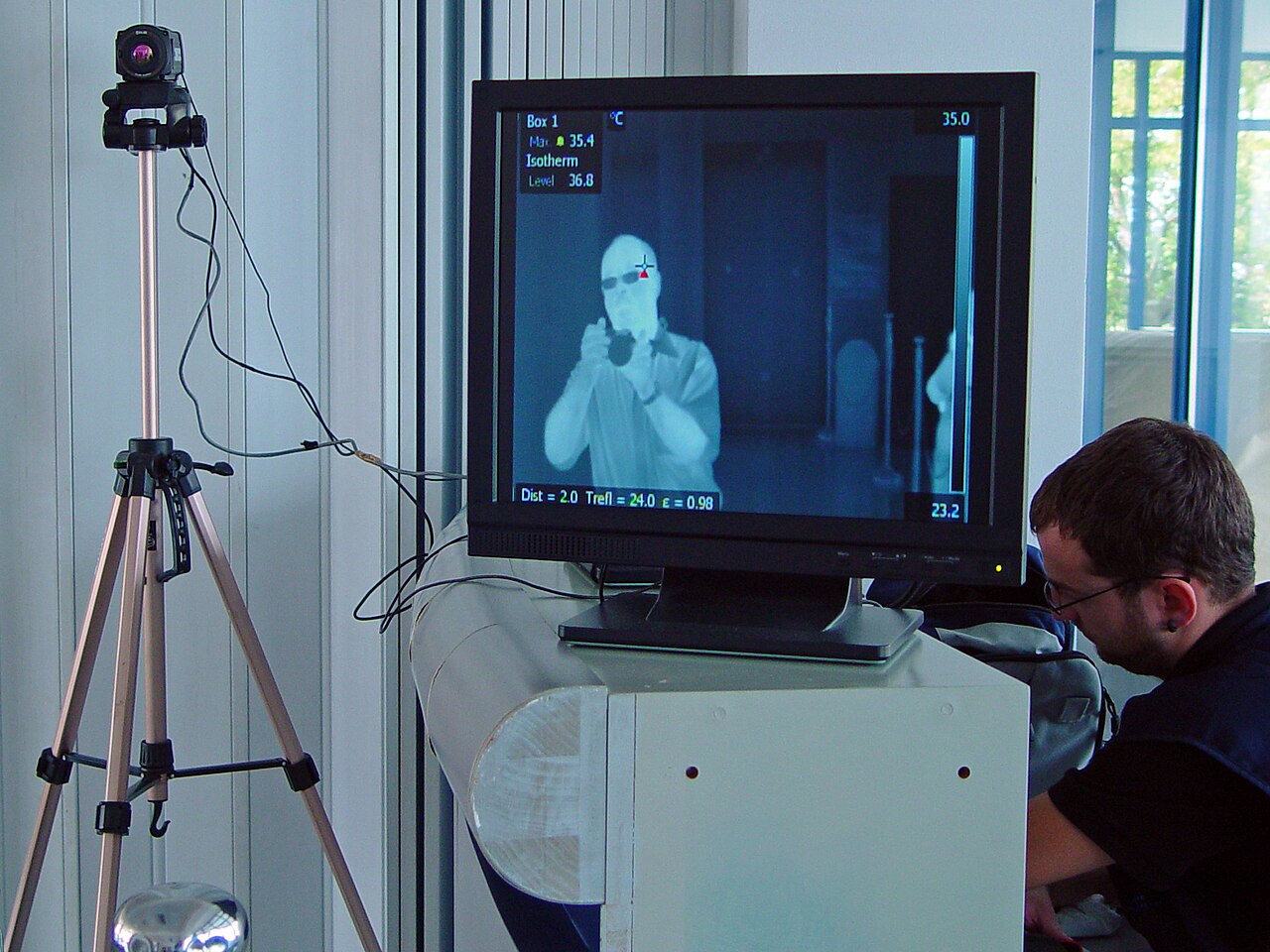
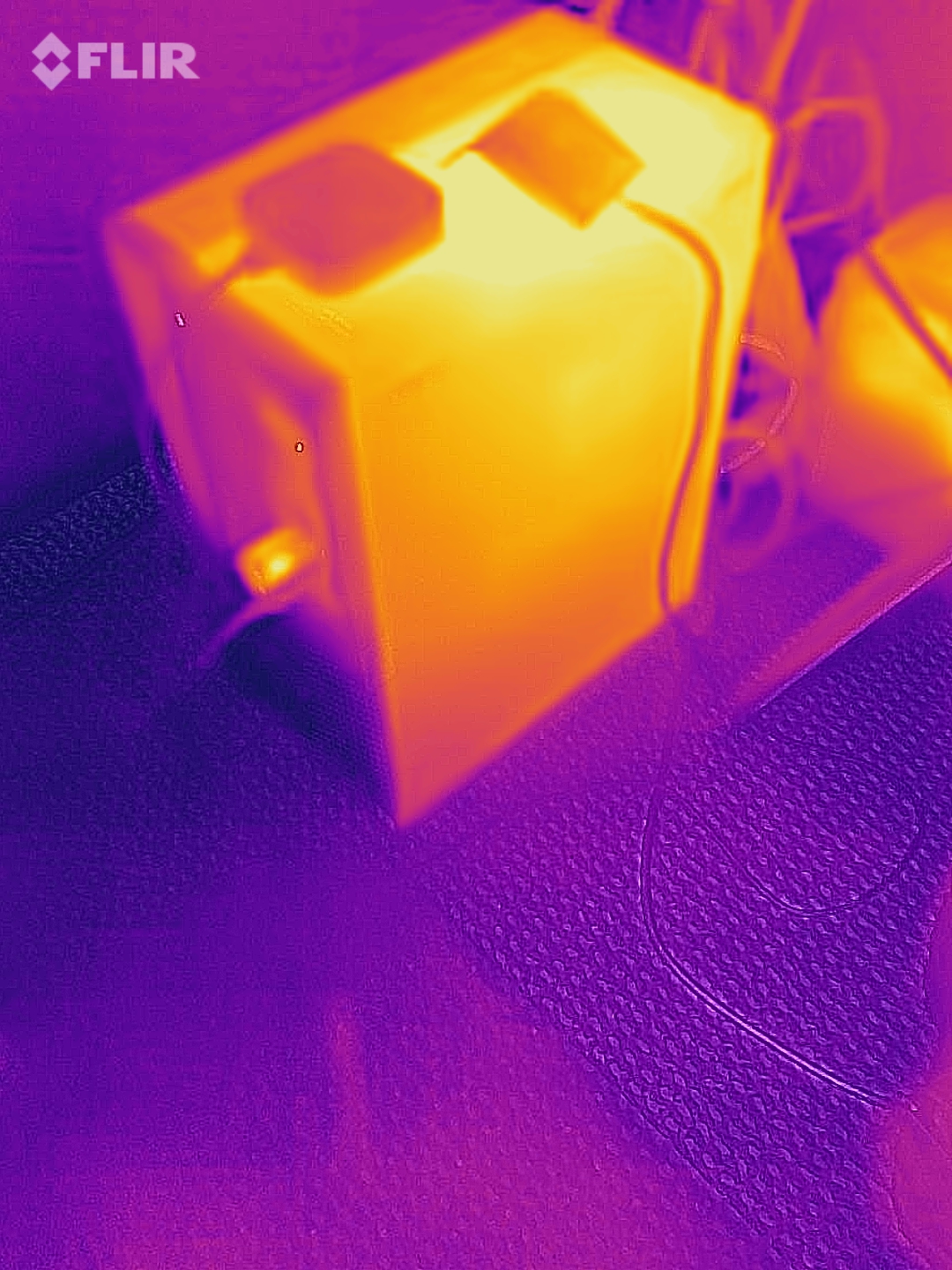
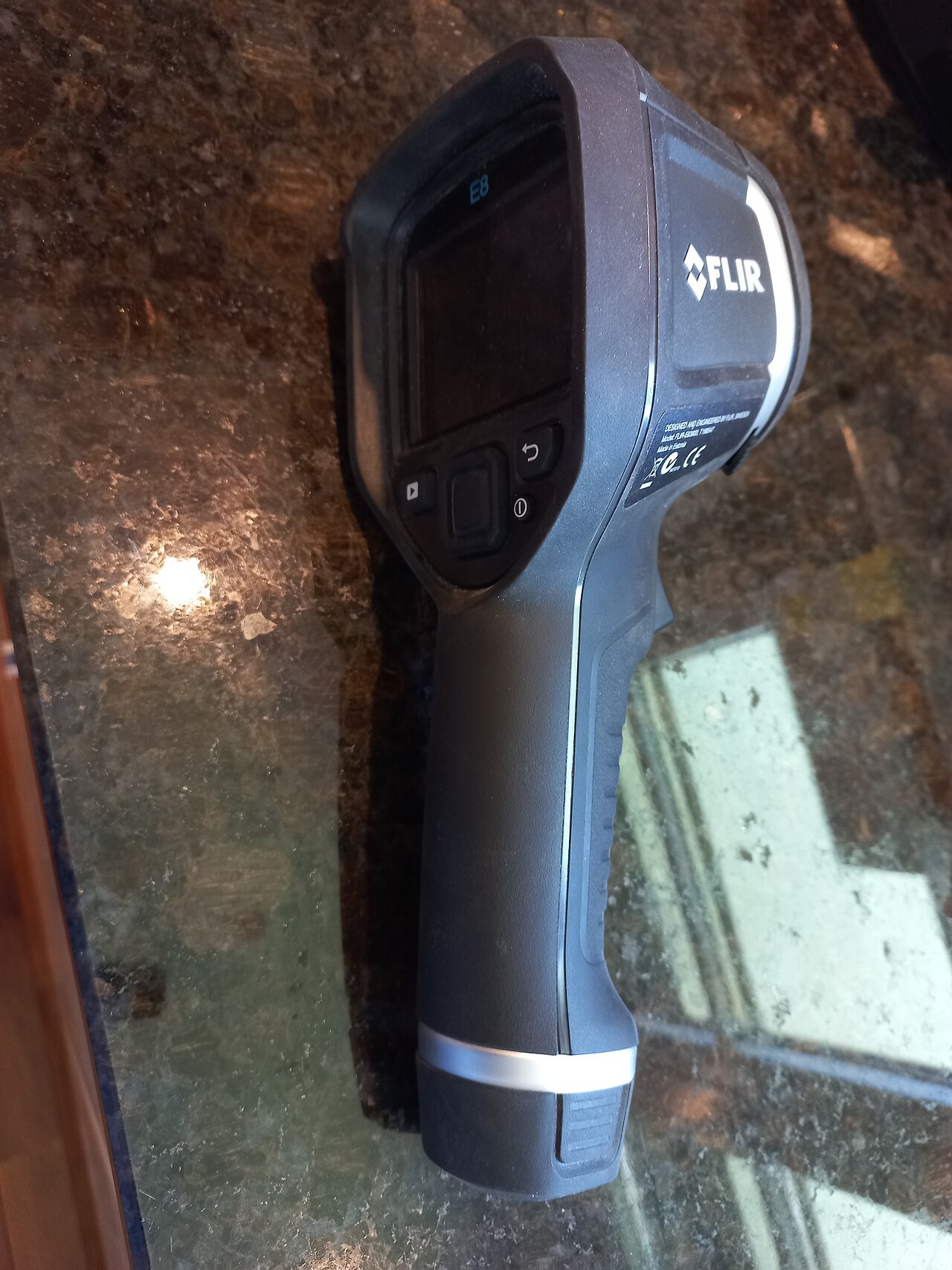
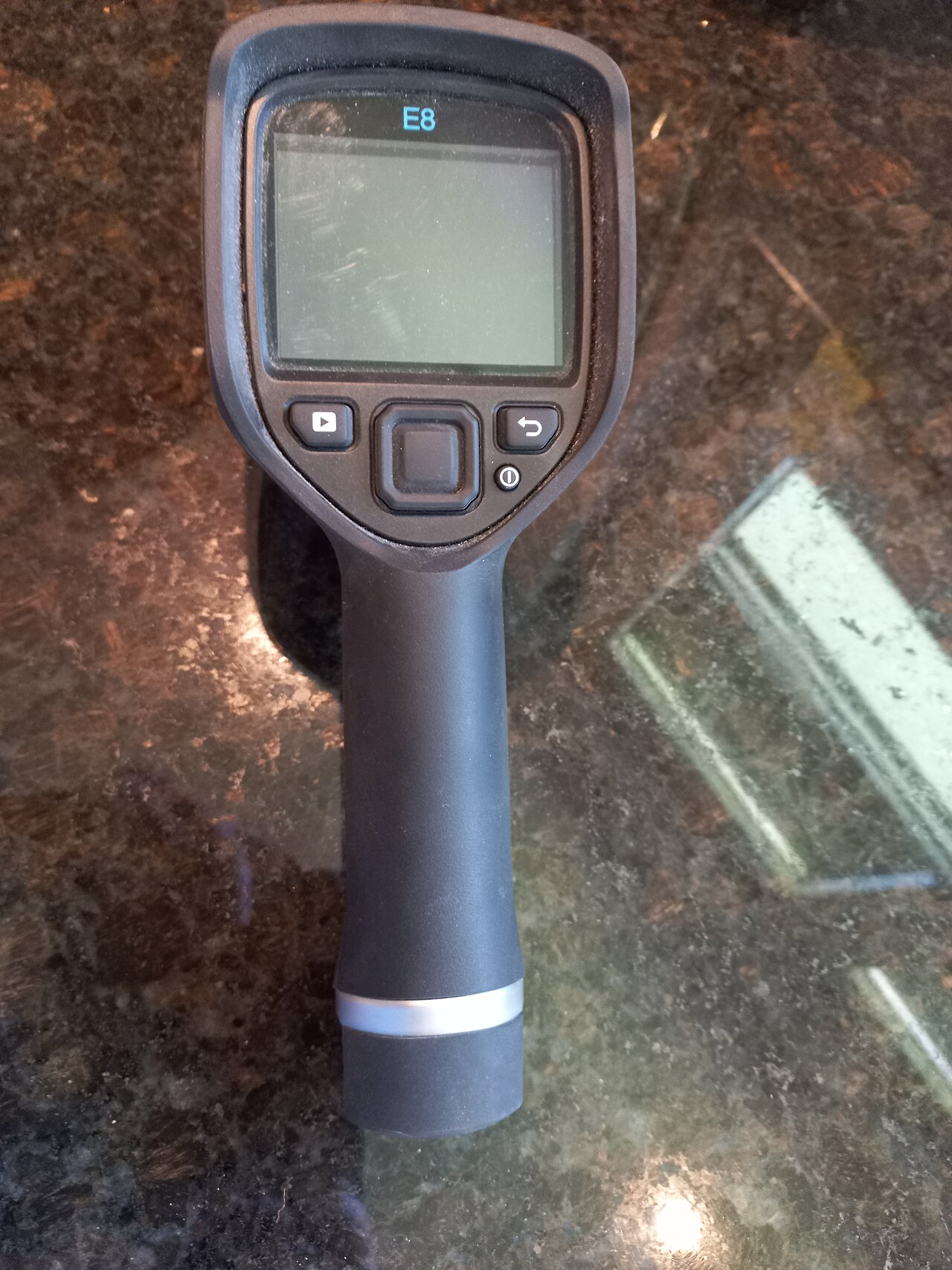
A thermographic camera, also known as a thermal imaging camera, is a device that detects infrared radiation originating from the surface of objects and produces a visible image called a thermogram. It is notable for allowing observation of temperature variations without visible illumination, making warm objects stand out against cooler backgrounds, and is used in military surveillance, firefighting, maintenance, building inspection, and clinical diagnostics.
- Common operating wavelengths
- Long-wave infrared (LWIR) 7–14 μm; mid-wave infrared (MWIR) 3–5 μm
- Typical resolution
- 160×120 or 320×240 pixels, up to 1280×1024 for most expensive models
- Common fpa sensor types
- InSb, InGaAs, HgCdTe, QWIP, and uncooled microbolometers
- Emissivity range
- 0 (completely not-emitting) to 1 (completely emitting)
- Example low emissivity
- Silver, emissivity coefficient 0.02
- Example high emissivity
- Asphalt, emissivity coefficient 0.98
Lore & Background
Thermography has a long history, but its use increased dramatically with commercial and industrial applications over the past 50 years. The appearance and operation of a modern thermographic camera is often similar to a camcorder, and the live thermogram often reveals temperature variations so clearly that a photograph is not necessary for analysis. Specialized thermal imaging cameras use focal plane arrays (FPAs) that respond to longer wavelengths, with common types including InSb, InGaAs, HgCdTe, and QWIP FPA, while newer technologies use low-cost, uncooled microbolometers as FPA sensors.
Thermal imaging cameras are much more expensive than visible-spectrum counterparts, and higher-end models are often export-restricted due to potential military uses. Older bolometers or more sensitive models such as InSb require cryogenic cooling, usually by a miniature Stirling cycle refrigerator or with liquid nitrogen. The resolution of thermal cameras is considerably lower than that of optical cameras, mostly 160×120 or 320×240 pixels, and up to 1280×1024 for the most expensive models.
The thermogram is a visual display of total infrared energy emitted, transmitted, and reflected by an object. The camera uses processing algorithms to reconstruct a temperature image, but because there are multiple sources of infrared energy, it is sometimes difficult to get an accurate temperature. The incident radiant power equals the sum of emitted, transmitted, and reflected radiant power, and this phenomenon occurs everywhere all the time as radiant heat exchange.
Reader's Guide
The significance of the thermographic camera lies in its ability to make temperature variations visible, enabling a wide range of practical applications. Firefighters use it to see through smoke, find persons, and locate the base of a fire. Maintenance technicians locate overheating joints and sections of power lines, which are signs of impending failure. Building construction technicians detect heat leaks in faulty thermal insulation, improving the efficiency of heating and air-conditioning units. In clinical diagnostics, it monitors physiological changes in humans and other warm-blooded animals, and has been used in allergy detection and veterinary medicine. Some alternative medicine practitioners promote its use for breast screening, despite an FDA warning that those who opt for this method instead of mammography may miss the chance to detect cancer at its earliest stage. Government and airport personnel used thermography to detect suspected swine flu cases during the 2009 pandemic. The camera's radiometric processing converts detected infrared radiation into estimates of surface temperature, but accuracy is limited by factors such as emissivity, reflected radiation, and atmospheric effects. For non-contact temperature measurement, the emissivity setting must be properly set, and a thermographer may refer to an emissivity table or apply a standard material of known high emissivity for more accurate readings.
Did You Know?
- Thermal cameras most commonly operate in the long-wave infrared (LWIR) range of 7–14 μm.
- The resolution of thermal imaging cameras is considerably lower than optical cameras, typically 160×120 or 320×240 pixels.
- Silver has a very low emissivity coefficient of 0.02, while asphalt has a high emissivity coefficient of 0.98.
The Wood Effect and Visual Signatures
The most immediately striking quality of infrared photography is what practitioners call the Wood effect — a dreamlike, sometimes almost lurid rendering of the natural world that has no parallel in visible-light imaging. The phenomenon is driven primarily by the way vegetation, from grass blades to broad tree canopies, reflects near-infrared radiation with an intensity comparable to the way fresh snow bounces back visible light. A minor contribution comes from chlorophyll fluorescence, but that is marginal and not the true source of the brilliant brightness seen in these exposures. The effect is named for Robert W. Wood, the pioneer who first documented it, and has nothing to do with the material wood, which does not reflect infrared strongly. Beyond foliage, the 700-to-900-nanometer window produces skies that render almost black because Rayleigh scattering is greatly reduced at these wavelengths. Atmospheric haze is penetrated more easily as well, owing to diminished Mie scattering. Shadows receive less infrared illumination, water surfaces mirror those dark skies, and clouds pop with unusual contrast. When pointed at a human face, the radiation penetrates a few millimeters into skin, lending portraits a soft, milky quality while eyes often appear as solid black voids.
From Scientific Curiosity to Commercial Art
For most of the nineteenth century, capturing infrared images was simply impossible. Standard silver halide emulsions responded only to blue and, to a lesser degree, green light, and any sensitivity beyond that required a dye to act as a color sensitizer. That barrier finally fell in the first decade of the 1900s. Robert W. Wood produced the first published infrared photographs, appearing in The Century Magazine in February 1910 and the Royal Photographic Society Journal in October of that year. Because the experimental plates demanded very long exposures, his subjects were almost entirely landscapes. In 1911 he shot a further series in Italy using plates supplied by C. E. K. Mees of Wratten & Wainwright; Mees himself captured a small set in Portugal in 1910, now preserved in the Kodak archives. During World War I, American laboratories developed infrared-sensitive plates for spectroscopic analysis and explored sensitizing dyes to improve haze penetration in aerial reconnaissance. After 1930, new emulsions from Kodak and other manufacturers opened the door to infrared astronomy. By the mid-1930s the medium had gone commercial: The Times ran staff-photographer landscapes on Ilford infrared film, and by 1937 five manufacturers, including Agfa, Kodak, and Ilford, offered thirty-three distinct infrared films.
Filters, Spectrum, and the Mechanics of Seeing
Infrared light sits between the visible and microwave portions of the electromagnetic spectrum, spanning a wide range of wavelengths just as visible light stretches from red to violet. Near-infrared radiation, the band relevant to photography, runs from roughly 700 to 5000 nanometers, while far-infrared — the territory of thermal imaging — extends from about 25 to 350 micrometers. Far-infrared wavelengths are approximately the size of a pinhead; near-infrared wavelengths are on the order of cells. Historically, black-and-white infrared films were sensitive to near-infrared wavelengths shorter than about 860 nanometers but also retained significant sensitivity to blue light. Without a corrective filter, that blue response lowers contrast and effectively cancels the distinctive infrared look, making the negative resemble a conventional one. An infrared-passing filter is therefore essential: it lets infrared through while blocking most visible light, and these filters typically appear black or deep red to the eye. The Wratten #25 red filter is often recommended as the best compromise, removing blue while still passing enough visible light for focusing. Orange filters such as Wratten #15 or #21 allow a slight amount of blue to reach the film, softening contrast, while very dark-red #29 or visually opaque #72, #70, #89b, and #87c filters block all blue and even visible red, yielding a purer infrared image with more pronounced contrast. Some manufacturers now embed the transition wavelength directly into the filter specification rather than relying on the traditional Wratten numbering.
From Camouflage Detection to Psychedelic Album Covers
The practical and artistic applications of infrared film have spanned a remarkable range. During the 1940s, Clark and colleagues at Kodak developed the first version of what would become Ektachrome Infrared Aero Film, originally called Kodacolor Aero-Reversal-Film, specifically for camouflage detection. The EIR variant later became available in 35 mm format in the 1960s before eventually being discontinued. In cinema, infrared movie film was used to create day-for-night effects; a notable example is the pseudo-night aerial sequences in The Bride Came C.O.D., starring James Cagney and Bette Davis. The medium also found a passionate audience in the world of music. During the 1960s, artists including Jimi Hendrix, Donovan, Frank Zappa, and the Grateful Dead all released albums featuring infrared cover photography. The unexpected colors and surreal effects that infrared film produces aligned naturally with the psychedelic aesthetic emerging at the time, making the medium a visual shorthand for a generation's creative experimentation. The Royal Photographic Society marked the centenary of Wood's pioneering 1910 publications with a dedicated celebration in 2010, underscoring how a scientific curiosity had grown into a versatile tool spanning military technology, cinema, astronomy, and popular culture.
Gallery
Frequently Asked Questions
What is a thermographic camera?
A thermographic camera is an instrument that captures infrared radiation emitted by object surfaces and converts it into a visible picture called a thermogram. It lets you see temperature differences without any visible light, so warmer areas pop out against cooler surroundings.
What infrared wavelengths do thermographic cameras detect?
Most units operate in the long-wave infrared band (7–14 μm) or the mid-wave infrared band (3–5 μm). These two ranges cover the bulk of thermal radiation emitted by objects at everyday temperatures.
What kinds of focal-plane-array sensors are used in thermographic cameras?
Common FPA sensor materials include InSb, InGaAs, HgCdTe, QWIP, and uncooled microbolometers. The choice of material largely determines the operating temperature range and overall cost of the camera.
How does emissivity influence what a thermographic camera shows?
Emissivity scales from 0 (a perfect reflector that emits nothing) to 1 (a perfect emitter), and it directly affects the temperature a camera reads. For instance, polished silver has an emissivity of only 0.02, while asphalt sits near 0.98, so the same surface temperature will look very different on the thermogram.
What pixel resolution is typical for a thermographic camera?
Entry-level models often deliver 160×120 or 320×240 pixels, while the most expensive units reach up to 1280×1024. Higher resolution gives finer detail in the thermogram but comes at a significantly higher price.
More in Astrophotography, Part 2 1-24
Spotted an error? Know more?
Reader corrections go straight into our review queue. Suggest an edit · How this site is sourced