Spectro-Polarimetric High-Contrast Exoplanet Research
Direct imaging facility for exoplanets at the Very Large Telescope.

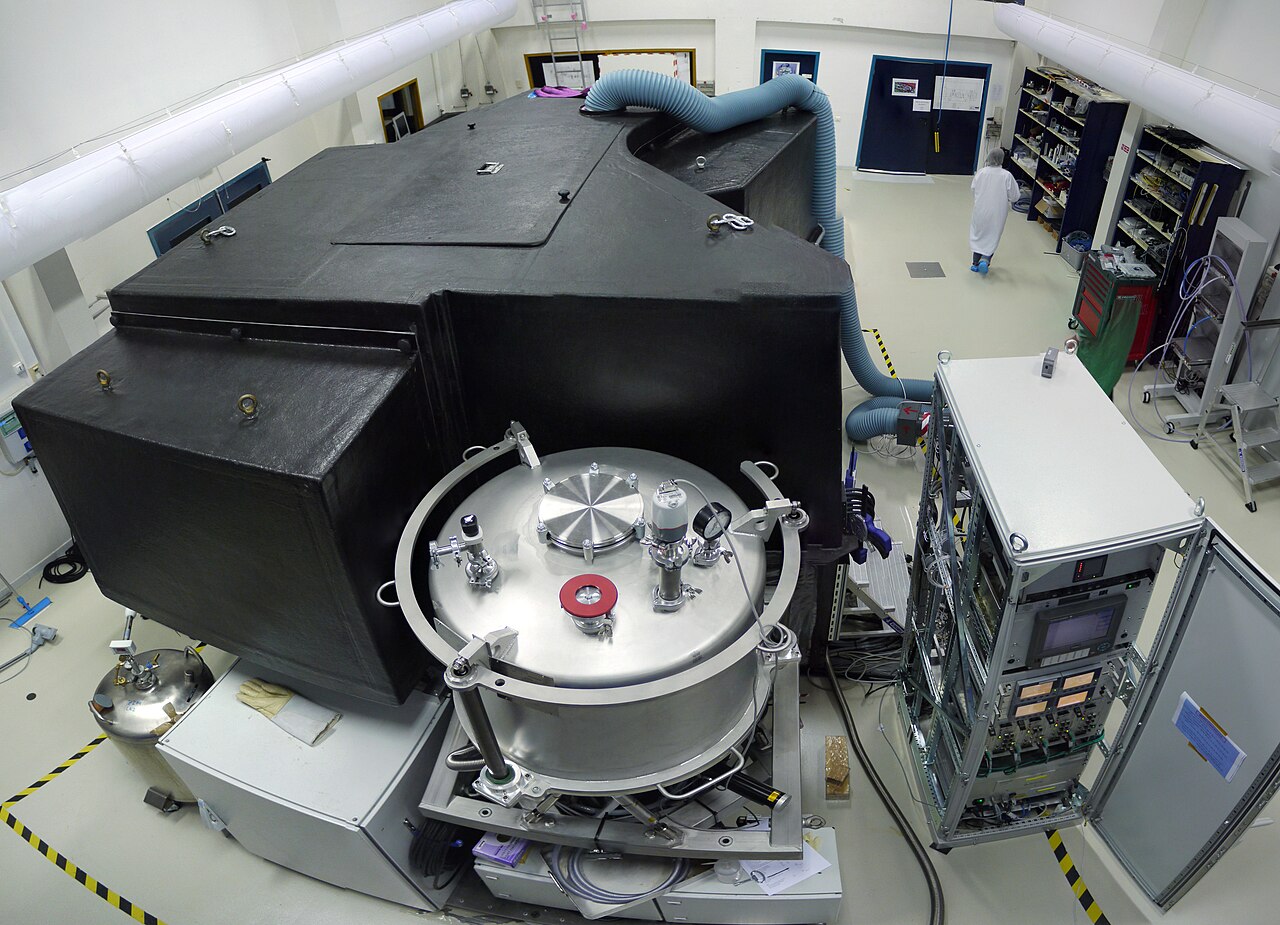
SPHERE Project/ESO/J.-L. Beuzit and J.-F. Sauvage. · CC BY 4.0
The Spectro-Polarimetric High-contrast Exoplanet REsearch (SPHERE) is an adaptive optics system and coronagraphic facility at the Very Large Telescope (VLT). It provides direct imaging as well as spectroscopic and polarimetric characterization of exoplanet systems, operating in the visible and near infrared to achieve exquisite image quality and contrast over a small field of view around bright targets. SPHERE is notable as a second-generation instrument that combines extreme adaptive optics with high-efficiency coronagraphs and differential imaging to directly detect and study exoplanets.
- First light
- May 2014
- Telescope
- Very Large Telescope (VLT) Unit Telescope 3 (Melipal)
- Adaptive optics correction rate
- 1380 times per second
- Ifs field of view
- 1.73" x 1.73"
- Irdis field of view
- 11" x 12.5"
- Zimpol resolution
- <30 mas
Lore & Background
SPHERE was installed on Unit Telescope 'Melipal' (UT3) and achieved first light in May 2014, at the time the latest of a series of second-generation VLT instruments such as X-shooter, KMOS, and MUSE. The instrument comprises three sub-instruments: the Integral Field Spectrograph (IFS), the Infrared Dual-band Imager and Spectrograph (IRDIS), and the Zurich Imaging Polarimeter (ZIMPOL), all fed by the Common Path and Infrastructure (CPI) which includes the SAXO adaptive optics system. SPHERE is targeted toward direct detection of Jupiter-sized and larger planets separated from their host stars by 5 AU or more, focusing on nearby young stellar associations, stars with known planets, the nearest stars, and stars aged 100 Myr to 1 Gyr.
Reader's Guide
SPHERE's significance lies in its ability to directly image exoplanets, a challenging task due to the extreme brightness contrast between a planet and its host star (ranging from 10⁻⁶ for hot young giants to 10⁻⁹ for rocky planets) and the small angular separations involved. The instrument complements results from other planet-finder projects such as HARPS, CoRoT, and the Kepler Mission. Early results validated its power, including the detection of the planet HIP 65426 b in July 2017, the first image of the spiral protoplanetary disk in HD 100453, and the first confirmed image of a newborn planet PDS 70b in June 2018. SPHERE also directly imaged two gas giants around TYC 8998-760-1 in July 2020. Notably, a search for a brown dwarf around V471 Tauri yielded no detection, challenging the conventional explanation for the system's eclipse timing variations. Performance improvements include the HiRISE visitor instrument (implemented since July 2023) and the SPHERE+ upgrade project under active development.
Did You Know?
- SPHERE's first announced planet, HD 131399Ab in 2016, was later shown to be a background star.
- The instrument corrected for atmospheric turbulence 1380 times per second via its SAXO adaptive optics system.
- A search for a brown dwarf around V471 Tauri with SPHERE found no companion, contradicting the expected explanation for the binary's eclipse timing variations.
Gallery
Frequently Asked Questions
Who is Spectro-Polarimetric High-Contrast Exoplanet Research?
SPHERE is a second-generation adaptive optics and coronagraphic instrument mounted on the Very Large Telescope at ESO's Paranal Observatory in Chile. It was purpose-built to directly image and characterize exoplanets orbiting nearby bright stars across the visible and near-infrared spectrum.
What are SPHERE's powers and role?
SPHERE fuses extreme adaptive optics—correcting wavefront distortions up to 1,380 times per second—with high-efficiency coronagraphs and differential imaging to suppress starlight and expose faint planetary companions. It offers three principal modes: ZIMPOL for polarimetric imaging, IRDIS for wide-field infrared detection, and IFS for integral field spectroscopy.
How does SPHERE's story begin?
SPHERE achieved first light in May 2014, ushering in a new era of ground-based direct exoplanet detection. Its arrival on the VLT marked the first time a facility combined extreme adaptive optics, coronagraphy, and spectro-polarimetry into a single, integrated system.
Why is SPHERE important to the astrophotography community?
SPHERE is significant because it lets astronomers do far more than simply spot an exoplanet; it can probe the atmosphere's composition and the scattering behavior of its light. That depth of characterization from a ground-based telescope was previously unattainable and has reshaped how the community approaches high-contrast imaging.
What telescope does SPHERE call home, and how large is its field of view?
SPHERE is installed on VLT Unit Telescope 3, nicknamed Melipal, at the Paranal site in the Atacama Desert. Its IFS module covers a 1.73-arcsecond square region, IRDIS spans roughly 11 by 12.5 arcseconds, and ZIMPOL delivers resolution finer than 30 milliarcseconds.
More in Astrophotography, Part 2 1-24
Spotted an error? Know more?
Reader corrections go straight into our review queue. Suggest an edit · How this site is sourced