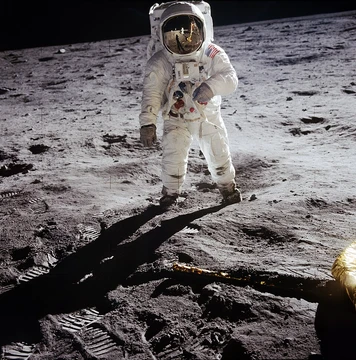
Tranquility Base
First human landing site on the Moon.

NASA Neil A. Armstrong · via Wikipedia: Tranquility Base · Public domain
Tranquility Base (also known by its Latin name, Statio Tranquillitatis) is the spot on the Moon where humans first set foot on a world other than Earth. This happened in July 1969, when NASA astronauts Neil Armstrong and Buzz Aldrin touched down in the Apollo Lunar Module *Eagle* at around 20:17:40 UTC on July 20. They landed in the southwestern part of the dark lunar plain called Mare Tranquillitatis, or the Sea of Tranquility.
The site’s name was announced by Armstrong about 18 seconds after landing, when he radioed, “Houston, Tranquility Base here. The Eagle has landed.” During training, Armstrong and Aldrin had only used the callsign “Eagle” in simulated conversations, but just before the flight they decided on “Tranquility Base” and told Capsule Communicator Charles Duke so he wouldn’t be caught off guard. The International Astronomical Union officially recognizes the name, listing it on lunar maps as Statio Tranquillitatis, following the convention of using Latin for Moon place names.
The landing site was chosen from an initial list of 30 potential spots, narrowed down to five near the lunar equator based on photos from Lunar Orbiter spacecraft and data from uncrewed Surveyor landers. These five sites were numbered 1 to 5 from east to west. Site number 2, centered at 0°42′50″N 23°42′28″E in the Sea of Tranquility, was selected. Because a precise landing wasn’t expected on the first mission, the target area was an ellipse 11.5 miles (18.5 km) east-west by 3.0 miles (4.8 km) north-south. During descent, navigation errors from residual pressure in the docking tunnel and an imperfect understanding of the Moon’s uneven gravity pushed the landing spot about 4 miles (6.4 km) west of the planned point. The automated system aimed for a crater Armstrong described as “football-field sized” with many boulders, so he took manual control and flew farther downrange. The landing still fell within the target ellipse.
Armstrong exited the spacecraft six hours and 39 minutes after touchdown, with Aldrin following 19 minutes later. They spent two hours and 31 minutes on the surface, examining and photographing the area, setting up scientific experiments, and collecting 47.5 pounds (21.5 kg) of lunar dirt and rock. They lifted off on July 21 at 17:54 UTC. About 100 artificial objects remain at the site, along with the astronauts’ footprints.
Quick Facts
- Beginning Date
- July 20, 1969
- Beginning Label
- Named and founded
- Founder
- Neil Armstrong and Buzz Aldrin
- Governing Body
- California, New Mexico
- Location
- Mare Tranquillitatis, Moon<!--
- Locmapin
- Moon Can't get template:location map to work with module:location map/data/Moon#Usage...-->
Facts from the source article.
Lore & Background
For more than two years, NASA planners considered 30 potential sites for the first crewed landing. Based on high-resolution photographs from Lunar Orbiter spacecraft and data from uncrewed Surveyor landers, the list was narrowed to five sites near the lunar equator. Site number 2, centered at 0°42′50″N 23°42′28″E, was the Sea of Tranquility site ultimately chosen. The target area was an ellipse measuring 11.5 miles east and west by 3.0 miles north and south.
On landing, navigation errors from residual pressure in the docking tunnel and an imperfect understanding of the Moon's uneven gravitational field pushed the powered descent initiation point about 3 miles downrange, and the computer-targeted landing spot about 4 miles downrange. Armstrong took manual control to avoid a crater with boulders, landing within the target ellipse. Armstrong announced the name "Tranquility Base" at 20:17:58 UTC, about 18 seconds after landing. He and Aldrin had decided on the name just before the flight, telling only Capsule Communicator Charles Duke.
Reader's Guide
Tranquility Base holds cultural and historic significance as the site of the first human landing on an extraterrestrial body. About 100 artificial objects and footprints remain at the site. The descent stage of the Lunar Module remains at the original landing point. A laser reflector was placed for precise distance measurements to the Moon; a solar-powered seismometer stopped functioning after 21 days. A disc containing Apollo 11 goodwill messages was left, along with gear such as Aldrin's boots. The U.S. states of California and New Mexico have listed it on their heritage registers due to association with their facilities. The U.S. National Park Service declined National Historic Landmark status to avoid violating the Outer Space Treaty's prohibition on sovereignty claims. UNESCO has not accepted it as a World Heritage Site because nations may only submit sites within their own borders. In 2020, the One Small Step to Protect Human Heritage in Space Act was enacted, protecting Tranquility Base and other Apollo landing sites from damage by US-licensed space activity.
Did You Know?
- Armstrong and Aldrin spent two hours and 31 minutes on the lunar surface, collecting 47.5 pounds of dirt and rock samples.
- The landing site was named by Armstrong and Aldrin just before the flight, and they only told Capsule Communicator Charles Duke.
- The International Astronomical Union officially recognizes the designation 'Tranquility Base' and lists it on lunar maps as Statio Tranquillitatis.
- The US flag planted at the site was blown over by the ascent rocket exhaust but remains on the lunar surface.
More in Apollo 11 1-24
Spotted an error? Know more?
Reader corrections go straight into our review queue. Suggest an edit · How this site is sourced