Apollo 11 anniversaries
Celebrating Apollo 11 anniversaries from 1979 to 2019

NASA · Public domain
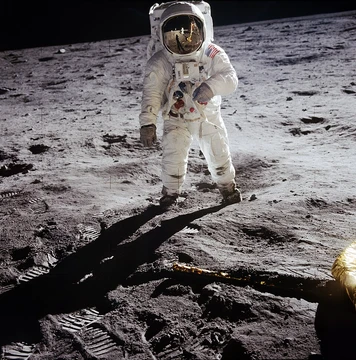
Apollo 11 was the first human spaceflight to land on the Moon. In the decades after its 1969 mission took place, widespread celebrations have been held to celebrate its anniversaries.
Quick Facts
- Genre
- anniversary
- Begins
- 16 · 7
- Ends
- 20 · 7
- Frequency
- Quinquennially
- Country
- United States
- Years Active
- 16 July 1974
- First
- 1974-07-16
- Founder Name
- NASA
Facts from the source article.
Lore & Background
The Apollo 11 crew—Buzz Aldrin, Neil Armstrong, and Michael Collins—made their first public appearance since the fifth anniversary to take part in Washington, D.C., ceremonies on July 20, 1979, marking ten years after the mission.
For the fifteenth anniversary in 1984, Kennedy Space Center hosted a model rocket launch that was not open to the public because of the explosives used.
On the twentieth anniversary in 1989, President George H. W. Bush announced the Space Exploration Initiative (SEI), a plan to return to the Moon and later go to Mars. The U.S. Postal Service issued a $2.40 priority mail stamp designed by Chris Calle, whose father, Paul Calle, had designed the 1969 Apollo 11 stamp. The stamp shows two astronauts planting a flag on the Moon; because living people cannot appear on U.S. stamps, the astronauts’ faces are hidden by their visors. It was released July 20 at the Smithsonian Air and Space Museum in Washington, D.C.
For the twenty-fifth anniversary on July 16, 1994, NASA replayed the countdown and launched scale models of the Saturn rocket. The Apollo 11 astronauts chose not to attend, having done so five years earlier. The USPS issued two stamps: a 29-cent vertical stamp showing an astronaut saluting a flag on the Moon, and a $9.95 express mail stamp with a zoomed-out version of the same scene. Paul and Chris Calle designed them, and Aldrin unveiled the design on July 20 in Washington. On July 21, the Apollo 11 crew accepted a White House invitation to celebrate, joined by President Bill Clinton, Vice President Al Gore, First Lady Hillary Clinton, and other Apollo flight crew members. PBS released the documentary *Apollo 13: To the Edge and Back*.
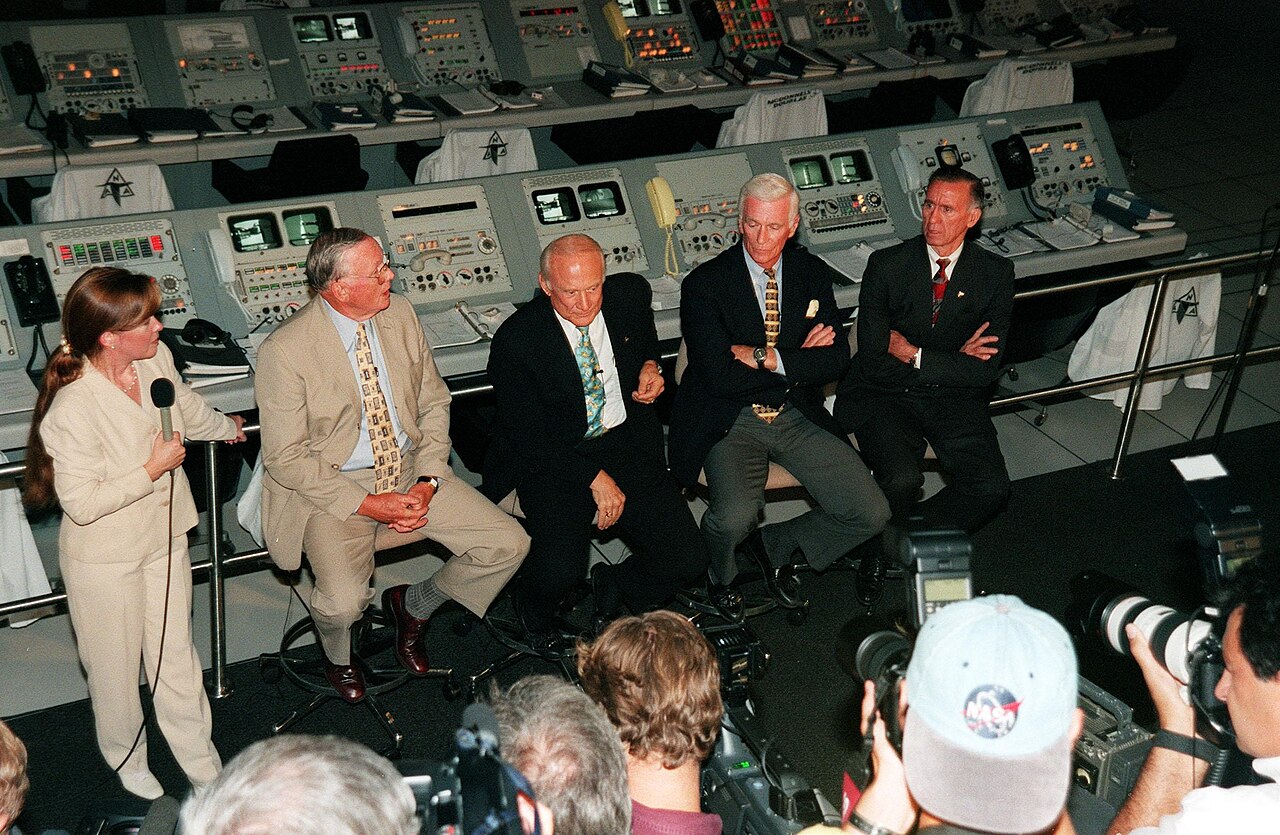
On the thirtieth anniversary in 1999, Vice President Al Gore presented the Apollo 11 astronauts with the Langley Gold Medal for aviation—only the twenty-second time it had been awarded. The ceremony took place at the National Air and Space Museum. Armstrong said, “We the Apollo 11 crew are enormously appreciative of being asked to receive this Langley Medal and we do so on behalf of all the men and women of the Apollo program.” He attended a banquet at Kennedy Space Center but refused to sign autographs or give a speech. Aldrin also attended; Collins, who was retired, did not. Aldrin held a public briefing at the center on July 17. The USPS issued a 33-cent stamp as part of a series commemorating 1960s events; titled “Man Walks on Moon” (Scott catalogue number 3188e), it depicts Aldrin’s lunar bootprint and was unveiled at Kennedy Space Center on July 17. Ground was broken there for the Apollo Exhibit in the U.S. Space Walk of Fame. The National Air and Space Museum added two exhibits: Armstrong and Aldrin’s helmets and gloves, and a camera inside the lunar module that let visitors see the cockpit for the first time. On July 21, Aldrin spoke at the unveiling of a Moon rock at the base of Chicago’s Tribune Tower—the first time NASA loaned a lunar sample to a private corporation rather than a school, museum, or planetarium. The rock was removed in 2011 due to an outdated display; a new display is planned but not yet installed. The USS Hornet held a ten-day event called Moonfest 1999, featuring NASA exhibits and evening astronomy. Aldrin and Carl Seilberlich, the Hornet’s captain during recovery operations, attended on July 24, the anniversary of the recovery day. About 17,000 visitors came.
For the fortieth anniversary, on July 15, 2009, Life.com released a photo gallery of previously unpublished images taken by Life photographer Ralph Morse before the Apollo 11 launch. From July 16 to 24, 2009, NASA streamed the original mission audio on its website in real time, synchronized to the events forty years earlier. It also began restoring video footage and released a preview of key moments. In July 2010, air-to-ground voice recordings and film footage from Mission Control during the powered descent and landing were re-synchronized and released for the first time. The John F. Kennedy Presidential Library and Museum set up an Adobe Flash website rebroadcasting Apollo 11 transmissions from launch to landing. On July 20, 2009, Armstrong, Aldrin, and Collins met President Barack Obama at the White House. Obama said, “We expect that there is, as we speak, another generation of kids out there who are looking up at the sky and are going to be the next Armstrong, Collins, and Aldrin. We want to make sure that NASA is going to be there for them when they want to take their journey.” On August 7, 2009, an act of Congress awarded the three astronauts a Congressional Gold Medal, the highest U.S. civilian award, sponsored by Florida Senator Bill Nelson and Florida Representative Alan Grayson. A group of British scientists interviewed for the anniversary reflected on the Moon landing’s significance.
On the forty-fifth anniversary, July 21, 2014, the Kennedy Space Center Operations and Checkout building was renamed for Armstrong. Aldrin and Collins attended the ceremony.
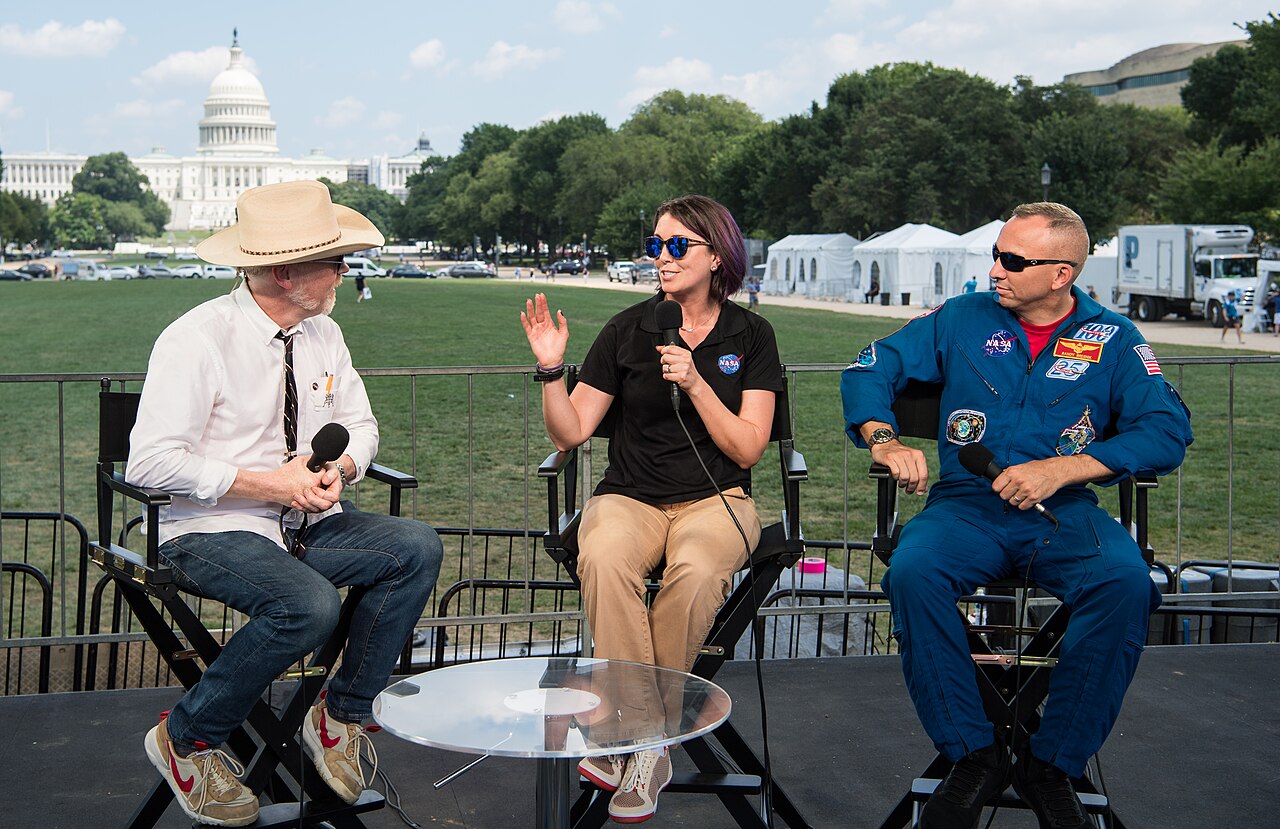
For the fiftieth anniversary, Congressman Bill Posey introduced a resolution on June 10, 2015.
Reader's Guide
The entry has been corrected to reflect that the 20th anniversary stamp shows the astronauts' faces completely obscured by their visors.
Did You Know?
- The 20th anniversary stamp was designed by Chris Calle, son of Paul Calle, who designed the 1969 Apollo 11 stamp.
- The 30th anniversary stamp, named 'Man Walks on Moon', depicts Aldrin's lunar bootprint.
- The 50th anniversary stamps include one showing Armstrong's reflection in Aldrin's visor.
- The 50th anniversary festival featured a Saturn V rocket projection on the Washington Monument.
The Archival Treasure Hunt
In late 2016, Todd Douglas Miller had just wrapped work on The Last Steps, a short documentary about Apollo 17, when British archival producer Stephen Slater pitched the idea of a companion piece timed to the 50th anniversary of the 1969 Moon landing. CNN Films joined as a partner. The project's most consequential breakthrough came in May 2017, when Miller's team, working alongside NASA and the National Archives and Records Administration, uncovered previously unreleased 70 mm film covering everything from Launch Complex 39 preparations and the Saturn V ignition to the recovery of the crew aboard the USS Hornet. To preserve the fragile reels, the crew used climate-controlled transport vans to move material to and from College Park, Maryland, and high-resolution digital scans were produced at Final Frame in New York. The team also pulled over 11,000 hours of audio, including 30-track Mission Control voice tapes. Canadian software engineer Ben Feist wrote custom tools to restore the audio fidelity, while Slater handled the painstaking synchronization of sound to silent 16 mm footage. One serendipitous find: the folk song "Mother Country" by John Stewart, audible in Lunar Module recordings, made its way into the final cut.
A Wordless Cinematic Philosophy
Miller deliberately stripped the film of every modern storytelling crutch. There is no voice-over narration, no present-day interviews, and no staged recreations. The only spoken words are those the astronauts and mission controllers uttered in 1969, preserved on tape. Where the story needed visual explanation of spacecraft components, the filmmakers turned to animated line-drawing graphics whose style was borrowed from the cel-animated sequences in Theo Kamecke's 1971 documentary Moonwalk One. Three brief biographical vignettes introduce Aldrin, Armstrong, and Collins through family photographs and period archive clips, all without a single spoken word of exposition. The soundtrack, composed by Matt Morton, was built exclusively from electronic instruments that existed in 1969, grounding the score in the era's sonic palette. The seventeen-track album was issued by Milan Records in digital, CD, and vinyl formats throughout 2019. This rigorous commitment to period authenticity meant the audience experienced the mission almost as if watching it unfold in real time, unmediated by hindsight.
From Sundance to Screens
The film had its world premiere at the Sundance Film Festival in Park City, Utah, on January 24, 2019. Neon, which had secured worldwide theatrical distribution rights in July 2018, gave it a limited U.S. IMAX release on March 1. The opening weekend pulled in $1.6 million across 120 IMAX venues, landing at 15th place. The following weekend, most IMAX screens were ceded to Captain Marvel, but the film expanded to 405 traditional theaters and still earned $1.3 million, climbing to 10th. A third weekend saw it hold at 588 theaters for $1.2 million, a mere two-percent dip. By the end of its theatrical run it had grossed $15 million. Universal Pictures handled home media, releasing digital, DVD, and Blu-ray in the U.S. on May 14, 2019, with a bonus featurette called "Apollo 11: Discovering the 65mm." In the U.K., Dogwoof and Universal brought out a 4K Ultra HD two-disc set on November 4, 2019. A 47-minute "First Steps Edition" cut was also prepared for museum IMAX screenings, featuring extended large-format sequences not in the full-length version.
Critical Acclaim and a Small Timeline Liberty
Critics responded with near-universal enthusiasm. On Rotten Tomatoes, 192 reviews yielded a 99 percent approval rating and an average score of 8.9 out of 10, with the consensus praising the film as both edifying and inspiring. At the 4th Critics' Choice Documentary Awards, the documentary swept a leading five trophies, including Best Documentary Feature. At the 72nd Primetime Creative Arts Emmy Awards, it collected three wins out of five nominations, with distinctions for editing and sound. One of those Emmy nods specifically honored Buzz Aldrin and Michael Collins for their work capturing the mission on film, a recognition that the astronauts themselves had been active participants in creating the archival record. The film's accuracy was largely faithful, though it took a small liberty with timeline: an incident on day 8 of the mission, when Collins's biomedical impedance pneumograph disconnected and he quipped, "I promise to let you know if I stop breathing," was placed during the lunar approach rather than on the return voyage.
Gallery
Frequently Asked Questions
What are Apollo 11 anniversaries?
Apollo 11 anniversaries are the recurring celebrations held each July 20 to mark the first crewed Moon landing of 1969. Since the original flight, these commemorations have taken many forms, from crew reunions to government announcements and public demonstrations.
Who reunited for the 10th anniversary of Apollo 11?
Neil Armstrong, Buzz Aldrin, and Michael Collins all appeared together in Washington, D.C., on July 20, 1979. It marked their first public event as a group since the fifth anniversary.
What happened at the 15th anniversary of Apollo 11?
A model rocket launch was staged at Kennedy Space Center to commemorate the occasion. The event was closed to the public because of the explosives involved in the demonstration.
What did the 20th anniversary of Apollo 11 lead to?
During the 1989 celebrations, President George H. W. Bush used the occasion to announce the Space Exploration Initiative. The anniversary thus became a launching pad for new government plans in space exploration.
Why do fans care about Apollo 11 anniversaries?
They mark the date humanity first set foot on another world, making them a cornerstone of spaceflight history. Each anniversary gives the fan community a chance to reflect on the crew's achievement and the broader legacy of American space exploration.
More in Apollo 11 1-24
Spotted an error? Know more?
Reader corrections go straight into our review queue. Suggest an edit · How this site is sourced