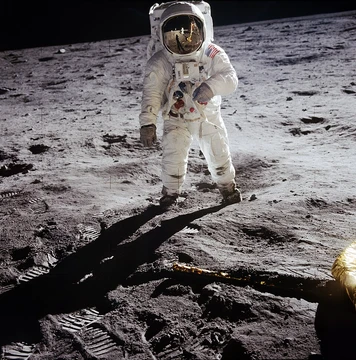
Apollo 11 lunar sample display
Plaques with Moon dust gifted by Nixon to nations and states.

Union Carbide, Nuclear Division · CC0
In 1970, President Richard Nixon gifted a commemorative plaque to 135 countries, all 50 U.S. states, U.S. territories, and the United Nations. Known as the Apollo 11 lunar sample display, each plaque is a podium-style display that holds four tiny dust particles—often called "Moon rocks"—alongside the recipient’s flag and two small metal plates engraved with descriptive messages. The plaques were produced at Nixon’s request after the Apollo 11 mission in 1969. NASA created about 250 of them. Each display contains roughly 50 milligrams of Moon dust, divided into four rice-sized grains, encased in an acrylic plastic button. The accompanying flag had been flown to the Moon and back on Apollo 11. With the exception of Venezuela, whose actual flag was not flown to the Moon on Apollo 11, the wording on the plaque (with the appropriate name filled in) was: "Presented to the people of _____ by Richard Nixon, President of the United States of America. This flag of your state was carried to the Moon and back by Apollo 11 and this fragment of the Moon's surface was brought to Earth by the crew of that first manned lunar landing."
Tracking these displays has been inconsistent. A 2012 *New York Times* report noted that NASA did not carefully monitor the gifts. In the United States, transferring public gifts requires legislation, while other countries set their own rules. Some samples from Apollo 11 and the later Apollo 17 mission (lunar basalt 70017) have been reported missing. Since 2005, efforts to locate the displays have been led by Joseph Gutheinz, a former NASA Office of Inspector General special agent and University of Phoenix professor, who assigned his online students the task of finding them. Robert Pearlman of collectSPACE has also tracked the displays.
- Field
- Space exploration memorabilia
- Known for
- Presentation plaques containing Moon dust from Apollo 11
- Number created
- About 250
- Recipients
- 135 countries (though not all were delivered or presented), 50 U.S. states, U.S. territories, and the United Nations
- Year given
- 1970
Lore & Background
At the request of President Richard Nixon, NASA had about 250 presentation plaques made following Apollo 11 in 1969. Each included about four rice-sized particles of Moon dust from the mission totaling about 50 mg. The display has an acrylic plastic button containing the Moon dust mounted with the recipient's country or state flag that had been to the Moon and back. The plaques were intended for 135 countries, though not all were actually delivered or presented; some were lost or returned. The 50 states of the United States, U.S. territories, and the United Nations also received them. The plaques were given as gifts by Nixon in 1970. With the exception of Venezuela, whose actual flag was not flown to the Moon on Apollo 11, the wording on the plaque (with the appropriate name filled in) was: 'Presented to the people of _____ by Richard Nixon, President of the United States of America. This flag of your state was carried to the Moon and back by Apollo 11 and this fragment of the Moon's surface was brought to Earth by the crew of that first manned lunar landing.'
Reader's Guide
The Apollo 11 lunar sample display represents a unique diplomatic gesture following the first manned lunar landing. The New York Times reported in 2012 that gifts of moon rocks were not well tracked or managed by NASA. Within the US, public gifts require legislation to be transferred, but other nations set their own laws. Some samples of lunar dust soil from the Apollo 11 and lunar basalt 70017 from the later Apollo 17 missions have been reported missing. Since 2005 entities and people have made concerted efforts to find the displays. Joseph Gutheinz, a former NASA Office of Inspector General special agent and a professor who teaches an online course at the University of Phoenix, had his students try to locate the displays. Robert Pearlman of collectSPACE has also tracked the displays. The fate of many plaques remains uncertain, with some lost or stolen, highlighting challenges in tracking such gifts.
Did You Know?
- Each plaque contained about four rice-sized particles of Moon dust totaling about 50 mg.
- The plaques were given as gifts in 1970 by President Richard Nixon to 135 countries (though not all were delivered), the 50 states, U.S. territories, and the United Nations.
- Since 2005, efforts have been made to locate missing displays.
From Grumman's Shop to the Most Reliable Stage
The Lunar Module's journey from design to flight was far from smooth. Grumman oversaw the program, yet the project suffered significant setbacks that pushed the first uncrewed test roughly ten months behind schedule and the first crewed mission about three months late. Despite those early struggles, the vehicle ultimately earned a reputation as the single most dependable element of the entire Apollo–Saturn stack. The price of that reliability was enormous: when adjusted to 2016 dollars through NASA's New Start Inflation Indices, the full development and production bill climbed to approximately $21.65 billion, up from a nominal $2.29 billion at the time. Structurally, the two-stage craft was designed purely for the vacuum of space—it could never have generated lift in Earth's atmosphere. It rode to lunar orbit attached beneath the command and service module, a vehicle roughly twice its own mass, before its two-person crew took over the final leg to the surface. To this day, no other crewed vehicle has ever touched down beyond our planet.
The Descent: From Orbit to Touchdown
Once in lunar parking orbit, the commander and module pilot climbed into the lander, powered up its systems, replaced docking hardware, and unfolded the landing legs before separating from the command module. The commander handled flight controls and engine throttle while the pilot monitored other systems and relayed navigational data. A thirty-second burn lowered the orbit's lowest point to roughly fifty thousand feet, about 480 km uprange of the target. As the craft neared that low point, the descent engine reignited and the crew, lying on their backs, let the onboard computer manage velocity through engine throttling and attitude thrusters guided by landing radar. The vehicle slowed from ten thousand feet to seven hundred, then pitched into a near-vertical attitude so the astronauts could see the ground ahead. At two thousand feet uprange, manual control transferred to the commander, who carried enough fuel to hover for up to two minutes. An abort remained possible at nearly any moment by jettisoning the descent stage and firing the ascent engine. On touchdown, one or more of three probes extending from the footpads bent up to a full half-turn or snapped off, triggering the contact light that signaled the commander to cut the engine.
Ten Modules, Six Landings, One Lifeboat
Ten Lunar Modules were launched into space over the course of the program, and six of them carried human crews to the Moon's surface between 1969 and 1972. Before any actual landing, the vehicle underwent a careful testing sequence. Apollo 5 flew the first uncrewed demonstration in low Earth orbit, followed by Apollo 9, which added a crew to verify the same maneuvers with people aboard. Apollo 10 then pushed the rehearsal further, flying the lander through low lunar orbit in a full dress rehearsal for the landing that Apollo 11 would execute just weeks later. Perhaps the most dramatic role any Lunar Module ever played came on Apollo 13. When an oxygen tank in the command and service module exploded en route to the Moon, disabling the primary spacecraft, the crew retreated into the Lunar Module. There it served as a lifeboat, providing the life support and propulsion needed to bring three astronauts safely home—a function it was never designed to perform.
Where the Stages Ended Up
The fates of the ten Lunar Modules diverge sharply depending on whether they ever touched the Moon. The six descent stages that carried crews to the surface still sit at their respective landing sites, frozen in the airless vacuum where they first made contact. Their paired ascent stages, after lifting the astronauts back to the command module, were deliberately crashed into the lunar surface. Apollo 10's ascent stage, nicknamed Snoopy, took a different path: after its descent stage was jettisoned in lunar orbit, the upper stage was discarded into a heliocentric orbit around the Sun. The remaining three modules—those from Apollo 5, Apollo 9, and Apollo 13—were destroyed during controlled re-entries into Earth's atmosphere. The four individual stages from the first two test flights each re-entered separately, while Apollo 13's Aquarius, having served as the crew's lifeboat, came back as a single intact unit before being destroyed in the same manner.
Gallery
Frequently Asked Questions
What is the Apollo 11 lunar sample display?
It is a small podium-style plaque that NASA produced in 1970 at President Nixon's request to commemorate the 1969 Moon landing. Each unit holds four tiny grains of lunar dust, the recipient's flag, and two engraved metal plates with descriptive text.
How many Apollo 11 lunar sample display plaques were made?
NASA manufactured roughly 250 of these commemorative plaques. They were intended as one-of-a-kind diplomatic gifts tied to the first crewed lunar mission.
Who received the Apollo 11 lunar sample display plaques?
The plaques were gifted to 135 foreign nations, all 50 U.S. states, U.S. territories, and the United Nations. In practice, not every plaque was actually delivered or formally presented to its intended recipient.
How much Moon dust is actually in an Apollo 11 lunar sample display?
Each plaque contains approximately 50 milligrams of lunar regolith, divided into four rice-grain-sized particles. The public often calls them "Moon rocks," but they are technically just fine dust rather than solid rock fragments.
Why did Nixon give the Apollo 11 lunar sample displays?
Nixon commissioned them as a diplomatic gesture to share the tangible achievement of the first crewed Moon landing with governments around the world. Distributed in 1970, the plaques served as a physical symbol of the mission's success and a token of international goodwill.
More in Apollo 11 1-24
Spotted an error? Know more?
Reader corrections go straight into our review queue. Suggest an edit · How this site is sourced