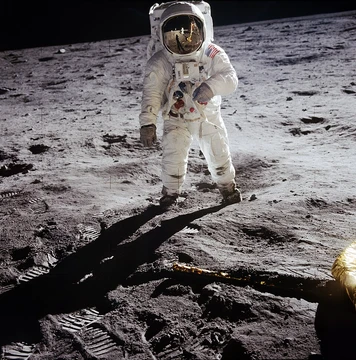
Carrying the Fire
Autobiography of Apollo 11 astronaut Michael Collins.

Kadir2023 · CC BY-SA 4.0
Michael Collins, the astronaut who flew on Gemini 10 and served as the command module pilot for Apollo 11, wrote his autobiography *Carrying the Fire: An Astronaut's Journeys*. First published in 1974, the book includes a foreword by famed aviator Charles Lindbergh, who died that same year. It was re-released in 2009 for the 40th anniversary of the first Moon landing, and again in 2019 for its 50th anniversary.
The narrative traces Collins’s career as a U.S. Air Force test pilot, his selection as an astronaut, his spacewalks during Gemini 10, and his historic flight on Apollo 11. He offers frank assessments of his fellow astronauts, calling Neil Armstrong "the best choice to be the first man on the moon" and describing Buzz Aldrin as someone who "would make a champion chess player; always thinks several moves ahead."
Collins originally planned to title the book *World in my Window*, but decided that was "too corny." After consulting with his editor, he settled on three words to capture spaceflight: *Carrying the Fire*. The book also discusses the selection of the first Moonwalker and the tension that decision created.
Critics praised the work. In *Time* magazine, Robert Sherrod called it "the best-written book yet by any of the astronauts." Collins wrote without a ghostwriter, arguing that "No matter how good the ghost, I am convinced that a book loses realism when an interpreter stands between the storyteller and his audience." He later wrote other books, including *Flying to the Moon and Other Strange Places* (1976), *Liftoff: The Story of America's Adventure in Space* (1988), and *Mission to Mars* (1990).
Related works include the 2005 biography *First Man: The Life of Neil A. Armstrong*, the 1994 book *A Man on the Moon: The Voyages of the Apollo Astronauts*, and the 2019 book *One Giant Leap*.
Quick Facts
- Author
- Michael Collins
- Language
- English
- Subject
- Autobiography · Science
- Pages
- 478
- Isbn
- 0-8154-1028-X
- Dewey
- 629.45/0092 B 21
- Congress
- TL789.85.C65 A3 1998
- Oclc
- 897906
- Followed By
- Flying to the Moon and Other Strange Places
- Published
- 1974 (Cooper Square Press) · 2009 (Farrar, Straus & Giroux · 2019 (Farrar, Straus & Giroux; Pan)
Facts from the source article.
Lore & Background
The book covers Collins's life as a test pilot in the United States Air Force; his selection as an astronaut and his spacewalks on Gemini 10 and historic flight as the command module pilot on Apollo 11. Collins presents some candid insights into his astronaut colleagues, including Neil Armstrong and Buzz Aldrin. Collins discusses the selection of the first person to walk on the Moon, and the resulting tension that arose from it.
Reader's Guide
Carrying the Fire is considered a significant work because it offers a firsthand account of the Apollo 11 mission from the astronaut who remained in lunar orbit. Collins wrote the book without ghost writers, stating that 'No matter how good the ghost, I am convinced that a book loses realism when an interpreter stands between the storyteller and his audience.' The book was re-released in 2009 to coincide with the 40th anniversary of the first crewed lunar landing, and again for its 50th anniversary in 2019. Its candid portrayal of fellow astronauts and the tensions surrounding the selection of the first moonwalker provides a unique historical perspective.
Did You Know?
- Collins originally wanted to title the book World in my Window but decided it was 'too corny'.
- The title Carrying the Fire was chosen after Collins and his editor decided to use three words to describe spaceflight.
- The book includes a foreword by aviator Charles Lindbergh, who died in 1974.
- Collins wrote the book without assistance from ghost writers.
The Mission and the Tragedy
Originally designated AS-204, Apollo 1 was conceived as the inaugural crewed flight of America's program to put a human being on the Moon. The mission was slated for February 21, 1967, and would have served as the first low Earth orbital test of the Apollo command and service module, launched atop a Saturn IB rocket. The spacecraft, built by North American Aviation, was a Block I configuration designed before the lunar orbit rendezvous strategy was finalized, meaning it carried no docking capability for a lunar module. The flight was expected to last anywhere up to two weeks, testing launch operations, ground tracking, and the full Apollo-Saturn assembly. On January 27, 1967, during a launch rehearsal at Cape Kennedy Air Force Station Launch Complex 34, a cabin fire erupted and killed all three astronauts—Command Pilot Gus Grissom, Senior Pilot Ed White, and Pilot Roger B. Chaffee—while destroying the command module. The crew's own chosen name, Apollo 1, was made official by NASA as a tribute to the men who perished.
The Investigation and Political Storm
In the immediate aftermath of the January 27 fire, NASA assembled an Accident Review Board to identify the cause, while both the House and Senate launched their own committee inquiries to oversee the agency's work. The board concluded that an electrical fault had ignited the blaze, which then raced through the cabin because of abundant combustible nylon material and the fact that the interior was pressurized with pure oxygen at high pressure. Rescue efforts were thwarted by the plug-door hatch, which the crew could not unseal against the internal pressure. Because the Saturn IB rocket had not been fueled for the rehearsal, the test had not been treated as a high-risk event, and emergency preparedness was correspondingly thin. The congressional proceedings took a dramatic turn when Senator Walter Mondale publicly surfaced an internal NASA document—the so-called Phillips Report—that flagged quality-control problems at prime contractor North American Aviation. The disclosure embarrassed Administrator James E. Webb, who had not known the document existed, and drew public controversy onto the program. Nevertheless, both congressional committees ultimately determined that the concerns raised in the report had no bearing on the accident itself.
Crew Selection and Mission Architecture
Director of Flight Crew Operations Deke Slayton named the first Apollo crew in January 1966, pairing veteran Command Pilot Grissom with Senior Pilot White and rookie Donn F. Eisele. However, Eisele suffered two shoulder dislocations aboard the KC-135 weightlessness training aircraft and required surgery on January 27, prompting Slayton to slot in Chaffee. NASA formally announced the trio on March 21, 1966, with James McDivitt, David Scott, and Russell Schweickart designated as the backup crew. The spacecraft itself, CSM number 012, was a Block I design that predated the lunar orbit rendezvous approach, so it could not dock with a lunar module; that capability would arrive with the Block II configuration. In October 1966, NASA confirmed the flight would carry a small television camera to broadcast live from the cabin and let ground controllers monitor the instrument panel. The crew also designed their own mission insignia in June 1966, depicting the CSM flying over the southeastern United States with the Moon visible in the distance, rendered in artwork by North American Aviation employee Allen Stevens.
The Long Road Back to Flight
Crewed Apollo operations were grounded for twenty months while engineers addressed the hazards that had contributed to the fire. During that interval, development and uncrewed testing of both the lunar module and the Saturn V rocket pressed forward on schedule. The very Saturn IB vehicle that had been assigned to AS-204 was repurposed for Apollo 5, the first test flight of the lunar module. The broader flight sequence that had been planned—AS-205 as a second Block I crewed mission, AS-206 as an uncrewed LM test, and AS-278 as a dual launch to achieve the first crewed Block II rendezvous and docking—was reshaped by the lessons of the tragedy. Block II incorporated the safety improvements learned from Block I and was designed to work with the lunar module once it was flight-ready. When crewed flights finally resumed, the first successful mission was Apollo 7 in October 1968, piloted by the very backup crew—McDivitt, Scott, and Schweickart—that had stood behind Grissom, White, and Chaffee.
Gallery



Frequently Asked Questions
Who wrote Carrying the Fire?
Michael Collins, the command module pilot on Apollo 11 and a veteran of Gemini 10, authored this autobiography. It stands as the only first-person narrative from the three astronauts who flew that mission.
What does Carrying the Fire cover?
The book follows Collins's path from U.S. Air Force test pilot to NASA astronaut, detailing his Gemini 10 spacewalks and his solitary orbit of the Moon during Apollo 11. It was originally published in 1974.
Who wrote the foreword to Carrying the Fire?
Legendary aviator Charles Lindbergh penned the foreword for the 1974 original edition. Lindbergh passed away later that same year.
Has Carrying the Fire been reprinted since 1974?
Yes, the book received a new edition in 2009 to coincide with the 40th anniversary of the first Moon landing, and another in 2019 for the 50th anniversary.
Why is Carrying the Fire significant to Apollo 11 fans?
Because Collins spent the lunar module descent alone in the command module orbiting the Moon, his account gives a perspective neither Armstrong nor Aldrin could offer. It remains the definitive personal look at that isolated, historic watch.
More in Apollo 11 1-24
Spotted an error? Know more?
Reader corrections go straight into our review queue. Suggest an edit · How this site is sourced