1969 (TV series)
Documentary series on major events of 1969.

Bull-Doser · Public domain
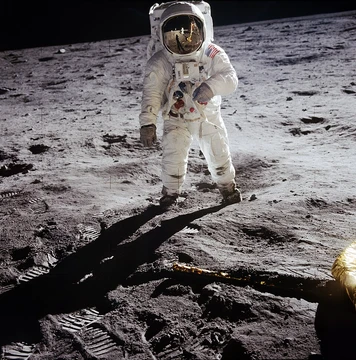
1969 is a six-episode American television documentary series that aired on ABC in 2019. It explores the untold stories behind key events of 1969, such as the Apollo 11 Moon landing and the Woodstock festival, through interviews with people who were directly involved.
The series received mixed reviews. Verne Gay of Newsday described the Apollo 11 episode as a necessary reminder of the many people who made the event possible, praising its effort to highlight women’s contributions—a gap often left by other accounts, made more apparent by the 2016 book and film *Hidden Figures*. However, he noted that a later episode on the Chappaquiddick incident was a letdown. A review in Vox examined the episode about the Manson family women through a #MeToo lens, observing that a counter-narrative has emerged: women from the group who avoided prison have spoken about their abuse by Manson, and popular culture is increasingly acknowledging them as individuals with agency, rather than simply “the Manson girls.”
Quick Facts
- Genre
- Documentary
- Language
- English
- Country
- United States
- Executive Producer
- Jeanmarie Condon
- First Aired
- 2019-04-23
- Last Aired
- 2019-05-28
- Num Series
- 1
- Num Episodes
- 6
- Network
- ABC
Facts from the source article.
Lore & Background
The series consists of six episodes, each focusing on a different event from 1969. It includes interviews with some of those who were part of the events, providing behind-the-scenes perspectives. The first episode covers the Apollo 11 Moon landing, while another episode addresses the Chappaquiddick incident.
Reader's Guide
The series received critical attention for its approach to historical events. Verne Gay of Newsday praised the Apollo 11 episode as an essential reminder of the collective effort behind the Moon landing, noting its honorable effort to include women contributors, a perspective influenced by the 2016 book and film Hidden Figures. However, he found the Chappaquiddick episode less successful, describing it as a hard landing back to Earth. A review in Vox framed the Manson Girls episode in #metoo terms, highlighting a counternarrative in which women of the Manson family who did not go to prison have spoken about their treatment, insisting on their identities as agents and human beings. The series thus contributes to ongoing cultural conversations about gender and historical memory.
Cold War Ambition and the Presidential Mandate
In the wake of the Soviet Union's 1957 launch of Sputnik 1, the first artificial satellite, the United States confronted a stark challenge to its claims of military and technological supremacy. The satellite's success raised fears that the USSR could deliver nuclear weapons across intercontinental distances, igniting the Sputnik crisis. President Eisenhower answered by creating NASA and initiating Project Mercury, yet the Soviets still claimed the first human spaceflight when Yuri Gagarin orbited Earth in April 1961; Alan Shepard's suborbital flight followed barely a month later. Because Soviet launch vehicles already offered greater lift capacity, President Kennedy deliberately chose a goal beyond either nation's existing rockets—a crewed lunar landing—to reset the competition on equal footing. In a May 25, 1961 address to Congress, he committed the nation to landing a man on the Moon and returning him safely before the decade closed, insisting it would be an entire nation's effort. A September 1962 speech at Rice University in Houston amplified the vision. The program drew on Mercury and Gemini technologies and endured the fatal Apollo 1 launchpad fire of January 1967.
The Saturn V and the Three-Part Spacecraft
The Apollo 11 spacecraft, the fifth crewed mission in NASA's Apollo program, was a three-part vehicle launched atop a Saturn V rocket from Kennedy Space Center in Florida on July 16, 1969, at 13:32 UTC. The command module, named Columbia, housed the three astronauts and was the sole section designed to re-enter Earth's atmosphere. The service module supplied propulsion, electrical power, oxygen, and water to sustain the crew during transit. The Lunar Module, designated Eagle, comprised two distinct stages: a descent stage carrying a large engine and fuel tanks for the lunar landing, and a lighter ascent stage with a cabin for two astronauts and a smaller engine to boost them back into lunar orbit. The crew—Commander Neil Armstrong, Command Module Pilot Michael Collins, and Lunar Module Pilot Edwin 'Buzz' Aldrin—were all on their second and final spaceflights. After a three-day journey, Armstrong and Aldrin separated from Collins in Columbia and descended aboard Eagle toward the Moon's surface.
Landing in the Sea of Tranquility and the First Moonwalk
Eagle touched down in the Sea of Tranquility on July 20 at 20:17 UTC, while Collins continued orbiting in Columbia. Approximately six hours after landing, Armstrong became the first human to set foot on the Moon, followed by Aldrin nineteen minutes later. Over roughly two and a half hours of surface activity, the two astronauts planted an American flag, held a live conversation with President Richard Nixon at the White House, deployed scientific instruments, and gathered 21.5 kilograms of lunar rock and soil. They remained on the surface for more than twenty-one hours before firing the ascent engine to rejoin Collins in orbit. The crew then completed their return journey, splashing down safely in the Pacific Ocean on July 24. In a poignant Cold War footnote, the Soviet uncrewed probe Luna 15 crashed onto the Moon on July 21—just one day after the American crew had already departed the surface—underscoring that the USSR, despite its early spaceflight leads, could not match the Saturn V's capability.
Global Broadcast, Scientific Legacy, and Lasting Honors
Armstrong's first step on the lunar surface was witnessed live by an estimated 600 million viewers—roughly one-fifth of the global population—making the broadcast one of the most-watched television events in history. As he stepped onto the regolith, he declared, 'That's one small step for [a] man, one giant leap for mankind.' The mission's scientific returns proved equally historic: lunar samples brought back by the crew led to the identification of three minerals previously unknown to science, and the instruments left on the surface continued transmitting data for years. Back on Earth, the astronauts were celebrated with ticker-tape parades, a world goodwill tour, and the awarding of the Presidential Medal of Freedom. The command module Columbia now resides in the National Air and Space Museum in Washington, D.C., while the descent stage of Eagle still sits on the lunar surface—a permanent monument to the culmination of the Space Race and the fulfillment of Kennedy's 1961 challenge.
Gallery



Frequently Asked Questions
What is 1969 (TV series)?
It is a six-part American documentary series that premiered on ABC in 2019. Each episode explores a major moment from that year by featuring interviews with people who were directly involved in the events.
How many episodes does 1969 (TV series) have and where did it air?
The series consists of six episodes and was broadcast on the ABC network in the United States. It first reached audiences in 2019.
What makes the Apollo 11 episode of 1969 (TV series) stand out?
Critics highlighted that it deliberately spotlights the behind-the-scenes contributors, especially women whose roles are frequently overlooked in mainstream retellings. This emphasis was seen as a welcome corrective following the cultural conversation sparked by Hidden Figures.
What did critics say about 1969 (TV series)?
Reception was mixed overall. While the Apollo 11 installment drew praise for giving voice to lesser-known participants, the series as a whole attracted a range of opinions from reviewers.
What other events does 1969 (TV series) cover besides Apollo 11?
Beyond the Moon landing, the series examines other landmark moments from that year, including the Woodstock music festival. Each episode is built around firsthand accounts from people who directly experienced the event.
More in Apollo 11 1-24
Spotted an error? Know more?
Reader corrections go straight into our review queue. Suggest an edit · How this site is sourced