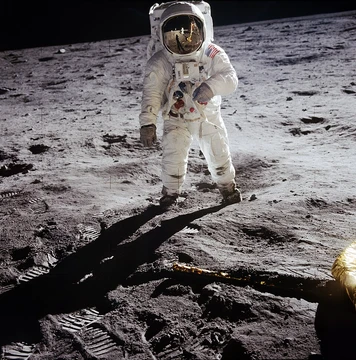
Colombia lunar sample displays
Moon rock plaques gifted to Colombia, later returned to public display.

Anfecaro · CC0
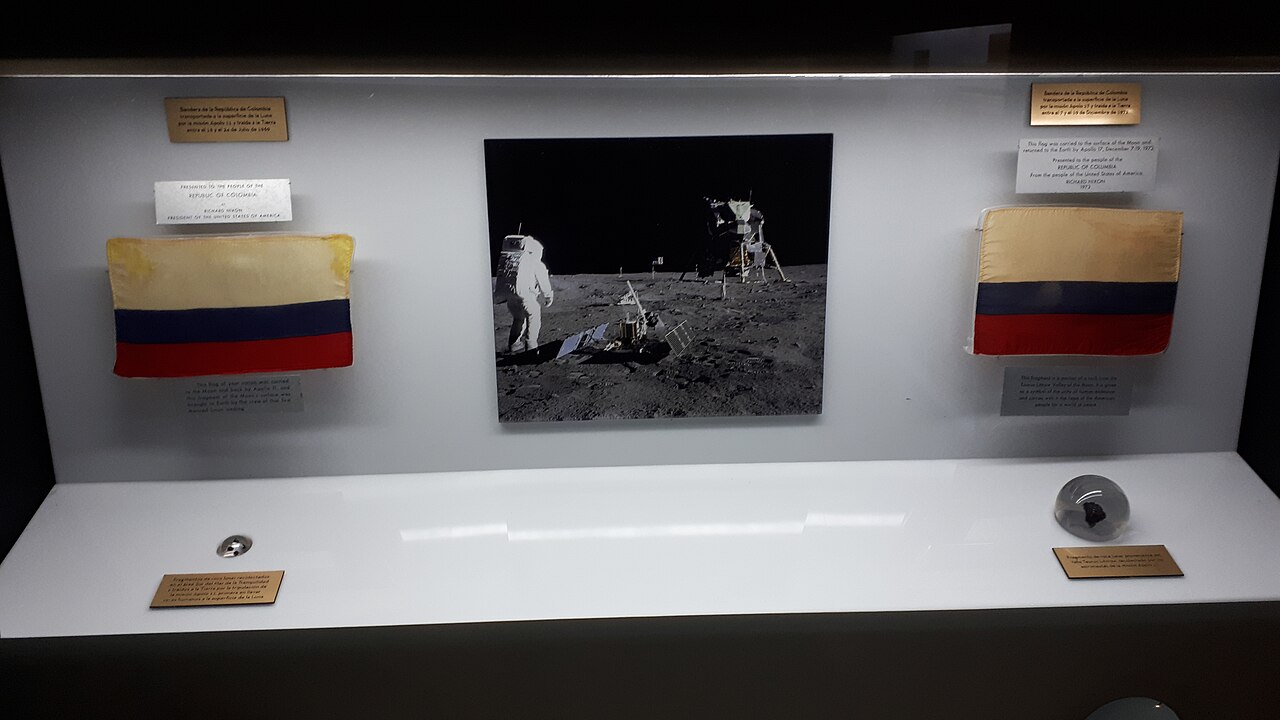
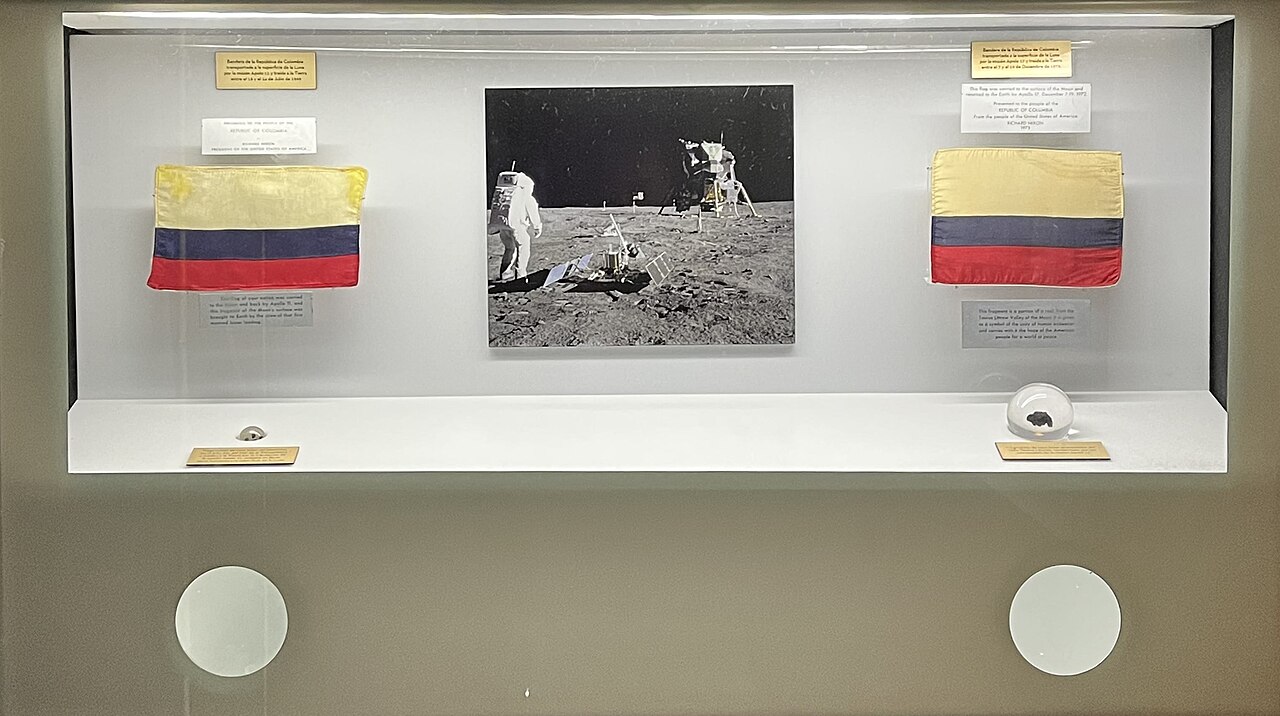
The Bogotá Planetarium holds two commemorative plaques that contain tiny Moon rock fragments. These came from the Apollo 11 and Apollo 17 missions. The displays are not mounted on their original stands. Alongside them, the planetarium shows Colombian flags that flew on those Apollo flights, plus related documents and photographs.
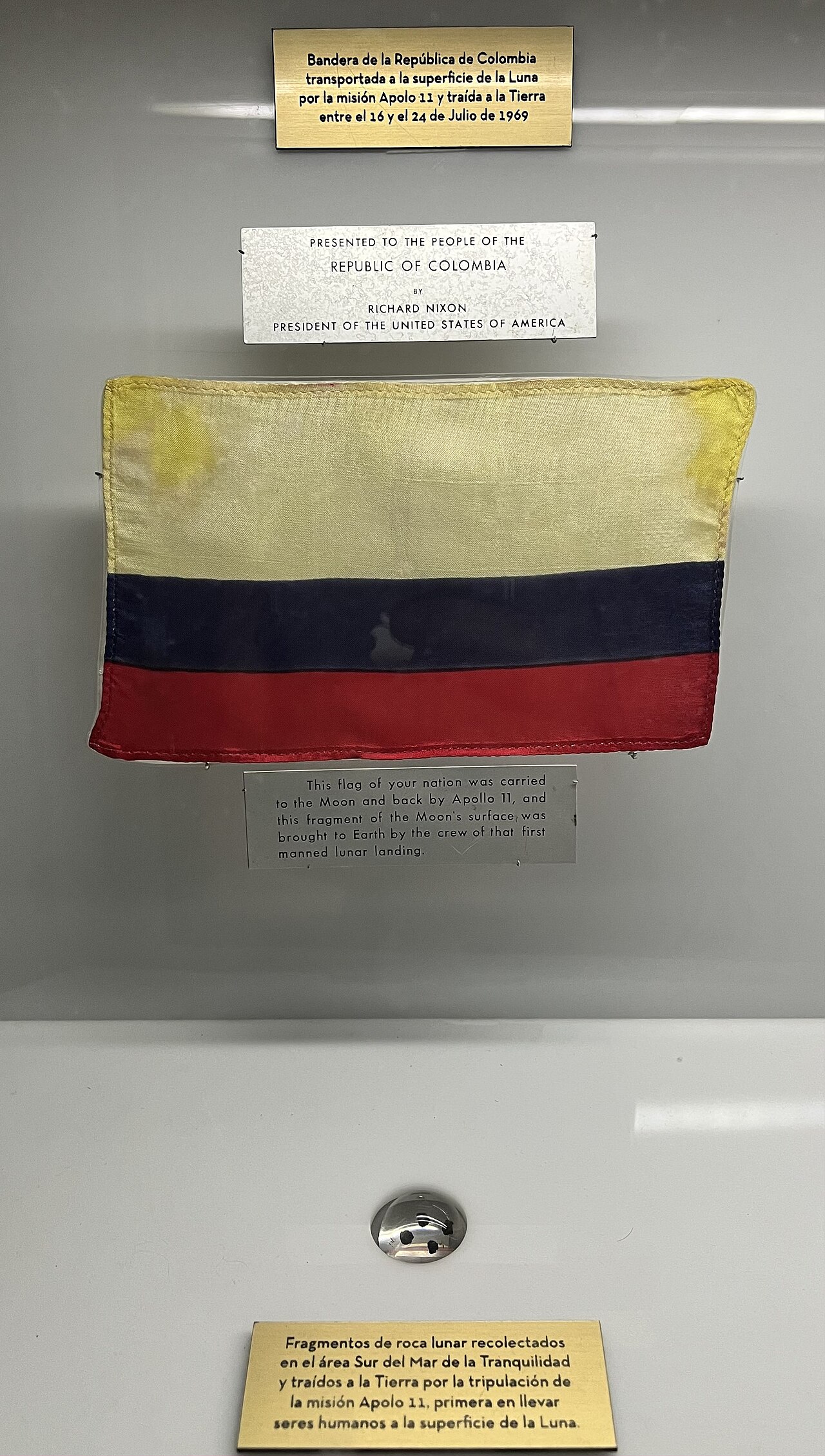
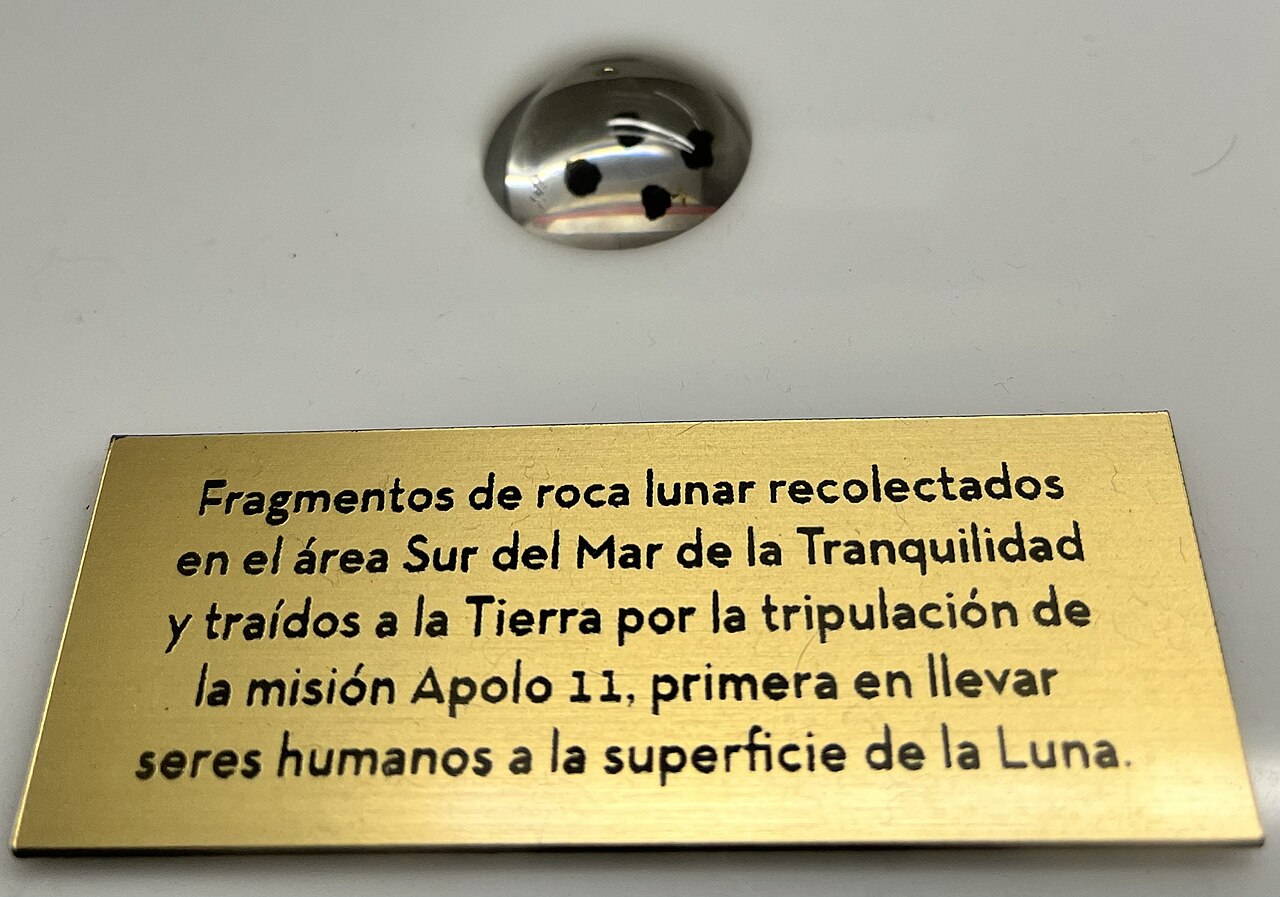
For Apollo 11, NASA made about 250 presentation plaques at President Richard Nixon’s request. Each held roughly four rice-sized grains of lunar dust, totaling about 50 milligrams, set in an acrylic button. The button was mounted with a flag of the recipient country or state that had also traveled to the Moon. All 135 countries, the 50 U.S. states, U.S. territories, and the United Nations received one. Nixon gave these as gifts in 1970. Colombia’s Apollo 11 display was later removed from its original wooden stand and placed in a custom case with the Apollo 17 display.
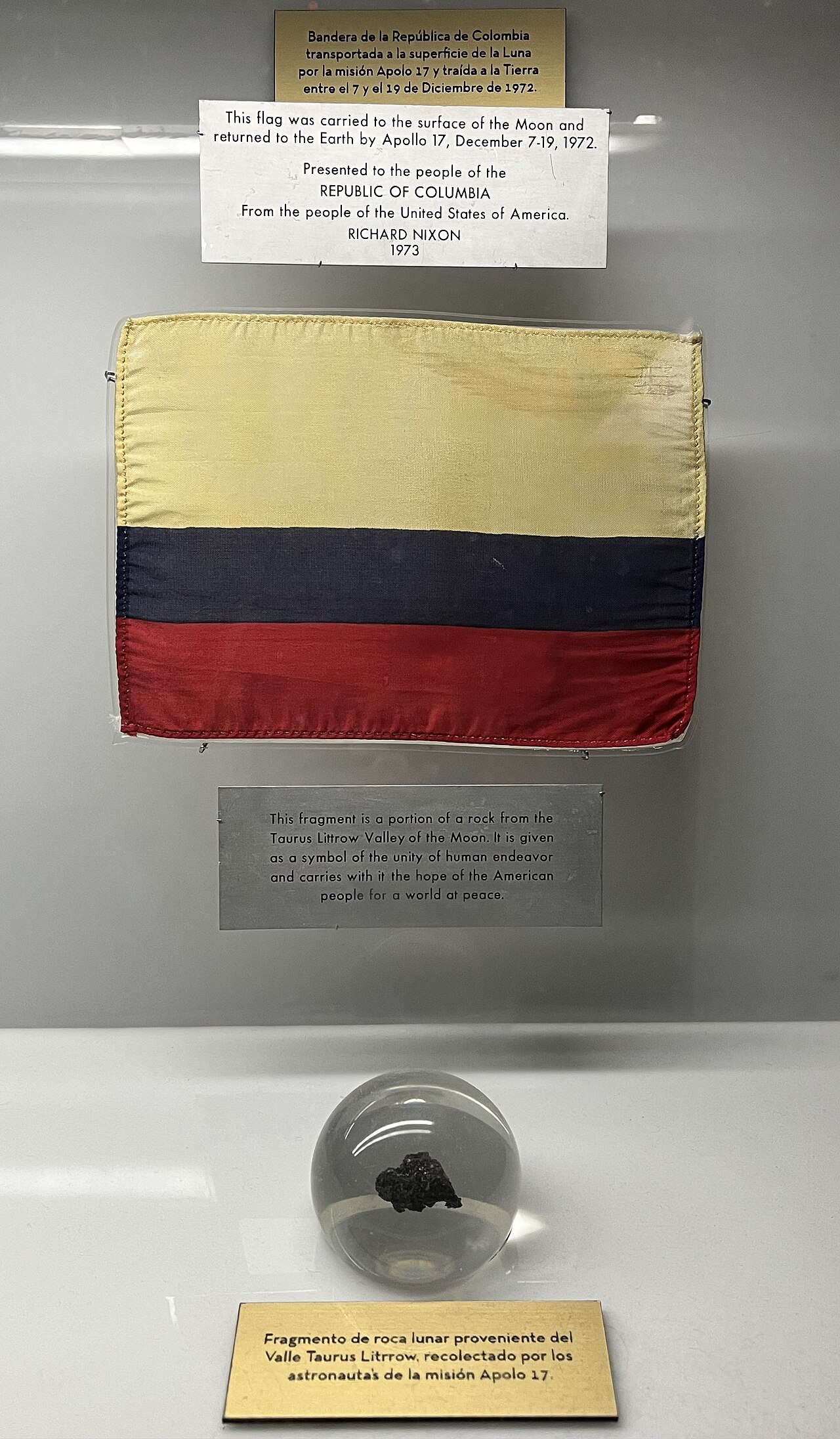
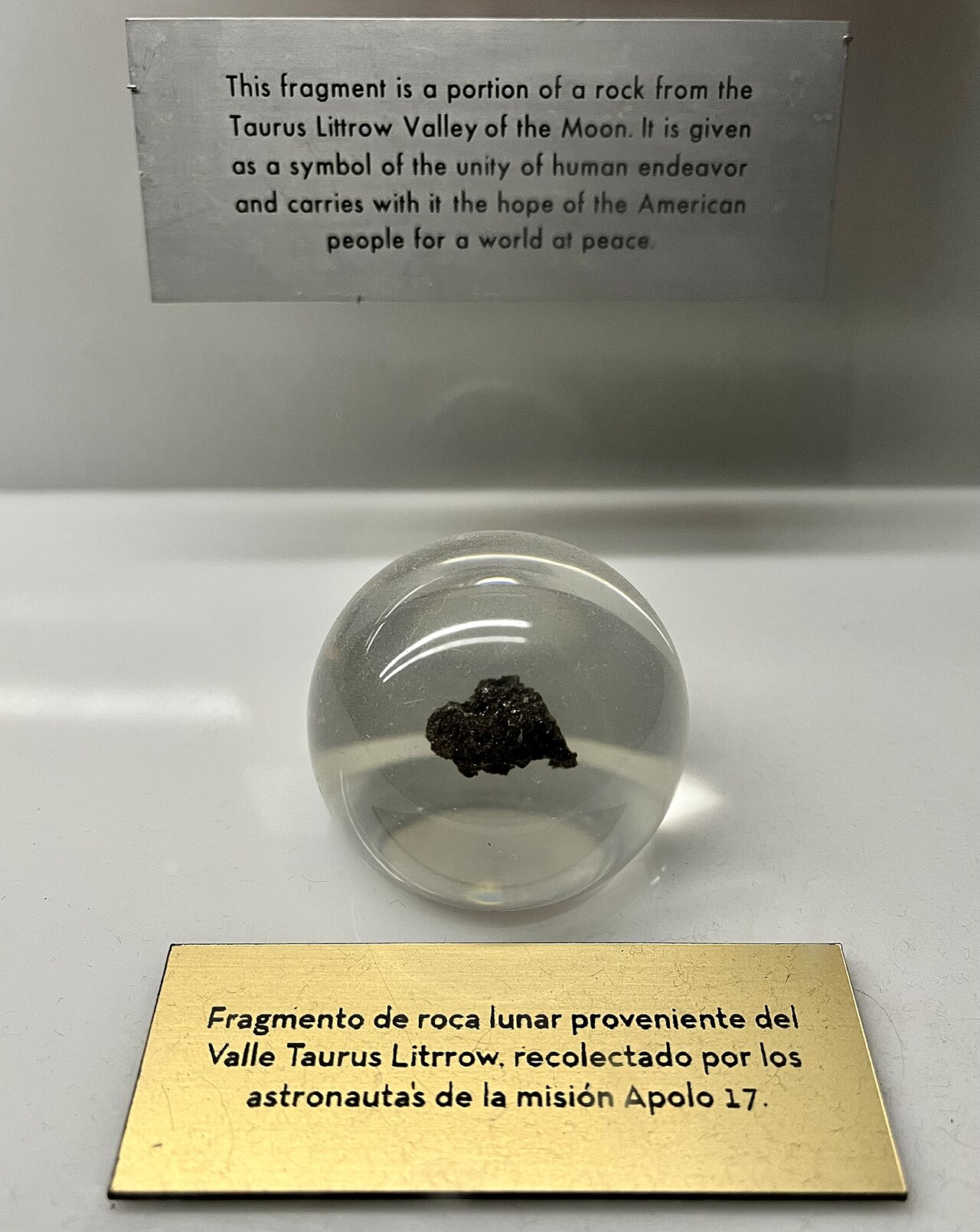
The Apollo 17 sample, a piece of lunar basalt called 70017, is known as the Goodwill rock. Fragments weighing about 1.14 grams each were set in acrylic lucite and mounted with a flag that had flown on Apollo 17. In 1973, Nixon sent these plaques to 135 countries, including Colombia, as a goodwill gesture. President Richard Nixon personally presented Colombia’s display to the people of Colombia. This display was also removed from its original wooden stand and placed in the same custom case as the Apollo 11 display.
Colombian President Misael Pastrana Borrero, in office from 1970 to 1974, received both lunar displays from President Nixon. He kept them on his desk at the Casa de Nariño. Believing they were a personal diplomatic gift, Pastrana kept the Moon rocks after his term ended, using them as decoration in his private Bogotá living room. In 1980, journalist Daniel Samper Pizano searched for the displays, which were thought to be missing. He contacted the U.S. Embassy in Bogotá, which confirmed the displays were not a personal gift to Pastrana but belonged to all Colombians. Samper published an article accusing Pastrana of stealing the lunar displays. In response, Juan Carlos Pastrana, the former president’s son, gave the displays to the Bogotá Planetarium on his father’s behalf. After returning to public hands, the displays were placed on public display in the 1980s and remain part of the permanent collection.
Quick Facts
- Type Link
- Lunar soil
Facts from the source article.
Lore & Background
At the request of then United States President Richard Nixon, NASA had about 250 presentation plaques made following Apollo 11 in 1969, each including about four rice-sized particles of Moon dust totaling about 50 mg. The Apollo 11 lunar sample display has an acrylic plastic button containing the Moon dust mounted with the recipient's country or state flag that had been to the Moon and back. All 135 countries received the display, as did the 50 states of the United States and the U.S. provinces and the United Nations. The plaques were given as gifts by Nixon in 1970. Since being placed on public viewing, the Colombia Apollo 11 lunar display has been dismounted from the wooden stand in which it was originally presented and placed in a custom display case along with the Apollo 17 lunar display.
The sample Moon rock collected during the Apollo 17 mission was later named lunar basalt 70017, and dubbed the Goodwill rock. Pieces of the rock weighing about 1.14 grams were placed inside a piece of acrylic lucite, and mounted, along with a flag of the country which would receive it, that had flown on Apollo 17. In 1973, then United States President Richard Nixon had the plaques sent to 135 countries, including Colombia, as a goodwill gesture. The display for Colombia was personally presented by Neil Armstrong to the people of Colombia. Since being placed on public viewing, the Colombia Apollo 17 lunar display has been dismounted from the wooden stand in which it was originally presented and placed in a custom display case along with the Apollo 11 lunar display.
Misael Pastrana Borrero, as President of Colombia between 1970 and 1974, received from Neil Armstrong both lunar sample displays which he kept on his desk at the Casa de Nariño. Allegedly believing that the displays were a personal diplomatic gift, Pastrana kept the Moon rocks after the end of his presidential term as interior decoration in the living room of his private residence in Bogotá. It was not until 1980 when journalist Daniel Samper Pizano, in search of the thought to be missing lunar displays, embarked on a mission that included contacting the Embassy of the United States in Bogotá which confirmed that the displays were not a personal gift to then President Pastrana but rather to all people of Colombia. Having received this information, Samper published an article with the allegation that Pastrana had stolen the lunar displays prompting Juan Carlos Pastrana, son of Misael Pastrana Borrero, to bestow the displays to the Bogotá Planetarium on behalf of his father. Since their return to public hands, the lunar sample displays remained in secured storage within the Bogotá Planetarium until 2003 when they were displayed for the first time to the public as part of the planetarium's permanent collection.
Reader's Guide
The Colombia lunar sample displays represent a unique intersection of space exploration and national heritage. As part of a global goodwill initiative by President Richard Nixon, these plaques—containing Moon dust from Apollo 11 and a piece of the Goodwill rock from Apollo 17—were intended as gifts to the people of Colombia. Their journey from the Casa de Nariño to a private residence and finally to the Bogotá Planetarium highlights the importance of public access to artifacts of scientific and historical significance. The displays serve as tangible reminders of humanity's achievements in space and the diplomatic gestures that accompanied them. Their eventual public display in 2003, after years in secured storage, underscores the value of transparency and the role of journalism in recovering cultural treasures. The plaques remain a permanent part of the planetarium's collection, alongside the Colombian flags that flew on the Apollo missions, offering visitors a direct connection to the Moon.
Did You Know?
- The Apollo 17 display contains a piece of lunar basalt 70017, dubbed the Goodwill rock, weighing about 1.14 grams.
- Journalist Daniel Samper Pizano's 1980 article alleging that President Misael Pastrana Borrero had stolen the displays prompted their return to public hands.
- The displays were not shown to the public until 2003, after being kept in secured storage at the Bogotá Planetarium.
The 1969 Goodwill Distribution
When Apollo 11 touched down on the Moon in 1969, the crew brought back only a few dozen pounds of lunar material, consisting mainly of rock and dust. From that limited supply, NASA set aside roughly 0.05 grams for each small display case. These cases were then distributed one apiece to the fifty U.S. states, to political entities under American administration such as territories, and to sovereign nations around the globe. Colombia, as an established nation at the time, fell within the group of approximately 135 countries that received one of these goodwill displays. The gesture carried a dual purpose: it was a scientific artifact and a diplomatic token, offering each recipient a tangible fragment of a shared human milestone. The tiny mass of material in each case made the gesture all the more remarkable—a sliver of another world pressed into the hands of a nation's representatives.
What Sat Inside Each Case
Every display case held two distinct elements: a small fragment of lunar material and a miniature flag representing the political entity that had traveled to the Moon and returned. For Colombia's case, this pairing meant a tiny national flag sat beside the 0.05-gram sample of rock and dust gathered during the 1969 landing. The flag personalized the universal achievement, anchoring the cosmic to the specific identity of the recipient. The sample itself was a geological fragment from the Moon's surface, no larger than a grain of sand in mass. Together, the flag and the fragment turned each case into a compact diplomatic monument, a small object that simultaneously commemorated the engineering feat of the Apollo program and honored the particular nation to which it had been gifted. No two cases were identical in their flag, making each one a unique artifact.
Apollo 17, Apollo 15, and the Broader Collection
The Apollo 11 distribution was not the final chapter of the goodwill program. When Apollo 17 flew in 1972, NASA repeated the gesture using a different lunar sample, specifically identified as Lunar basalt 70017. This meant that recipient nations, including Colombia, could potentially hold a second case featuring a distinct geological composition from a different landing site. In addition, a small number of displays incorporating samples from the Apollo 15 mission also exist in the broader collection. The variety across missions—different basalt types, different surface geologies gathered at different sites—added a scientific richness to what was primarily a symbolic program. For a nation like Colombia, the possibility of holding material from more than one lunar landing site deepened the connection to the program's full scope.
Inheritance, Loss, and Enduring Significance
The roughly 135 displays gifted to nations in 1969 and 1972 captured the geopolitical map as it existed at that moment. Countries that have since been created were never part of the original distribution, while some displays have passed by inheritance from predecessor states to successor nations, complicating their provenance. The broader program also carries a shadow: the documented history of stolen and missing Moon rocks reminds us that these tiny artifacts have not always remained safely in their cases. For Colombia and the other recipient nations, the displays persist as fragile diplomatic relics—each one a 0.05-gram piece of the Moon preserved in a small case, a physical echo of a moment when humanity first walked on another world and chose to share that experience with the entire planet.
Gallery
Frequently Asked Questions
What are the Colombia lunar sample displays?
They are two commemorative plaques—one from Apollo 11 and one from Apollo 17—each holding a small fragment of actual Moon rock. They were part of a set of roughly 250 presentation plaques that NASA produced at President Nixon's request to gift to nations around the world.
Where can you see the Colombia lunar sample displays today?
Both plaques are on public view at the Bogotá Planetarium, though they are no longer mounted on their original stands. The planetarium also shows the Colombian flags that flew on those Apollo flights, along with related documents and photographs.
What material is inside the Apollo 11 plaque given to Colombia?
The Apollo 11 plaque holds about 50 milligrams of lunar dust—roughly four rice-sized grains—encased in a small acrylic button. The companion Apollo 17 plaque contains a slightly larger piece, approximately 1.14 grams of lunar basalt (sample 70017).
How did the Moon rock plaques end up in Colombia?
President Richard Nixon personally presented them as part of NASA's international gifting program, which paired each plaque with a flag of the recipient country. The Colombian flags from both the Apollo 11 and Apollo 17 missions are still displayed alongside the plaques at the Bogotá Planetarium.
Why do the Colombia lunar sample displays matter to Apollo fans?
They are among the few publicly accessible pieces of genuine Moon material in South America, giving fans a tangible link to the 1969 and 1972 landings. They also illustrate how the Apollo legacy was deliberately shared with the world rather than kept exclusively in U.S. institutions.
More in Apollo 11 1-24
Spotted an error? Know more?
Reader corrections go straight into our review queue. Suggest an edit · How this site is sourced