
Armalcolite
Lunar titanium mineral named after Apollo 11 astronauts.

Henk Smeets – tomeikminerals.com · CC BY 4.0
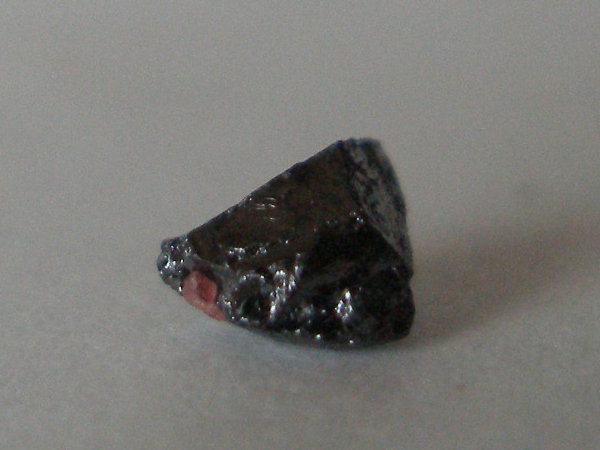
Armalcolite is a titanium-rich mineral, formula (Mg,Fe²⁺)Ti₂O₅, named for Apollo 11 astronauts Armstrong, Aldrin, and Collins. It was first discovered in 1969 at Tranquility Base on the Moon, alongside tranquillityite and pyroxferroite—the three new minerals found there. Later, armalcolite was also identified on Earth and synthesized in labs.
The mineral forms under low pressures and high temperatures, requiring rapid quenching from about 1,000 °C to ambient conditions to prevent it from breaking down into magnesium-rich ilmenite and rutile. This conversion slows with cooling, which is why armalcolite is rare and usually found with ilmenite and rutile. Its relative abundance versus ilmenite can indicate cooling rates during formation.
On the Moon, armalcolite was found at Tranquility Base, the Taurus–Littrow valley, and the Descartes Highlands, with the largest samples from Apollo 11 and 17. On Earth, it occurs in lamproite dikes and plugs in Smoky Butte, Montana, and at sites in Germany (Nördlinger Ries impact crater), Greenland (Disko Island), Mexico (El Toro cinder cone), South Africa (kimberlite mines), Spain (Albacete and Jumilla), Ukraine (Pripyat Swell), the United States (Knippa quarry, Texas; Smoky Butte, Montana), and Zimbabwe (Mwenezi District). It has also been detected in lunar meteorites like Dhofar 925 and 960 from Oman.
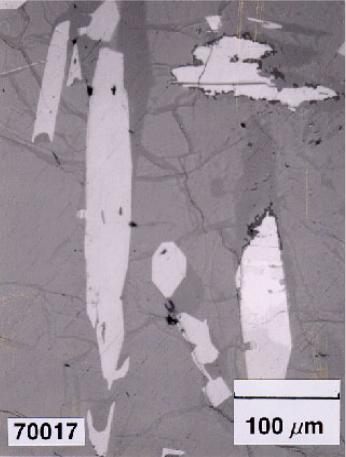
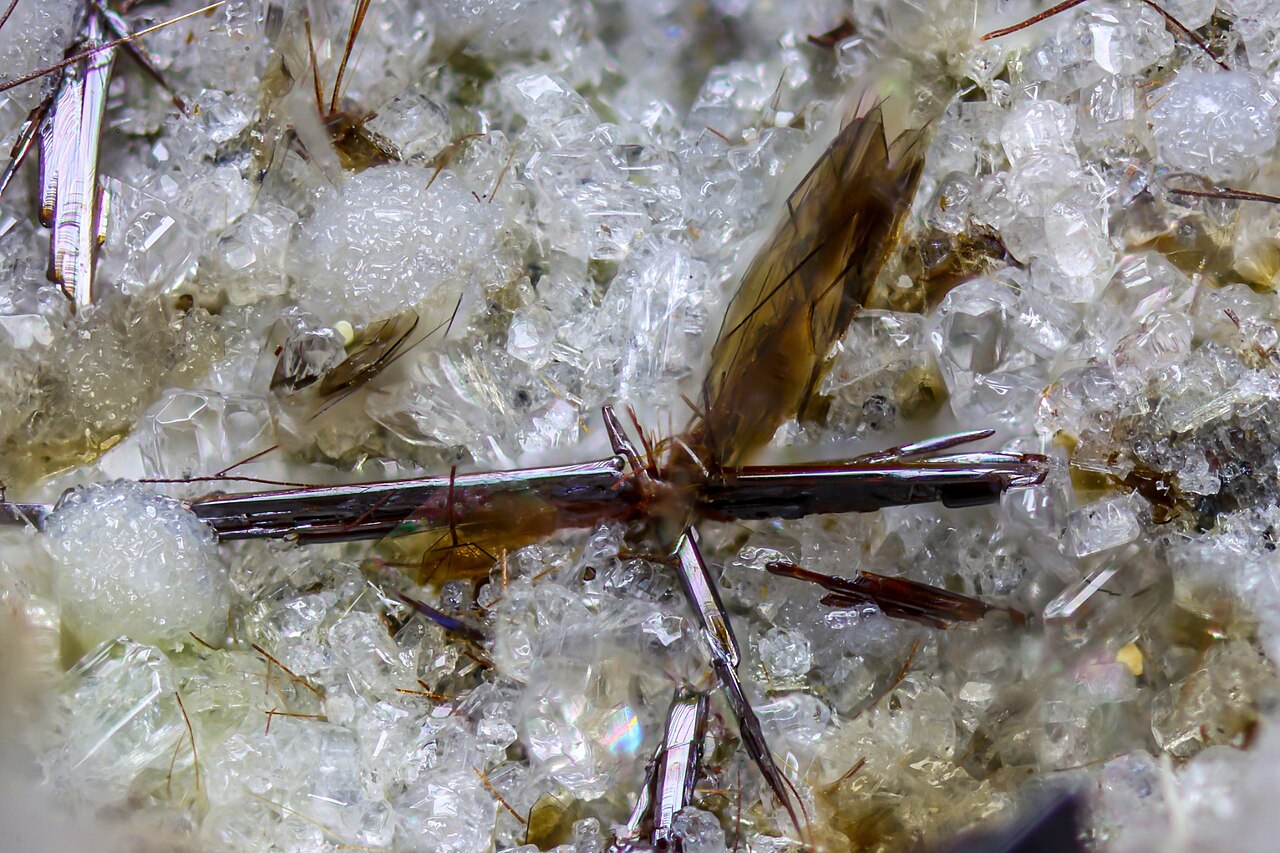
Armalcolite is a minor mineral in titanium-rich basalts, volcanic lava, and occasionally granite pegmatite, ultramafic rocks, lamproites, and kimberlites. It forms elongated crystals 0.1–0.3 mm long embedded in basalt, associated with mixed iron-titanium oxides, graphite, analcime, diopside, ilmenite, phlogopite, and rutile.
In the lab, crystals up to several millimeters are grown by mixing iron, titanium, and magnesium oxide powders, melting at about 1,400 °C, crystallizing at 1,200 °C for days, then quenching. The quenching step is essential to avoid conversion to ilmenite and rutile below 1,000 °C. This conversion threshold rises with pressure and can exceed the melting point, preventing formation at high pressures.
Armalcolite’s formula (Mg,Fe²⁺)Ti₂O₅ fits the general XY₂O₅ structure, where X = Mg and Fe²⁺, Y = Ti, and O is oxygen. Both X and Y sites are octahedrally coordinated, with a cation-to-anion radius ratio of 0.6.
Quick Facts
- Category
- Titanium mineral
- Formula
- (Mg,Fe / 2+ / )Ti / 2 / O / 5
- Imasymbol
- Arm
- Strunz
- 4.CB.15
- System
- Orthorhombic
- Class
- Dipyramidal (mmm) / H-M symbol: (2/m 2/m 2/m)
- Symmetry
- Bbmm
- Mohs
- <5
- Luster
- Metallic
- Opticalprop
- Biaxial
- Gravity
- 4.64 g/cm / 3 / (measured)
Facts from the source article.
Lore & Background
Armalcolite was originally found on the Moon in the Sea of Tranquility at Tranquility Base, and also in the Taurus–Littrow valley and the Descartes Highlands. The largest amounts were provided by the Apollo 11 and 17 missions. It was later identified on Earth from samples of lamproite dikes and plugs taken in Smoky Butte, Garfield County, Montana, US. On Earth, it also occurs in Germany (Nördlinger Ries impact crater in Bavaria), Greenland (Disko Island), Mexico (El Toro cinder cone, San Luis Potosí), South Africa (Jagersfontein, Bultfontein and Dutoitspan kimberlite mines), Spain (Albacete Province and Jumilla, Murcia), Ukraine (Pripyat Swell), United States (Knippa quarry, Uvalde County, Texas and Smoky Butte, Jordan, Montana) and Zimbabwe (Mwenezi District). Armalcolite was also detected in lunar meteorites, such as Dhofar 925 and 960 found in Oman.
Reader's Guide
Armalcolite is significant as one of only three minerals first discovered on the Moon, marking a milestone in lunar mineralogy and the Apollo program. Its synthesis requires low pressures, high temperatures, and rapid quenching from about 1,000 °C to ambient temperature to avoid conversion to ilmenite and rutile. This quenching requirement makes armalcolite relatively rare and useful as an indicator of cooling rates during mineral formation. The Ti3+/Ti4+ ratio in armalcolite can serve as an indicator of oxygen fugacity during formation and allows distinction between lunar and terrestrial samples. Its occurrence on Earth in diverse settings—from kimberlite mines to impact craters—demonstrates that the mineral can form under similar conditions on both worlds. The mineral's crystal structure, part of the pseudobrookite group, and its solid solution behavior provide insights into cation substitution in octahedral sites. Armalcolite thus bridges planetary science and terrestrial petrology, offering a tool for understanding high-temperature, low-pressure igneous processes.
Did You Know?
- Armalcolite is named for Armstrong, Aldrin and Collins, the three Apollo 11 astronauts.
- It was first found at Tranquility Base on the Moon in 1969 during the Apollo 11 mission.
- Armalcolite breaks down to a mixture of magnesium-rich ilmenite and rutile at temperatures below 1,000 °C.
- The Ti3+/Ti4+ ratio in armalcolite can distinguish lunar and terrestrial samples, being zero for terrestrial armalcolite.
A Mineral Born on Another World
Armalcolite's story begins not in a laboratory but on the surface of another world. During the Apollo 11 mission in 1969, samples collected at Tranquility Base in the Sea of Tranquility revealed a mineral never before catalogued. It was named in honor of the three astronauts—Armstrong, Aldrin, and Collins—whose names were woven into the mineral's very identity. Subsequent lunar missions expanded the picture: Apollo 17 brought back the largest quantities from the Taurus–Littrow valley, and the Descartes Highlands also yielded specimens. Armalcolite joined tranquillityite and pyroxferroite as one of only three genuinely new minerals identified on the Moon. Its presence has even been confirmed in lunar meteorites recovered from Earth's surface, notably Dhofar 925 and 960, both found in Oman. This extraordinary provenance—born in the vacuum of the lunar highlands and later scattered across the desert—makes armalcolite one of the most narratively rich minerals in the entire catalog.
A Global Terrestrial Footprint
Once thought to be a uniquely lunar curiosity, armalcolite has since been identified across a remarkably wide swath of Earth's geology. On the North American continent, it appears in lamproite dikes and plugs at Smoky Butte in Garfield County, Montana, and in the Knippa quarry of Uvalde County, Texas. European occurrences include the Nördlinger Ries impact crater in Bavaria, Germany, and sites in Albacete Province and Jumilla in Spain. The mineral also crops up in Greenland's Disko Island, Mexico's El Toro cinder cone in San Luis Potosí, the Pripyat Swell in Ukraine, and Zimbabwe's Mwenezi District. South Africa's kimberlite mines at Jagersfontein, Bultfontein, and Dutoitspan represent particularly significant terrestrial sources. Petrographically, armalcolite is a minor constituent of titanium-rich basalt, volcanic lava, and occasionally granite pegmatite, ultramafic rocks, lamproites, and kimberlites. It typically forms elongated crystals measuring roughly 0.1 to 0.3 millimeters in length, embedded within a basaltic matrix, and is commonly accompanied by ilmenite, rutile, phlogopite, diopside, analcime, graphite, and various mixed iron-titanium oxides.
The Quenching Imperative and Why Armalcolite Is Rare
Reproducing armalcolite in the laboratory is a delicate exercise in thermal management. The standard protocol involves blending powdered iron, titanium, and magnesium oxides in precise stoichiometric ratios, melting the mixture in a furnace at approximately 1,400 °C, allowing the melt to crystallize over several days near 1,200 °C, and then rapidly quenching the resulting crystals down to ambient temperature. That final quench is not optional; it is the single most critical step. Below roughly 1,000 °C, armalcolite is thermodynamically unstable and will decompose into a mixture of magnesium-rich ilmenite and rutile. The conversion rate slows as temperature drops, but it never fully stops, meaning any slow cooling pathway will destroy the mineral. Raising pressure shifts the threshold temperature upward until it eventually surpasses the melting point, rendering armalcolite formation impossible at sufficiently high pressures. This fragility explains why the mineral is comparatively rare in nature and why it is almost always found alongside its decomposition products, ilmenite and rutile. Geologists can actually exploit this relationship: the relative proportions of ilmenite and armalcolite in a rock serve as a natural proxy for how quickly the melt cooled during formation.
Crystal Chemistry and the Lunar-Terrestrial Fingerprint
Armalcolite belongs to the pseudobrookite group, a family of isostructural orthorhombic minerals sharing the general formula X₂YO₅. Its own composition, (Mg,Fe²⁺)Ti₂O₅, places it between the end members armalcolite and the iron-poor karrooite (MgTi₂O₅), with pseudobrookite and ferropseudobrookite rounding out the series. The crystal structure features octahedrally coordinated cation sites: the larger iron ions preferentially occupy the M1 positions, while magnesium and titanium distribute across both M1 and M2 sites, enabled by their similar ionic radii and charges. Typical samples contain 71–76 percent TiO₂, 10–17 percent FeO, and 5.5–9.4 percent MgO, with trace Al₂O₃, Cr₂O₃, and MnO. A distinctive Cr-Zr-Ca variety carries elevated chromium, zirconium, and calcium. Perhaps most diagnostically, the Ti³⁺/Ti⁴⁺ ratio in armalcolite records the oxygen fugacity at the time of crystallization. Lunar specimens show a measurable fraction of Ti³⁺, whereas terrestrial armalcolite consistently yields a ratio of zero—a clean chemical fingerprint that separates Moon-born crystals from their Earthly counterparts.
Gallery
Frequently Asked Questions
What is Armalcolite?
Armalcolite is a titanium-rich mineral belonging to the pseudobrookite group, with the chemical formula (Mg,Fe²⁺)Ti₂O₅. It crystallizes in the orthorhombic system.
Who is Armalcolite named after?
The mineral takes its name from the three Apollo 11 crew members: Neil Armstrong, Buzz Aldrin, and Michael Collins. Each astronaut's surname contributes a syllable to the word.
Where and when was Armalcolite first discovered?
It was identified in 1969 at Tranquility Base on the Moon during the Apollo 11 mission. It was one of three brand-new minerals found there, alongside tranquillityite and pyroxferroite.
Why is Armalcolite so difficult to form or preserve?
It requires low-pressure, high-temperature conditions and must be quenched rapidly from roughly 1,000 °C down to ambient temperature. If cooling is too slow, it breaks apart into magnesium-rich ilmenite and rutile.
Has Armalcolite been found anywhere other than the Moon?
Yes—after its lunar discovery, the mineral was later identified in samples on Earth and has also been successfully synthesized in laboratory settings.
More in Apollo 11 1-24
Spotted an error? Know more?
Reader corrections go straight into our review queue. Suggest an edit · How this site is sourced