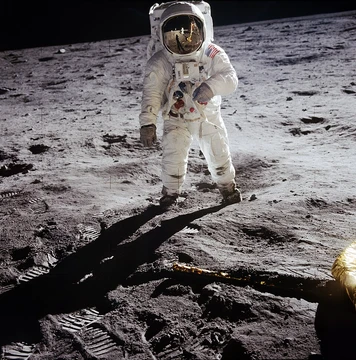
British television Apollo 11 coverage
UK television covered the first Moon landing across three channels.

British television coverage of the Apollo 11 mission, the first crewed Moon landing, was broadcast from 16 to 24 July 1969 by three UK channels: BBC1, BBC2, and ITV. The BBC provided 27 hours of coverage over ten days, with BBC2 in colour and BBC1 in black and white, while ITV offered 16 hours of coverage. Most footage was later wiped or lost, though some fragments survive.
Quick Facts
- Runtime
- 8 days
- Presenter
- James Burke / Patrick Moore / Cliff Michelmore / David Frost / Alastair Burnet
- Country
- United Kingdom
- Network
- BBC1, BBC2, ITV
- First Aired
- 1969-07-16
- Last Aired
- 1969-07-24
Facts from the source article.
Lore & Background
BBC coverage originated from Lime Grove Studios in London, with a set featuring a long angled desk, large models of the Moon and Earth, and a digital clock counting down to lift-off. Presenters included Cliff Michelmore, James Burke, and Patrick Moore. Michael Charlton reported live from Cape Kennedy and Mission Control in Houston. The Radio Times cover showed a rocket with the caption 'Target Moon'.
On the night of the Moon landing, 20–21 July, BBC1 and ITV remained on air for 11 hours, the first all-night broadcast on British television. The Lunar Module landed at 21:17:39 BST on 20 July; Neil Armstrong stepped onto the Moon at 3:56 a.m. British time on 21 July. James Burke provided commentary, often filling silences. The first images from the Moon were upside down; engineers corrected the signal electronically. The BBC's electronic standards converter later earned a Queen's Award for Industry.
ITV coverage, led by Alastair Burnet, included David Frost's Moon Party, a lighter-toned show with entertainers such as Peter Cook, Cilla Black, and Sammy Davis Jr. Author Ray Bradbury walked out, objecting to the frivolous tone. ITV used computer-generated captions showing the Eagle's speed and altitude. Paul Haney described the moonwalk as 'the greatest thing to happen since fish crawled up on the beach and survived.'
Reader's Guide
British television coverage of Apollo 11 was a landmark in broadcasting, marking the first all-night transmission on UK television and demonstrating the medium's ability to unite a nation around a global event. The BBC's 27 hours and ITV's 16 hours of coverage reflected the immense public interest and the technical challenges of live satellite relay. The BBC's use of an electronic standards converter, which earned a Queen's Award for Industry, highlighted the engineering innovations required to bring lunar images to British viewers. The coverage also showcased contrasting editorial approaches: the BBC's serious, scientific tone versus ITV's lighter, entertainment-focused format. The loss of most footage underscores the ephemeral nature of early television archives, making surviving fragments historically valuable. The event remains a touchstone for live broadcast history, illustrating how television can transform a distant scientific achievement into a shared cultural experience.
Did You Know?
- The BBC's Apollo 11 coverage included a special Omnibus anthology titled 'So what if it's just Green Cheese?' featuring Pink Floyd's instrumental 'Moonhead' and readings by Ian McKellen, Judi Dench, and others.
- David Bowie's song 'Space Oddity', released weeks before the landing, was included in the BBC coverage.
- ITV's David Frost's Moon Party featured Engelbert Humperdinck, who reportedly collapsed from exhaustion due to the show's length.
- The first images from the Moon were upside down; engineers used an electronic switch to correct the picture.
The Vanishing of the Raw Signal
The Apollo 11 mission captured its lunar surface footage in a raw slow-scan television format, a monochrome progressive-scan signal running at ten frames per second with 320 lines of resolution. Because radio bandwidth from the Lunar Module Eagle was extremely limited, this video had to share the transmission channel with telemetry and other communications. At the receiving stations on Earth, the incoming signal was split into two paths: one branch went straight to a 14-track analog tape recorder, capturing the untouched SSTV data onto one-inch-wide magnetic reels spinning at 120 inches per second. The other branch was fed into a scan converter for immediate broadcast. These backup tapes were meant to preserve every bit of transmitted data—video and telemetry alike—for future reference. Yet in the years after 1969, because the live broadcast had already been widely recorded on videotapes and kinescope films, nobody considered safeguarding the pristine originals a pressing concern. By the early 1980s, NASA's Landsat programme was running critically short of data tape stock, and it is almost certain the Apollo 11 reels were wiped and recycled under routine procedure.
The Optical Trick That Brought the Moon to Living Rooms
The SSTV signal arriving from the Moon was fundamentally incompatible with any broadcast standard of the era—NTSC, PAL, or SECAM. NASA's solution, chosen for the Apollo 7, 8, 9, and 11 missions, was an RCA scan converter that worked on a deceptively simple optical principle. The raw signal was first displayed on a high-quality ten-inch video monitor whose phosphors held the image long enough to act as a primitive frame buffer. A conventional RCA TK-22 television camera, set to the NTSC standard of 525 interlaced lines at 30 frames per second, simply re-photographed that screen. An analog disk recorder, based on the Ampex HS-100, captured the first field, then combined it with a time-delayed duplicate to build a full interlaced frame. This sequence repeated five more times before the camera caught the next incoming SSTV frame, effectively generating the extra twenty frames per second needed for a flicker-free picture. The whole process was crude by modern standards; the monitor and camera optics inevitably degraded contrast, brightness, and resolution. At Goldstone, mis-set converter parameters during the opening minutes of the moonwalk produced visibly poor images.
The Hunt for the Pristine Image
In the late 1990s, a handful of still photographs surfaced showing the raw SSTV signal as it appeared on ground-station monitors—visually far superior to anything in the public broadcast. This discovery ignited a multi-year investigation led by a team of retired NASA employees and contractors who set out to locate the original telemetry tapes. Their hope was that modern digital processing could extract a far higher-quality image from the untouched signal than the 1969 optical conversion ever achieved. After extensive searching in the early 2000s, the team concluded the raw tapes had been erased and reused by NASA in the early 1980s, consistent with standard practice of that period. Yet the search was not entirely fruitless. The researchers identified the best surviving NTSC videotapes and, remarkably, a reel of Super 8 film shot in Australia of a video monitor displaying the SSTV feed before it was converted. These materials offered the closest available window into the unprocessed lunar footage.
Restoration and the Surviving Record
In 2009, the visual materials uncovered during the search—enhanced NTSC tapes and the Australian Super 8 footage—were processed as part of a NASA-approved restoration project dedicated to the first moonwalk. At a news conference in Washington, D.C., the research team publicly announced its findings on the tapes' disappearance and partially unveiled the newly enhanced footage obtained during its investigation. The full restoration of the moonwalk sequence was completed by Lowry Digital later that same year. Meanwhile, the mission's other imaging systems had preserved higher-resolution records: the 16mm Maurer Data Acquisition Camera captured Armstrong's descent down the ladder and roughly 86 minutes of the lunar EVA, while Hasselblad 70mm still cameras documented the surface in sharp photographic detail. These surviving assets, combined with the restored broadcast footage, now form the most complete visual record of humanity's first steps on another world, even though the pristine raw signal itself is gone forever.
Frequently Asked Questions
Which UK channels broadcast the Apollo 11 Moon landing in 1969?
Three British networks carried live coverage of the mission: BBC1, BBC2, and ITV. The BBC split its broadcast across both of its channels while ITV provided its own separate feed.
How many hours of Apollo 11 coverage did British television air in total?
The BBC delivered 27 hours of programming over the ten-day mission window, while ITV contributed 16 hours of its own coverage. Together the three channels gave UK viewers extensive live and recorded access to the event.
Why can't I find most British Apollo 11 TV footage online?
The vast majority of the original broadcast tapes were either wiped for reuse or have since been lost to deterioration. Only small fragments of the coverage survive today, making a complete reconstruction impossible.
What was the difference between BBC1 and BBC2's Apollo 11 broadcasts?
BBC2 transmitted its coverage in colour while BBC1 aired the same material in black and white. This split reflected the technical standards each channel used at the time, with colour still being a newer technology in UK homes.
Why does the British Apollo 11 television coverage matter to fans and broadcast historians?
It represents the largest coordinated live television event ever attempted in the UK at that time, involving three separate networks simultaneously. Its near-total loss also makes the surviving fragments especially valuable to anyone studying the history of British broadcasting.
More in Apollo 11 1-24
Spotted an error? Know more?
Reader corrections go straight into our review queue. Suggest an edit · How this site is sourced