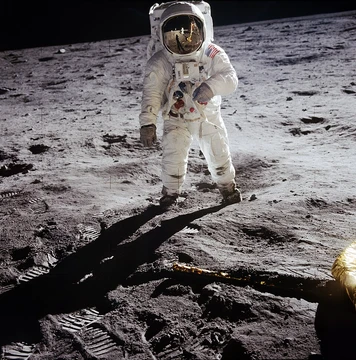
Apollo 10½: A Space Age Childhood
A nostalgic animated tale of a boy's secret Moon mission.

Apollo 10½: A Space Age Childhood is a 2022 American animated comedy about growing up, set just before the Apollo 11 Moon landing. The story is loosely inspired by director Richard Linklater's own childhood and follows a fictional fourth-grader who secretly becomes the first person to walk on the Moon. The voice cast includes Glen Powell, Zachary Levi, and Jack Black.
Linklater first had the idea in 2004. He originally planned to shoot it in live action, but switched to an animation style that looks like Saturday morning cartoons because that felt more playful. For research, he used home movies from 1960s Houston, some of which appear in the film. Filming started in February 2020 at Robert Rodriguez's Troublemaker Studios in Austin, Texas, and finished the next month. Some scenes were shot in front of the biggest green screen in Texas, while live-action footage was later animated using a rotoscoping technique similar to Linklater's *Waking Life* and *A Scanner Darkly*.
The story follows Stanley, a boy living with his five siblings in the growing suburbs of El Lago, Texas, in the 1960s. His father works an office job at NASA. Stanley grows up watching color TV, playing outside, and feeling optimistic about the future thanks to NASA, despite worries about the Cold War, Vietnam, and overpopulation. He learns about the Mercury and Apollo programs and wonders about aliens with his classmates.
In 1969, NASA officials approach 10-year-old Stanley on his school playground. They tell him he's been chosen for a secret Moon mission because the capsule was built too small for an adult. As an athletic, high-achieving student, he fits the role. He trains that summer under the guise of summer camp, learning survival skills like hunting and fishing, flying the Apollo 10½ module, and practicing Moon landings in simulations. The launch goes smoothly, and Stanley travels to the Moon, lands, and returns without issues—but the mission stays secret.
Later, Apollo 11 launches. Stanley and his family watch the astronauts' rocky descent and successful Moon landing. Stanley reflects on his own secret trip and the space program.
The film premiered at South by Southwest on March 13, 2022, played in select theaters on March 24, and started streaming on Netflix on April 1.
Quick Facts
- Director
- Richard Linklater
- Producer
- Richard Linklater / Tommy Pallotta / Mike Blizzard / Femke Wolting / Bruno Felix
- Starring
- Glen Powell / Zachary Levi / Jack Black
- Cinematography
- Shane F. Kelly
- Editing
- Sandra Adair
- Production Companies
- Netflix Animation Studios / Minnow Mountain / Submarine / Detour Filmproduction
- Distributor
- Netflix
- Released
- 13 March 2022 · SXSW · 2022 · 3 · 24 · United States
- Runtime
- 98 minutes
- Country
- United States
- Language
- English
Facts from the source article.
Lore & Background
The film follows Stanley, a boy in the 1960s living with his five siblings in the suburbs of El Lago, Texas. His father works an office job at NASA. Stanley grows up watching color TV and playing with neighborhood kids, while NASA brings his family optimism despite Cold War threats. In 1969, 10-year-old Stanley is approached by NASA officials on his school playground and told he has been selected for a secret Moon mission because the capsule was built too small for an adult. He trains under the cover of summer camp, learning survival skills and flying the Apollo 10½ module. After a flawless launch, he lands on the Moon and returns, but the mission remains secret. Later, he watches the Apollo 11 landing with his family.
Reader's Guide
Apollo 10½: A Space Age Childhood is significant as a personal project for Richard Linklater, conceived in 2004 and filmed using a stylized animation technique similar to rotoscoping, as seen in his earlier films Waking Life and A Scanner Darkly. The film blends nostalgic home movies from 1960s Houston with a fictional narrative, capturing the optimism of the Space Race era. Its production involved the largest green screen in Texas, and it premiered at South by Southwest in 2022 before streaming on Netflix. The film received positive reviews, with critics praising its writing, visuals, and nostalgic feel, and it was ranked seventh on Cahiers du Cinéma's top 10 films of 2022 list. Its appeal to the Academy for Animated Feature eligibility was initially denied but later reversed with support from fellow directors and animators.
Did You Know?
- The film was originally conceived by Richard Linklater in 2004 and was planned as live action before switching to animation.
- Principal photography took place in February and March 2020 at Robert Rodriguez's Troublemaker Studios in Austin, Texas.
- Parts of the film were shot in front of the largest green screen in Texas, with everything characters did not interact with animated in post-production.
- The film's eligibility for the Academy's Animated Feature category was initially denied but reversed after an appeal supported by fellow directors and animators.
Conception & Creative Vision
Richard Linklater first imagined this story back in 2004, when he was still envisioning it as a straightforward live-action feature. The project sat in development for years before he formally attached himself as writer and director in early 2018. What ultimately changed the film's DNA was his realization that animation could capture the boundless, rule-bending energy of a child's imagination in a way live action simply could not. He drew specifically on the visual language of Saturday morning cartoons, letting that playful register shape every frame. The story itself is a loose, affectionate retelling of his own childhood in Houston, Texas, during the 1960s, and he even pulled family home movies from that era into the research process, with a few clips finding their way into the finished picture. The result is a film that feels simultaneously deeply personal and wildly imaginative, a coming-of-age tale filtered through the lens of a boy who literally reaches for the Moon.
Production & Technical Innovation
Principal photography took place over a remarkably compressed window, from February to March 2020, at Robert Rodriguez's Troublemaker Studios in Austin, Texas. The shoot made use of what was billed as the largest green screen in the state, with the guiding rule being that anything the characters did not physically touch or interact with would be replaced with animation in post-production. For the live-action sequences already on camera, the team employed a rotoscoping process closely modeled on the techniques Linklater had pioneered in Waking Life (2001) and A Scanner Darkly (2006), hand-drawing over each frame to achieve the film's distinctive look. The production was interrupted by the pandemic, during which Linklater spent much of his time editing. The hybrid approach also sparked a notable dispute with the Academy of Motion Picture Arts and Sciences, which initially denied the film eligibility for the Animated Feature category. An appeal, backed by fellow directors and animators, ultimately reversed that decision.
Narrative & Thematic Core
The film follows Stanley, a ten-year-old boy growing up in the fast-expanding suburbs of El Lago, Texas, in the late 1960s. His father holds an office position at NASA, and the family lives modestly, sharing a new color television and a house with five siblings. Against the backdrop of Cold War nuclear anxiety, the Vietnam conflict, and fears about overpopulation, the space program becomes a wellspring of hope for the household. Stanley devours everything about the Mercury and Apollo programs and even speculates with classmates about alien life. The story's central conceit arrives on a school playground in 1969: NASA engineers have accidentally built a capsule too small for an adult, and only a child can fit inside. Stanley, athletic and academically sharp, is chosen for the secret mission. His training, disguised as summer camp, includes survival skills, piloting the tiny Apollo 10½ module, and practicing lunar landings. He completes the flight flawlessly but must keep it hidden from everyone, including his own family, even as they cheer on Apollo 11 from the couch.
Release & Critical Reception
Apollo 10½ made its world debut as the headliner of the 2022 South by Southwest Film Festival on March 13, 2022. A brief theatrical run in select venues followed on March 24, before the film landed on Netflix on April 1. Critics responded warmly across the board. Rotten Tomatoes tallied a 91 percent approval rating from 144 reviews, averaging 7.9 out of 10, with the consensus highlighting Linklater's ability to rework familiar visual and thematic material into something that feels both deeply personal and freshly inspired. Metacritic assigned a weighted score of 79 out of 100 based on 39 critics, landing in the generally favorable range. The film also earned a seventh-place spot on Cahiers du Cinéma's list of the ten best films of 2022, a notable distinction for an animated comedy. Praise consistently centered on the writing, the hand-drawn visual style, and the film's potent nostalgic atmosphere, which transported audiences back to a specific summer in a specific Texas suburb.
Frequently Asked Questions
What is Apollo 10½: A Space Age Childhood?
It is a 2022 animated coming-of-age comedy produced by Troublemaker Studios and released through Netflix. The film pairs a nostalgic late-1960s childhood story with a fantastical subplot in which a young kid secretly walks on the Moon.
Who directed Apollo 10½: A Space Age Childhood?
Richard Linklater directed the project, drawing on his own memories of growing up during the space-race era. He first pitched the idea in 2004 as a live-action film before reimagining it in a retro Saturday-morning-cartoon animation style.
What is the plot of Apollo 10½: A Space Age Childhood?
A fictional fourth-grader deals with everyday growing-up struggles while secretly becoming the first human to set foot on the Moon, all set just before the real Apollo 11 landing. The narrative interweaves friendships, family dynamics, and that wild lunar adventure into a single coming-of-age arc.
Why is the movie titled 'Apollo 10½'?
The half-step number signals that the story occupies the imaginative gap between the real Apollo 10 and Apollo 11 missions. It frames the kid's secret trip as a personal, in-between chapter rather than an official NASA flight.
Who is in the voice cast of Apollo 10½: A Space Age Childhood?
Glen Powell, Zachary Levi, and Jack Black are among the voice actors in the film. The characters are rendered in a deliberately playful, retro cartoon aesthetic that Linklater chose to keep the overall tone light and nostalgic.
More in Apollo 11 1-24
Spotted an error? Know more?
Reader corrections go straight into our review queue. Suggest an edit · How this site is sourced