Apollo 11 in popular culture
First human spaceflight to land on the Moon.

Attributed to Praxiteles · CC0
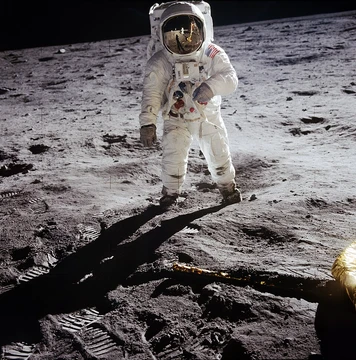
Apollo 11, the first crewed mission to land on the Moon, left a deep mark on popular culture, inspiring countless depictions of the flight and its astronauts—Neil Armstrong, Buzz Aldrin, and Michael Collins. The mission drew massive public attention. More than 53.5 million U.S. households watched the two weeks of television coverage, making it the most-watched TV event up to that time. Worldwide, about 650 million people viewed the first Moonwalk. After returning, the crew received ticker-tape parades in New York and Chicago, attended a dinner in Los Angeles, and spoke before a joint session of Congress. They then embarked on a 38-day, 23-country "Giant Leap" tour, starting in Mexico City, where they wore sombreros and saw another parade. The tour moved through South America, then to Spain, France, the Netherlands, Belgium, Norway, Germany, England, and Vatican City. After a rest at the U.S. embassy in Rome, they continued to Turkey and Africa. In Zaire, Buzz Aldrin jumped over a barricade to join dancers. Missing from the tour was Hungary, which rejected the United States's invitation to host the astronauts. Relations between Hungary and the United States were strained at the time, as the Hungarian crown jewels had been taken into U.S. custody after the Second World War and would not be returned until 1978. Many nations issued stamps for the mission. The U.S. released a $2.40 stamp for the 20th anniversary in 1989, a stamp for the 25th, and a 33¢ stamp for the 30th in 1999. The 1989 stamp, showing two astronauts planting a flag, raised concerns because law forbade depicting living people. The USPS never officially stated the figures were Armstrong and Aldrin, only generic astronauts. Other U.S. stamps included a 10¢ stamp on September 9, 1969, showing an astronaut descending a ladder, and a $9.95 anniversary stamp in 1994. The 1969 stamp was designed by Paul Calle, the 1989 by his son, and the 1994 by both. Ireland’s postal service issued a €1 stamp for the 50th anniversary in 2019 but misspelled "gealach" (Moon) as "gaelach" (Irish) due to a design error. The USPS issued two 50th anniversary Forever stamps: one a photo of the Moon with the landing site marked, the other Armstrong’s picture of Aldrin. Before the mission, the astronauts signed "insurance covers"—stamped envelopes meant as life insurance for their families to sell if they died.
- Field
- Space exploration
- Nationality
- American
- Known for
- First human spaceflight to land on the Moon
Lore & Background
The mission was extensively covered in the press. Over 53.5 million US households tuned in to watch the Apollo 11 mission across the two weeks it was on TV, making it the most watched TV programming up to that date. An estimated 650 million viewers worldwide watched the first steps on the Moon. After their return and ticker tape parades in New York and Chicago, a dinner event in Los Angeles, and an address to a joint session of Congress, the astronauts went on what was called the 'Giant Leap' tour, visiting 23 countries in 38 days. Starting in Mexico City, where they donned sombreros and were given a second parade, their tour took them through South America, to Spain, France, the Netherlands, Belgium, Norway, Germany, England, and Vatican City. After a rest in the U.S. embassy in Rome they went on to Turkey and Africa. In Zaire, Buzz Aldrin leaped over the barricade between him and some entertainers and joined in with their dancing. Missing from the tour was Hungary, which rejected the United States's invitation to host the astronauts. Relations between Hungary and the United States were strained at the time, as the Hungarian crown jewels had been taken into U.S. custody after the Second World War and would not be returned until 1978.
Reader's Guide
Apollo 11's influence on popular culture is extensive. The mission has been portrayed in numerous films and television shows, including the 1969 documentary 'Footprints on the Moon', the 1971 documentary 'Moonwalk One', and the 1995 film 'Apollo 13', which includes characters watching the moonwalk. Footage of the landing famously introduced viewers to MTV in 1981 and served as its top and bottom of the hour identifier during the cable channel's early years. The mission appears in episodes of 'Futurama', 'Doctor Who', 'The Astronaut Wives Club', 'Ready Jet Go!', and 'Timeless'. Films such as 'Transformers: Dark of the Moon' and 'Men in Black 3' incorporate Apollo 11 into their storylines. The United States acknowledged the success with a national day of celebration on Monday, July 21, 1969, allowing all but emergency and essential employees a paid day off. A replica of the footprint left by Neil Armstrong is located at Tranquillity Park in Houston, Texas, dedicated in summer of 1979. The Apollo 11 Cave in Namibia was named after the flight upon its successful return to Earth. A statue of Neil Armstrong by Jon Hair was unveiled at the University of Southern California in 2013, and 'The Eagle Has Landed', a 2019 sculpture, is exhibited at the Kennedy Space Center Visitor Complex.
Did You Know?
- The 20th anniversary stamp caused concern because the law forbade living people from being depicted on stamps, but the USPS never officially stated the figures were specifically Armstrong and Aldrin.
- Armstrong and Aldrin cancelled a commemorative stamp whilst on the surface of the Moon, originally planned with pre-scripted dialogue that was dropped as too lengthy.
Archival Discovery and Production Philosophy
The film's foundation rests on a remarkable archival find. In May 2017, Todd Douglas Miller's team, working alongside NASA and the National Archives and Records Administration, uncovered 70mm film that had never been shown to the public. This large-format material captured scenes from Launch Complex 39, the crowd watching the Saturn V ignite, the recovery of the crew and the Columbia capsule, and post-flight activities aboard the USS Hornet. Miller's guiding philosophy was a strict direct cinema approach: no narration, no interviews, no modern recreations. The only added visual elements were animated line-drawing graphics of the spacecraft, inspired by the cel-animated style of Theo Kamecke's 1971 film Moonwalk One, and three wordless biographical sequences built from family photographs and archive clips.
Sound Design and the 1969 Soundtrack
The audio work behind the film was as painstaking as the visual restoration. The production team sourced over 11,000 hours of audio recordings, including 30-track voice tapes from every Mission Control station. Canadian software engineer Ben Feist wrote custom software to improve the fidelity of the newly available audio, while British editor Stephen Slater handled the delicate task of synchronizing those recordings with silent 16mm Mission Control footage, a skill he had honed in earlier projects. One of the most delightful discoveries came from the Lunar Module voice recordings: the crew could be heard playing "Mother Country" by folk musician John Stewart, a track that was subsequently woven into the film. For the score, composer Matt Morton made the deliberate choice to use only electronic instruments that existed in 1969, grounding the music firmly in the era. The seventeen-track album was released by Milan Records in digital, CD, and vinyl formats across 2019.
Theatrical Release and Box Office Run
Apollo 11 had its world premiere at the Sundance Film Festival in Park City, Utah, on January 24, 2019. Neon secured worldwide theatrical distribution rights in July 2018 and gave the film a limited IMAX release in the United States on March 1. The opening weekend saw the documentary gross $1.6 million across 120 IMAX theaters, finishing 15th at the box office. The following weekend, the film lost most of its IMAX screens to the arrival of Captain Marvel but expanded into 405 traditional theaters, earning $1.3 million and climbing to 10th place. Remarkably, the film held steady in its third weekend, pulling in $1.2 million from 588 theaters, a mere two percent drop. In total, the documentary grossed $15 million domestically. A 47-minute "First Steps Edition" cut was also prepared for museum IMAX exhibitions, featuring extended large-format scenes not present in the full-length version. In the UK, Universal Pictures and Dogwoof released the film on June 28, 2019.
Critical Acclaim and Award Recognition
Critics responded with near-universal praise. On Rotten Tomatoes, 99 percent of 192 reviews are positive, averaging 8.9 out of 10, with the consensus describing the film as both edifying and inspiring. The award haul was equally impressive. At the 4th Critics' Choice Documentary Awards, Apollo 11 took home a leading five trophies, including Best Documentary Feature. At the 72nd Primetime Creative Arts Emmy Awards, the film won three of its five nominations, with categories covering editing and sound. One particularly notable Emmy recognized the work of Buzz Aldrin and Michael Collins themselves for capturing the mission on film. The film did take a small creative liberty with the mission timeline: an incident involving Collins disconnecting his biomedical sensor, during which he joked about letting people know if he stopped breathing, actually occurred on day 8 of the return voyage, but the film places it during the lunar approach before the command module and Lunar Module separated.
Gallery
Frequently Asked Questions
Who is Apollo 11 in popular culture?
Apollo 11 refers to the 1969 NASA mission and its three astronauts—Neil Armstrong, Buzz Aldrin, and Michael Collins—who have become enduring cultural icons. They appear across films, television series, books, and music as symbols of human ambition and exploration.
What role does Apollo 11 play in popular culture?
The mission serves as the backbone for countless documentaries, dramatizations, and retrospectives that retell the story of the first crewed Moon landing. It functions as a shared cultural reference point for discussions about space exploration, Cold War competition, and technological achievement.
How many people watched Apollo 11 on television?
More than 53.5 million U.S. households tuned in across the two weeks of broadcast coverage, making it the most-watched television event up to that point. Globally, an estimated 650 million viewers watched the first Moonwalk, giving the mission an unprecedented audience.
Why is Apollo 11 so important in popular culture?
Its sheer viewership and the historic nature of the first human Moon landing turned it into a defining moment in 20th-century storytelling. The mission's imagery and narrative have been recycled and reinterpreted for decades, keeping it firmly embedded in public consciousness.
More in Apollo 11 1-24
Spotted an error? Know more?
Reader corrections go straight into our review queue. Suggest an edit · How this site is sourced