Apollo 11 50th Anniversary commemorative coins
U.S. Mint coins commemorating the 50th anniversary of the Apollo 11 Moon landing.

Phebe Hemphill (coin), Mysterymanblue (photograph) · Public domain
The Apollo 11 50th Anniversary commemorative coins were issued by the United States Mint in 2019 to mark the 50th anniversary of the first crewed landing on the Moon by Apollo 11 astronauts Neil Armstrong and Buzz Aldrin. The set included a gold half eagle ($5 coin), two sizes of silver dollars, and a copper-nickel clad half dollar, each available in proof condition, with all but the larger silver dollar also issued in uncirculated. The coins were struck at the West Point Mint (gold), Philadelphia Mint (silver), and the mints in Denver and San Francisco (base metal half dollars).
- Issued
- 2019
- Mints
- West Point, Philadelphia, Denver, San Francisco
- Denominations
- gold half eagle, two silver dollars, clad half dollar
- Designer obverse
- Gary Cooper (sculptor), Joseph Menna (engraver)
- Designer reverse
- Phebe Hemphill (creator and engraver)
- Shape
- curved (concave obverse, convex reverse)
- Total sold
- over 600,000
Lore & Background
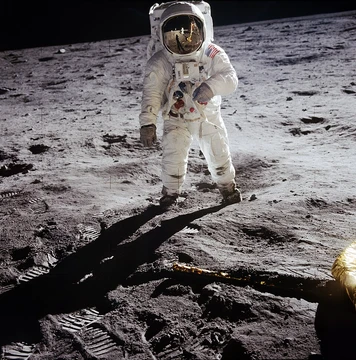
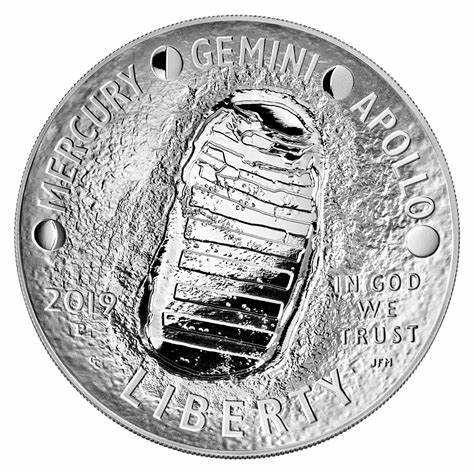
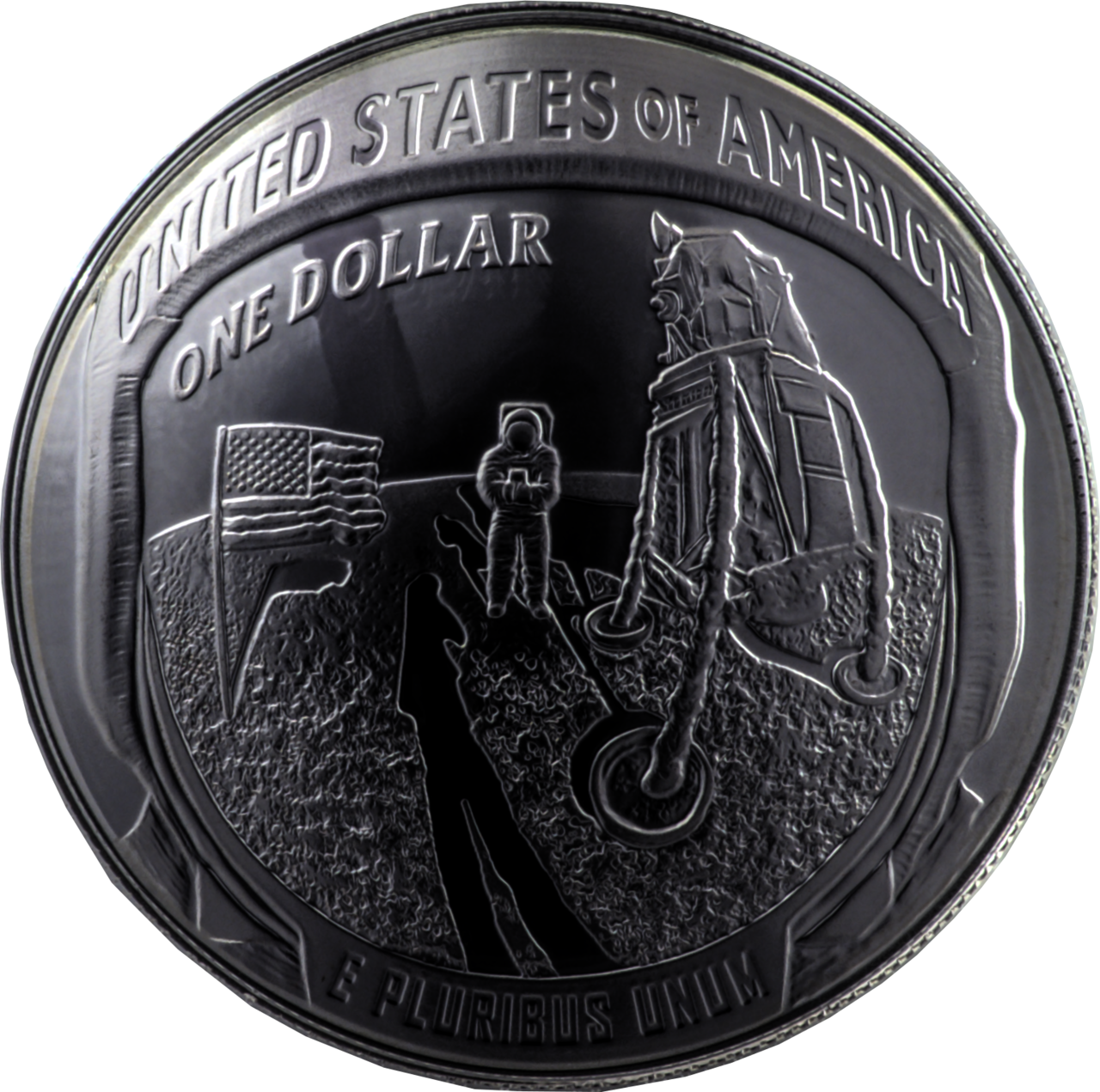
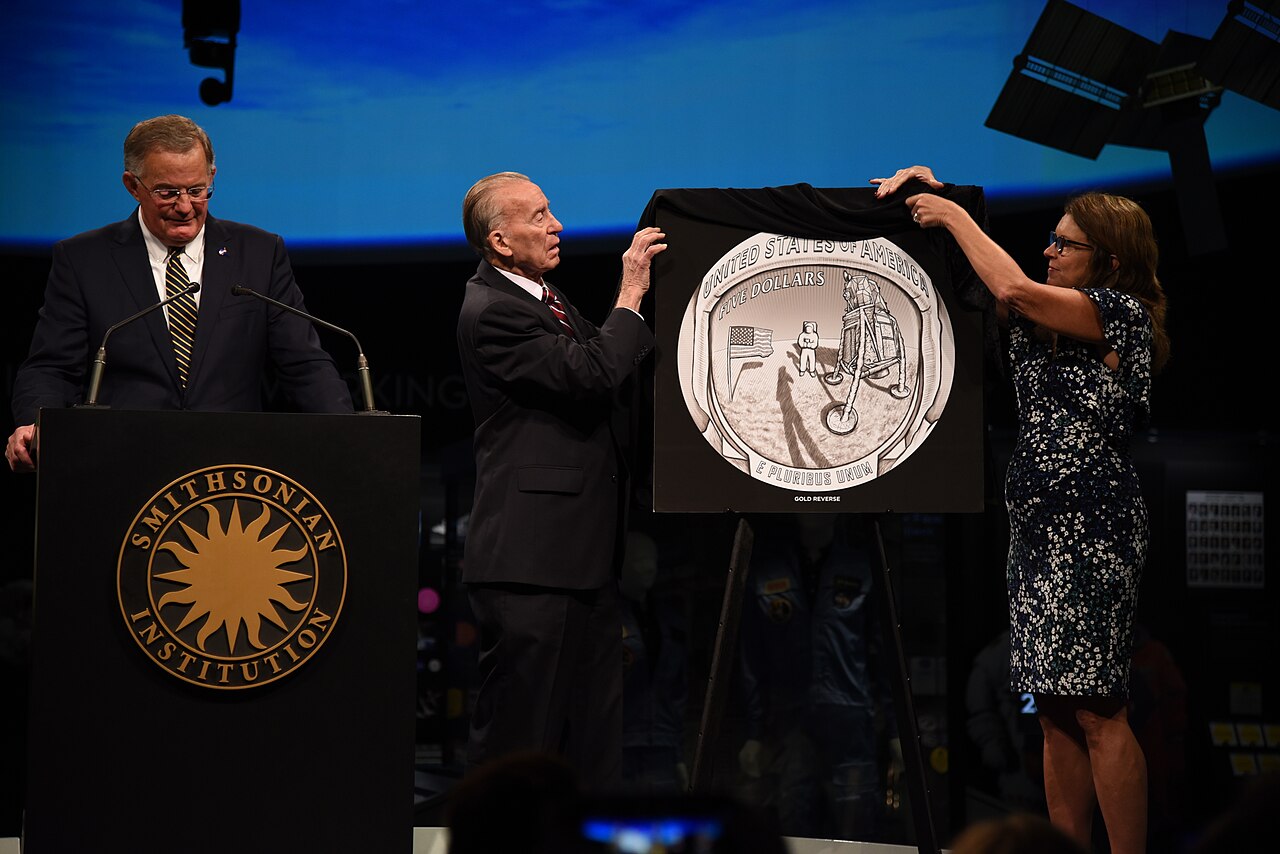
All four coins share the same design. The obverse depicts a bootprint on the lunar surface, based on a photograph taken by Aldrin, designed by Gary Cooper and engraved by Joseph Menna. The reverse, mandated by Congress, shows the visor and helmet of Aldrin's space suit, reflecting Armstrong, the U.S. flag, and the Lunar Module Eagle, based on a photograph taken by Armstrong; it was created and engraved by Phebe Hemphill. The depiction of Aldrin made him the seventh living person to appear on a U.S. coin at the time of striking. The coins are curved, with a concave obverse and convex reverse. Despite anticipation that some denominations might sell out, none did before sales ended on December 27, 2019. The program was the most successful U.S. commemorative coin program since the 2014 National Baseball Hall of Fame issue.
Reader's Guide
The Apollo 11 50th Anniversary commemorative coins represent a significant intersection of numismatics and space history. They were the first U.S. coins to honor the Apollo 11 mission directly, following earlier indirect references on the Eisenhower dollar, Susan B. Anthony dollar, and the 2002 Ohio state quarter. The coins' curved shape, echoing the 2014 Baseball Hall of Fame coins, was mandated by Congress. The larger silver dollar won the Coin of the Year Award for 2019-dated issues and was voted Best Collectible Silver Coin at the 2023 Mint Directors Conference. Surcharges from sales were distributed to the Smithsonian Institution's National Air and Space Museum for its 'Destination: Moon' exhibit, the Astronauts Memorial Foundation, and the Astronaut Scholarship Foundation. The program sold over 600,000 coins, reflecting enduring public interest in the Apollo 11 mission.
Design and Artistic Vision
The Apollo 11 50th Anniversary coins broke from tradition with a distinctive curved profile, giving the obverse a concave shape and the reverse a convex one. Every denomination in the set—the gold half eagle, two silver dollar sizes, and a copper-nickel clad half dollar—shares an identical design. The obverse presents a bootprint pressed into the lunar surface, drawn from a photograph Aldrin captured during his Boot Print Soil Mechanics Experiment. Maine-based sculptor Gary Cooper conceived that image, while Mint engraver Joseph Menna rendered it in final form. The reverse, a requirement set by Congress, shows the visor and surrounding helmet of Aldrin's space suit. Reflected in the gold-plated visor are Armstrong, the American flag, and the Apollo Lunar Module Eagle against the black lunar sky, all lifted from the iconic photograph Armstrong took of his crewmate. Phebe Hemphill of the Mint both created and engraved that reverse. Aldrin's inclusion made him the seventh person alive at the time of striking to appear on a United States coin.
The Legislative Battle
The path to minting these coins was neither quick nor guaranteed. Iowa-based Citizens Coinage Advisory Committee member Mike Olson first conceived the idea in February 2014 after rewatching the film Apollo 13, and he lobbied his CCAC colleagues to include a recommendation for Apollo 11 coinage in the committee's annual report. Though Olson had already left the committee, chair Gary Marks championed the cause. In January 2015, Olson brought the proposal to Iowa Representative Rod Blum, who passed it to Florida's Bill Posey, a legislator whose district encompassed the Kennedy Space Center and who had himself worked in the Apollo program as a young man. Posey assembled a bipartisan coalition of cosponsors and introduced the bill in June 2015. Prior attempts to honor the Moon landing with coinage had failed in 1993 and 2007. The 2015 bill stalled in the House Committee on Financial Services, with GovTrack.us estimating only a 13 percent chance of passage. By November 2016, it had gathered 298 cosponsors, enough for a floor vote. On December 5, the final day of the House session, Posey called up the bill for debate, and it passed without opposition.
Production, Sales, and Recognition
The United States Mint struck the four-coin set across multiple facilities: the gold half eagle at West Point, the silver dollars at Philadelphia, and the copper-nickel clad half dollars at both Denver and San Francisco. Each denomination was available in proof finish, while all except the larger silver dollar also came in uncirculated condition. Sales ran from January 24 to December 27, 2019. Early anticipation, fueled by the sellout experience with the 2014 National Baseball Hall of Fame curved coins, suggested some denominations might vanish quickly. In the end, none sold out before the window closed, yet the program still proved the most successful U.S. commemorative coin issue since the Baseball Hall of Fame set, moving over 600,000 pieces. The larger silver dollar earned the Coin of the Year Award for 2019-dated issues and was later voted Best Collectible Silver Coin at the 2023 Mint Directors Conference.
The Mission and the Photographs
The coins draw their imagery directly from events aboard the Apollo 11 mission of July 20, 1969, when Armstrong and Aldrin walked on the Moon while Collins orbited above. Roughly ninety minutes after Armstrong's first step, Aldrin conducted the Boot Print Soil Mechanics Experiment: he photographed an undisturbed patch of regolith, pressed two bootprints into it, and photographed the result. Those prints remained untouched by the crew's later activity and were still visible in photographs taken from the Lunar Module Eagle before liftoff. Shortly after, Aldrin handed the camera to Armstrong, who took eight frames. The eighth captured Aldrin's helmet visor reflecting Armstrong, the flag, the Eagle, and the moon's horizon against an impossibly black sky—a frame widely regarded as one of the most famous photographs ever taken. Both images became the visual foundation for the coin designs, translating a fleeting moment of human exploration into permanent metal.
Gallery
Frequently Asked Questions
What are the Apollo 11 50th Anniversary commemorative coins?
These are a set of U.S. Mint coins released in 2019 to celebrate the 50th anniversary of Neil Armstrong and Buzz Aldrin's first crewed Moon landing. The collection spans gold, silver, and base-metal denominations and was sold in both proof and uncirculated finishes.
Who designed the Apollo 11 50th Anniversary commemorative coins?
The obverse was sculpted by Gary Cooper and engraved by Joseph Menna, while the reverse was both created and engraved by Phebe Hemphill.
What denominations are included in the Apollo 11 50th Anniversary coin set?
The set comprises a $5 gold half eagle, two different sizes of silver dollar, and a copper-nickel clad half dollar. The larger silver dollar was only offered in proof, while the other three coins came in both proof and uncirculated versions.
Which mints produced the Apollo 11 50th Anniversary commemorative coins?
The gold half eagle was struck at the West Point Mint, the silver dollars at the Philadelphia Mint, and the clad half dollars at both the Denver and San Francisco mints.
What is special about the shape of the Apollo 11 50th Anniversary coins?
Rather than being perfectly flat, these coins feature a curved design with a concave obverse and a convex reverse. This gives them a distinctive three-dimensional profile that sets them apart from standard U.S. circulation coins.
More in Apollo 11 1-24
Spotted an error? Know more?
Reader corrections go straight into our review queue. Suggest an edit · How this site is sourced