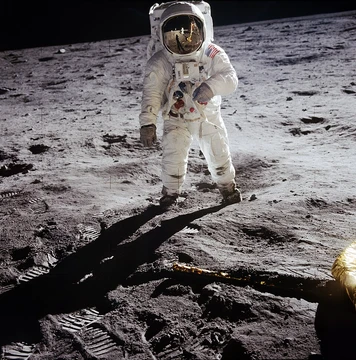
Neil Armstrong
First human to walk on the Moon, Apollo 11 commander.

Unknown authorUnknown author · via Wikipedia: Neil Armstrong · Public domain
Neil Armstrong, born August 5, 1930, in rural Ohio, was the first human to set foot on the Moon, commanding the Apollo 11 mission in 1969. He was also a naval aviator, test pilot, and later a university professor. Raised near Wapakoneta, Ohio, his family moved frequently due to his father’s job as a state auditor. Armstrong’s passion for flight began at age two, when his father took him to the Cleveland Air Races. He took his first airplane ride at five or six in a Ford Trimotor, and as a youth he built and flew model aircraft. By his 16th birthday, he had a student flight certificate; he soloed before getting a driver’s license. An Eagle Scout, he later received the Distinguished Eagle Scout Award and Silver Buffalo Award. While en route to the Moon in 1969, he sent greetings to a National Scout jamboree, and he carried a World Scout Badge among his few personal items to the lunar surface.
He studied aeronautical engineering at Purdue University under the Holloway Plan, which covered his tuition in exchange for Navy service. After becoming a midshipman in 1949 and a naval aviator in 1950, he flew Grumman F9F Panthers from the USS Essex during the Korean War. Following the war, he completed his bachelor’s degree at Purdue and became a test pilot at NACA’s High-Speed Flight Station at Edwards Air Force Base. He piloted Century Series fighters and flew the X-15 seven times, and he participated in the Air Force’s Man in Space Soonest and X-20 Dyna-Soar programs.
Selected in NASA’s second astronaut group in 1962, Armstrong made his first spaceflight as command pilot of Gemini 8 in March 1966, becoming NASA’s first civilian astronaut in space. With pilot David Scott, he performed the first spacecraft docking, but the mission was aborted after he used re-entry control fuel to stop a dangerous roll from a stuck thruster. During training for Apollo 11, he ejected from a Lunar Landing Research Vehicle just before it crashed.
On July 20, 1969, Armstrong and Buzz Aldrin landed the Lunar Module Eagle on the Moon while Michael Collins orbited above in the Command Module Columbia. The next day, they spent two and a half hours outside the lander. Armstrong’s first words on the lunar surface—“That’s one small step for [a] man, one giant leap for mankind”—were broadcast to about 530 million viewers.
- Born
- August 5, 1930, near Wapakoneta, Ohio
- Died
- August 25, 2012, age 82
- Field
- Astronautics, aeronautical engineering
- Nationality
- American
- Known for
- First person to walk on the Moon (Apollo 11, 1969)
Lore & Background
Armstrong was born and raised near Wapakoneta, Ohio. He entered Purdue University studying aeronautical engineering under the Holloway Plan, became a midshipman in 1949 and a naval aviator in 1950. He flew Grumman F9F Panthers from USS Essex during the Korean War, completing 78 missions. After the war he earned his bachelor's degree, became a test pilot at NACA's High-Speed Flight Station, flew the X-15 seven times, and participated in the Man in Space Soonest and X-20 Dyna-Soar programs.
Armstrong joined NASA's second astronaut group in 1962. His first spaceflight was as command pilot of Gemini 8 in March 1966, performing the first docking of two spacecraft; the mission was aborted after a stuck thruster caused a dangerous roll. During training for Apollo 11, he ejected from the Lunar Landing Research Vehicle moments before a crash. On July 20, 1969, Armstrong and Buzz Aldrin landed on the Moon; the next day they spent two and a half hours outside the Lunar Module while Michael Collins orbited above. Armstrong's first words on the lunar surface were broadcast to an estimated 530 million viewers.
After resigning from NASA in 1971, Armstrong taught aerospace engineering at the University of Cincinnati until 1979. He served on the Apollo 13 accident investigation and the Rogers Commission investigating the Challenger disaster. He died in 2012 from complications of coronary bypass surgery.
Reader's Guide
Neil Armstrong's significance rests on his role as commander of Apollo 11, the mission that fulfilled President John F. Kennedy's 1961 goal of landing a man on the Moon and returning him safely before the decade ended. His first step onto the lunar surface on July 20, 1969, was a major U.S. victory in the Space Race and was witnessed by an estimated 530 million people worldwide. Armstrong's career also included pioneering work as a test pilot on the X-15 and Century Series fighters, and he performed the first docking of two spacecraft during Gemini 8. His legacy is reflected in the many honors he received: the Presidential Medal of Freedom, the Congressional Space Medal of Honor, induction into the National Aviation Hall of Fame, and the Congressional Gold Medal. After leaving NASA, he contributed to accident investigations for Apollo 13 and the Challenger disaster, and taught at the University of Cincinnati. His life and work remain a benchmark in human space exploration.
Did You Know?
- Armstrong earned a student flight certificate on his 16th birthday and soloed before he had a driver's license.
- He was an Eagle Scout and carried a World Scout Badge to the Moon.
- During the Korean War, Armstrong flew 78 missions and once had 6 feet of his wing torn off by a cable booby trap.
- He was NASA's first civilian astronaut to fly in space, on Gemini 8 in 1966.
More in Apollo 11 1-24
Spotted an error? Know more?
Reader corrections go straight into our review queue. Suggest an edit · How this site is sourced