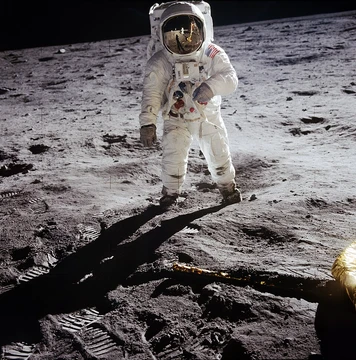
Michael Collins (astronaut)
Apollo 11 command module pilot who orbited the Moon alone.

NASA; restored by Coffeeandcrumbs · via Wikipedia: Michael Collins (astronaut) · Public domain
Michael Collins, born in Rome on Halloween 1930, spent his early years moving around the world with his Army officer father. He graduated from West Point in 1952, then joined the Air Force rather than the Army to avoid charges of nepotism—his father, brother, uncle, and cousin all served in the Army. After flying F-86 Sabres in France, he trained as a test pilot at Edwards Air Force Base in 1960.
NASA selected Collins in 1963 as one of 14 new astronauts. His first spaceflight came in 1966 on Gemini 10, where he and John Young practiced orbital rendezvous with two spacecraft and performed two spacewalks. That made him the fourth person and third American to walk in space, and the first to do it more than once.
His most famous mission was Apollo 11 in 1969. While Neil Armstrong and Buzz Aldrin landed on the Moon, Collins orbited it alone in the command module Columbia, completing thirty orbits. He became the second person to circle the Moon solo, after John Young had done so on Apollo 10. In total, he was one of 24 Apollo astronauts who reached the Moon.
After leaving NASA in 1970, Collins worked as Assistant Secretary of State for Public Affairs. He then directed the National Air and Space Museum from 1971 to 1978, followed by a stint as undersecretary of the Smithsonian Institution. In 1980 he became a vice president at LTV Aerospace, resigning five years later to start his own consulting firm. Alongside his Apollo 11 crewmates, he received the Presidential Medal of Freedom in 1969 and the Congressional Gold Medal in 2011. He died on April 28, 2021.
- Born
- October 31, 1930, Rome, Kingdom of Italy
- Died
- April 28, 2021
- Field
- Astronaut, test pilot, U.S. Air Force major general
- Nationality
- American
- Known for
- Apollo 11 command module pilot; orbited the Moon alone while Armstrong and Aldrin landed
Lore & Background
Michael Collins was born in Rome, where his father was serving as the U.S. military attaché. He graduated from the United States Military Academy in 1952 and joined the U.S. Air Force, flying F-86 Sabre fighters in France. He was accepted into the U.S. Air Force Experimental Flight Test Pilot School at Edwards Air Force Base in 1960, also graduating from the Aerospace Research Pilot School. He met his future wife, Patricia Mary Finnegan, in an officers' mess; they married in 1957 after Collins converted to Catholicism. They had three children: Kate, Ann, and Michael.
Collins' first spaceflight was on Gemini 10 in 1966, where he and Command Pilot John Young performed orbital rendezvous with two spacecraft and undertook two spacewalks. On Apollo 11 in 1969, he orbited the Moon thirty times in the command module Columbia. He was the fourth person to perform a spacewalk, the first to perform more than one, and the second person to orbit the Moon alone. After retiring from NASA in 1970, he served as Assistant Secretary of State for Public Affairs, then director of the National Air and Space Museum, undersecretary of the Smithsonian Institution, and vice president of LTV Aerospace before starting his own consulting firm.
Reader's Guide
Michael Collins' role in Apollo 11 was unique: while Armstrong and Aldrin descended to the lunar surface, Collins remained alone in the command module Columbia, orbiting the Moon for over 21 hours. He became the second person to orbit the Moon alone, after John Young on Apollo 10. His ability to execute critical rendezvous maneuvers ensured his crewmates' safe return. Collins' earlier Gemini 10 mission demonstrated his skill in orbital rendezvous and spacewalking, making him the first person to perform more than one spacewalk. After his NASA career, he contributed to public understanding of spaceflight as director of the National Air and Space Museum, overseeing its creation. Along with his Apollo 11 crewmates, he received the Presidential Medal of Freedom in 1969 and the Congressional Gold Medal in 2011. His legacy is that of a skilled pilot and essential team member in humanity's first Moon landing.
Did You Know?
- He was the fourth person and third American to perform a spacewalk.
- He was the first person to have performed more than one spacewalk.
- Collins converted to Catholicism before marrying his wife, Patricia Mary Finnegan.
More in Apollo 11 1-24
Spotted an error? Know more?
Reader corrections go straight into our review queue. Suggest an edit · How this site is sourced