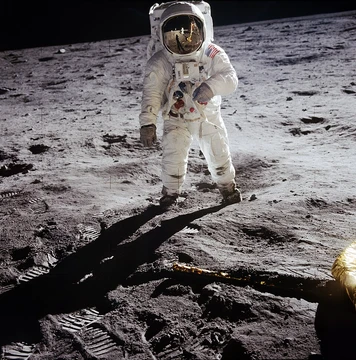
Command module Columbia
Command module of the first Moon landing mission.

Command module Columbia (CM-107) was the command module for Apollo 11, the first mission to put people on the Moon. Of all the spacecraft involved in that 1969 mission, Columbia alone came back to Earth.
The name came from Julian Scheer, a NASA public affairs official, who mentioned it to astronaut Michael Collins during a phone call, saying some people at the agency were "kicking around Columbia." Collins initially found the name "a bit pompous," but he couldn't think of a better one, and his crewmates Buzz Aldrin and Neil Armstrong had no problem with it. Collins also liked how it echoed "Columbiad," the space gun in Jules Verne's 1865 novel *From the Earth to the Moon*.
After the mission and a tour of U.S. cities, Columbia was given to the Smithsonian Institution in 1971. It was named a "Milestone in Flight" and put on prominent display at the National Air and Space Museum in Washington, D.C., next to the 1903 Wright Flyer. In July 2016, the Smithsonian released a 3D scan of the capsule, which revealed markings the astronauts had left on its walls, including a calendar and a warning about smelly waste on a locker. For the 50th anniversary of the Apollo 11 landing in 2019, Columbia toured museums in Houston, St. Louis, Pittsburgh, Seattle, and Cincinnati. In 2022, it was removed from display during the museum's renovation and became the centerpiece of the new Destination Moon exhibit when the museum reopened that fall.
Quick Facts
- Mission
- Apollo 11
- Named After
- Columbiad
- Manufacturer
- North American Aviation
- Construction Number
- CM-107
- Landing Mass
- 10,873 lb
- Launch Date
- July 16, 1969
- Launch Site
- Kennedy LC-39A
- Landing Date
- July 24, 1969
- Landing Site
- Pacific Ocean
- Owners
- NASA
- Total Hours
- 195
- Preservation
- National Air and Space Museum
Facts from the source article.
Lore & Background
The name Columbia was first suggested to Michael Collins by Julian Scheer, NASA assistant administrator of public affairs during the Apollo program. Scheer mentioned the name in passing during a phone conversation, saying 'some of us up here have been kicking around Columbia.' Collins initially thought it was 'a bit pompous' but the name eventually stuck as he could not think of a better alternative and his crewmates Buzz Aldrin and Neil Armstrong had no objections. Collins was also influenced to accept the name because of its similarity to Columbiad, the name of the space gun in Jules Verne's 1865 science fiction novel From the Earth to the Moon.
Following the mission and after a tour of U.S. cities, Columbia was given to the Smithsonian Institution in 1971. It was designated a 'Milestone in Flight' and displayed prominently at the National Air and Space Museum in Washington, D.C., alongside the 1903 Wright Flyer. In July 2016, the Smithsonian released a 3D scan of Columbia produced by the Smithsonian's Digitization Program Office. During the scanning process a number of places where the astronauts had written on the walls of the capsule were found, including a calendar and a warning about smelly waste on one of the lockers.
Reader's Guide
Command module Columbia holds singular historical importance as the only spacecraft from the Apollo 11 mission to return to Earth, having carried astronauts Neil Armstrong, Buzz Aldrin, and Michael Collins to the Moon and back. Its name, initially considered 'a bit pompous' by Collins, was influenced by Jules Verne's science fiction, reflecting the imaginative roots of space exploration. After a post-mission tour, Columbia became a Smithsonian artifact in 1971, displayed alongside the Wright Flyer as a 'Milestone in Flight.' A 2016 3D scan revealed previously unnoticed astronaut graffiti, including a calendar and a locker warning about smelly waste, offering intimate glimpses into life aboard the capsule. In 2019, it toured U.S. museums for the 50th anniversary of the Apollo 11 landing, and in 2022 it became the centerpiece of the National Air and Space Museum's renovated Destination Moon exhibit. Columbia remains a tangible link to humanity's first lunar landing.
Did You Know?
- Collins initially thought the name Columbia was 'a bit pompous' but accepted it partly due to its similarity to Columbiad from Jules Verne's novel.
- A 2016 3D scan of Columbia revealed astronaut-written graffiti, including a calendar and a warning about smelly waste on a locker.
- Columbia was displayed alongside the 1903 Wright Flyer at the National Air and Space Museum.
Frequently Asked Questions
What is Command module Columbia?
Columbia, designated CM-107, was the crewed capsule that carried Neil Armstrong, Buzz Aldrin, and Michael Collins on Apollo 11 in 1969. It functioned as the astronauts' living space during the flight and the vehicle that brought them back to Earth.
How did the command module get the name Columbia?
NASA public affairs official Julian Scheer floated the name to Michael Collins during a phone call, noting that people at the agency were "kicking around" the word. Collins admitted it struck him as a bit pompous at first, but he couldn't think of a better alternative, and Armstrong and Aldrin raised no objections.
Did Columbia actually make it back to Earth?
Yes. Of every spacecraft that took part in the Apollo 11 mission, Columbia is the sole one that returned to Earth, splashing down in the Pacific after carrying the crew home from the Moon.
Where can I see Columbia today?
Columbia was donated to the Smithsonian Institution in 1971 and is currently housed at the National Air and Space Museum in Washington, D.C., where the public can view the actual capsule.
Why is Columbia considered so significant in space history?
As the only piece of hardware from the first crewed Moon landing to survive the journey back to Earth, Columbia is a physical, touchable link to that 1969 milestone. Its preservation at the Smithsonian lets people see the very module that carried the first Moon explorers home.
More in Apollo 11 1-24
Spotted an error? Know more?
Reader corrections go straight into our review queue. Suggest an edit · How this site is sourced