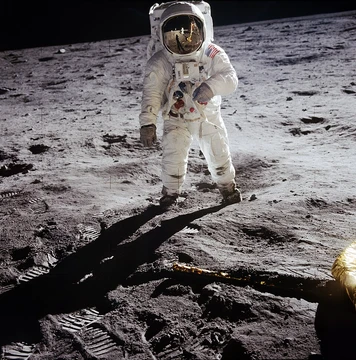
Buzz Aldrin
Second human to walk on the Moon.

NASA · via Wikipedia: Buzz Aldrin · Public domain
Buzz Aldrin (born Edwin Eugene Aldrin Jr. on January 20, 1930) is an American former astronaut, aeronautical engineer, and fighter pilot. He became the second human to set foot on the Moon, following mission commander Neil Armstrong, and served as the pilot of the Lunar Module *Eagle* during the 1969 Apollo 11 mission. With the deaths of Armstrong in 2012 and Michael Collins in 2021, Aldrin is now the last surviving member of the Apollo 11 crew and the oldest living astronaut.
Aldrin was born at Mountainside Hospital in Glen Ridge, New Jersey, and grew up in neighboring Montclair. His father, Edwin Eugene Aldrin Sr., was a former Army aviator and test pilot school commandant who later worked as an executive at Standard Oil; his mother was Marion Moon. He had two older sisters, Madeleine and Fay Ann. The nickname “Buzz” came from Fay’s childhood mispronunciation of “brother” as “buzzer,” which was later shortened; he made it his legal first name in 1988. As a Boy Scout, he reached the rank of Tenderfoot Scout.
In school, Aldrin earned straight A’s and played center on Montclair High School’s undefeated 1946 state champion football team. His father wanted him to attend the U.S. Naval Academy and enrolled him at the Severn School prep program, even securing a nomination from a New Jersey senator. But Aldrin suffered from seasickness and preferred flying over ships, so he convinced his father to switch the nomination to the U.S. Military Academy at West Point. He entered West Point in 1947, finished first academically in his plebe year, and competed in pole vault for the track team. In 1950, he traveled with other cadets to Japan and the Philippines to study Douglas MacArthur’s military government policies; during the trip, the Korean War began. He graduated third in the class of 1951 with a Bachelor of Science in mechanical engineering.
Choosing the U.S. Air Force, Aldrin was commissioned as a second lieutenant and trained in T-6 Texans at Bartow Air Base in Florida. His classmates included Sam Johnson, later a Vietnam prisoner of war. While flying a T-28 Trojan, he attempted a double Immelmann turn, suffered a grayout, and recovered just in time to avoid a crash at about 2,000 feet. Despite his father’s advice to fly bombers for leadership experience, Aldrin chose fighters.
- Born
- January 20, 1930, Glen Ridge, New Jersey
- Field
- Astronautics, aeronautical engineering, fighter pilot
- Nationality
- American
- Known for
- Second person to walk on the Moon; pilot of Apollo 11 Lunar Module Eagle; first astronaut with a doctoral degree
Lore & Background
Aldrin graduated third in the class of 1951 from the United States Military Academy at West Point with a degree in mechanical engineering. He was commissioned into the U.S. Air Force and served as a jet fighter pilot during the Korean War, flying 66 combat missions and shooting down two MiG-15 fighter jets. After earning a Doctor of Science degree in astronautics from MIT, he was selected as a member of NASA's Astronaut Group 3, becoming the first astronaut with a doctoral degree. His doctoral thesis, Line-of-Sight Guidance Techniques for Manned Orbital Rendezvous, earned him the nickname 'Dr. Rendezvous' from fellow astronauts.
His first space flight was in 1966 on Gemini 12, during which he spent over five hours on extravehicular activity. Three years later, Aldrin set foot on the Moon at 03:15:16 on July 21, 1969 (UTC), nineteen minutes after Armstrong first touched the surface, while command module pilot Michael Collins remained in lunar orbit. A Presbyterian elder, Aldrin became the first person to hold a religious ceremony on the Moon, when he privately took communion, which was the first food and liquid to be consumed there.
After leaving NASA in 1971, Aldrin became Commandant of the U.S. Air Force Test Pilot School. He retired from the Air Force in 1972 after 21 years of service. His autobiographies Return to Earth (1973) and Magnificent Desolation (2009) recount his struggles with clinical depression and alcoholism in the years after leaving NASA. Aldrin continues to advocate for space exploration, particularly a human mission to Mars, and developed the Aldrin cycler, a special spacecraft trajectory that makes travel to Mars more efficient in terms of time and propellant.
Reader's Guide
Buzz Aldrin's significance lies in his role as a key figure in humanity's first lunar landing, serving as the Lunar Module Eagle pilot on Apollo 11. His second steps on the Moon, just minutes after Neil Armstrong, cemented his place in history. Beyond that mission, Aldrin's earlier work on orbital rendezvous techniques, demonstrated during Gemini 12, was critical to the success of Apollo. His doctoral thesis earned him the nickname 'Dr. Rendezvous' and made him the first astronaut with a doctorate. After his NASA career, Aldrin's advocacy for Mars exploration and his development of the Aldrin cycler trajectory have influenced long-term spaceflight planning. His public struggles with depression and alcoholism, detailed in his autobiographies, have also contributed to broader discussions about mental health among astronauts. As the last surviving Apollo 11 crew member, he remains a living link to one of the 20th century's most celebrated achievements.
Did You Know?
- Aldrin's nickname 'Buzz' originated from his sister Fay mispronouncing 'brother' as 'buzzer', later shortened to 'Buzz'; it became his legal first name in 1988.
- He was the first astronaut to hold a doctoral degree, earning a Doctor of Science in astronautics from MIT.
- He shot down two MiG-15 fighter jets during the Korean War, flying 66 combat missions.
More in Apollo 11 1-24
Spotted an error? Know more?
Reader corrections go straight into our review queue. Suggest an edit · How this site is sourced