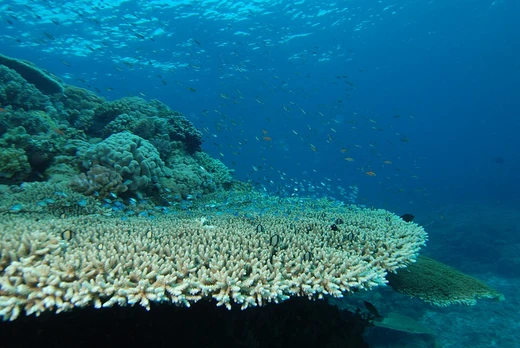
Branch coral
A common acroporid coral found across the Indo-Pacific.

Branch coral (*Acropora florida*) is an acroporid species found across a wide range, from the southwest and northern Indian Ocean through the central Indo-Pacific, Australia, Southeast Asia, Japan, the East China Sea, the Cook Islands, and the oceanic west Pacific. It lives on shallow reefs, including reef tops, walls, and slopes, at depths up to 30 meters. The coral forms thick, upright or sometimes horizontal branches that grow from a sprawling or encrusting base, with side branches and small, knob-like branchlets. Its corallites are evenly spaced, and its color varies, ranging from pinkish-brown to shades of green.
This species is zooxanthellate, meaning it gets most of its nutrition from symbiotic dinoflagellates living inside its tissues. These photosynthetic organisms supply organic carbon and nitrogen, sometimes meeting up to 90% of the coral’s energy needs for growth and metabolism. The remaining needs are met by plankton caught by the polyps’ tentacles.
Though a common species with no specific threats identified, it faces general dangers to corals: climate change, mechanical habitat destruction, extreme weather, rising sea temperatures, and ocean acidification. The International Union for Conservation of Nature lists it as endangered, and it is protected under CITES Appendix II.
Quick Facts
- Taxon
- Acropora florida
Facts from the source article.
Lore & Background
Colonies of Acropora florida consist of thick upright, and sometimes horizontal, branches growing from a sprawling or encrusting base. There are side branches and small branchlets which resemble knobs. The corallites are evenly spread. The colour of this coral varies, and may be pinkish-brown or some shade of green.
Acropora florida is a zooxanthellate species of coral. It obtains most of its nutritional needs from the symbiotic dinoflagellates that live inside its soft tissues. These photosynthetic organisms provide the coral with organic carbon and nitrogen, sometimes providing up to 90% of their host's energy needs for metabolism and growth. Its remaining needs are met by the planktonic organisms caught by the tentacles of the polyps.
This coral is a common species and no species-specific threats have been identified. The main threats faced by corals in general are related to climate change and the mechanical destruction of their coral reef habitats; increasing damage from extreme weather events, rising sea water temperatures and ocean acidification.
Reader's Guide
Branch coral (Acropora florida) is a common species across a wide geographic range, from the Indian Ocean to the Pacific. Its significance lies in its role as a zooxanthellate coral, deriving up to 90% of its energy from symbiotic dinoflagellates, which underscores the importance of these partnerships in reef ecosystems. The species is assessed as endangered by the International Union for Conservation of Nature, reflecting broader threats to corals from climate change, extreme weather, rising sea temperatures, and ocean acidification, though no species-specific threats have been identified. Its listing on CITES Appendix II provides international protection. The coral's thick, upright branches and encrusting base contribute to reef structure in shallow waters up to 30 m deep. The color variation, ranging from pinkish-brown to green, and the evenly spread corallites are characteristic features. As a common species, it serves as an indicator of general coral health and the impacts of environmental stressors on reef habitats.
Did You Know?
- Acropora florida is found from the southwest and northern Indian Ocean to the Cook Islands and oceanic west Pacific.
- It can live on shallow reef tops, walls, and slopes to depths of 30 m.
- The coral's symbiotic dinoflagellates can provide up to 90% of its energy needs.
- The International Union for Conservation of Nature has assessed it as an endangered species.
More in Acropora Corals 1-24
Spotted an error? Know more?
Reader corrections go straight into our review queue. Suggest an edit · How this site is sourced