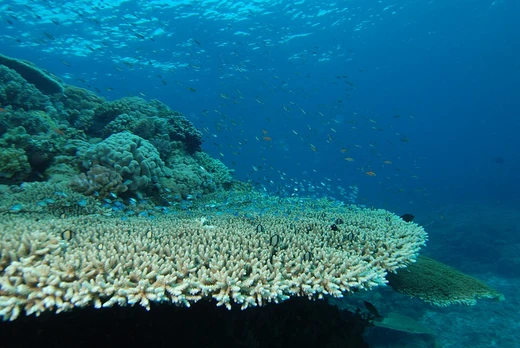
Acropora abrotanoides
A wave-resistant acroporid coral with well-developed corallite lips.

Acropora abrotanoides is an acroporid coral that lives in Indo-Pacific regions, ranging from the Red Sea and Gulf of Aden to the East China Sea, Japan, the central Pacific, and Australia. It typically grows on shallow reefs exposed to strong wave action, at depths no greater than 15 meters. The species is vulnerable to coral bleaching, disease, and crown-of-thorns starfish, but it resists predation thanks to its well-developed radial corallite lips.
First described by Lamarck in 1816 as *Madrepora abrotanoides*, it was later recognized that *Acropora irregularis* is the same species. The coral forms colonies of fused branches that spread across the seabed in a prostrate manner, with vertical outer branches reaching up to 3 meters in diameter and sometimes taking on a table-like shape. In the colony’s center, branches are fused and can be elongated or conical, occasionally tapering to a point. Both axial and radial corallites are present; radial corallites are elongated, while axial corallites vary in number and are rasp-like or tubular. The radial corallites have evolved prominent tips that deter predators. The coral’s color ranges from green-grey to pink-brown, and it resembles *Acropora pinguis* and *Acropora robusta*.
This species is found from the Gulf of Aden and Red Sea, across the Indian Ocean, into the Pacific, and as far as the East China Sea, Australia, Japan, and the southeastern Atlantic Ocean. Although listed as Least Concern on the IUCN Red List, its population is thought to be declining. It is included in Appendix II of CITES. While exact population figures are unknown, the coral faces threats from global reef degradation, rising temperatures that cause bleaching, climate change, human activities, crown-of-thorns starfish (*Acanthaster planci*), and disease.
Quick Facts
- Taxon
- Acropora abrotanoides
Facts from the source article.
Lore & Background
Acropora abrotanoides was first described by Lamarck in 1816 as Madrepora abrotanoides. Acropora irregularis was formerly considered a separate species but is now considered synonymous with Acropora abrotanoides. The species occurs in colonies of fused branches growing across the seabed (prostrate) with vertical outer branches, which can be table-shaped and reach diameters of up to 3 metres. In the center of a colony, branches are fused together and can be elongated or conical, sometimes with tapering ends. Its branches contain both axial and radial corallites; radial corallites are elongated, and axial corallites occur in varying numbers and are rasp-like or tubular in shape. Radial corallites have evolved well-developed tips that prevent predation. The coral is green-grey or pink-brown in color and is similar to Acropora pinguis and Acropora robusta.
Reader's Guide
Acropora abrotanoides is classed as a least concern species on the IUCN Red List, but its population is believed to be decreasing. It is listed under Appendix II of CITES. Population figures are unknown, but the species is likely threatened by the global reduction of coral reefs, increased temperature causing coral bleaching, climate change, human activity, the crown-of-thorns starfish (Acanthaster planci), and disease. Its significance lies in its resistance to predation due to well-developed radial corallite lips, which distinguishes it from many other acroporids. The species is found in shallow coral reefs exposed to strong waves, indicating a specialized ecological niche. Its wide distribution from the Red Sea and Gulf of Aden to the East China Sea, Japan, the central Pacific, Australia, and the south-eastern Atlantic Ocean underscores its adaptability, though threats from bleaching and starfish remain serious. The synonymy with Acropora irregularis reflects taxonomic refinement over time.
Did You Know?
- Its colonies can reach diameters of up to 3 metres (9.8 ft) and may be table-shaped.
- It is found in shallow coral reefs exposed to strong waves at depths up to 15 m.
Colony Architecture and Polyp Behavior
Acropora abrotanoides belongs to a genus of small polyp stony corals within the phylum Cnidaria, a group whose members have earned common names such as table coral, elkhorn coral, and staghorn coral. Like all corals, this species exists as a colony composed of numerous individual polyps, each roughly two millimeters in diameter, all interconnected through shared tissue and a diffuse nerve net. These polyps display remarkable behavioral flexibility: when undisturbed they extend slightly beyond the skeletal surface, but at the slightest sign of movement or a potential predator they retract fully back into the calcium carbonate structure. At night the polyps reach out considerably farther, taking advantage of darkness to capture plankton and dissolved organic matter drifting through the water column. Depending on the particular species and its local environment, Acropora colonies may take the form of broad plates or slender, branching structures. Across the genus, more than 149 species have been formally described, and together they form some of the principal architects of the massive calcium carbonate frameworks that underpin the thin living surface of tropical reefs.
Geographic Range and Taxonomic Complexity
The genus Acropora spans a remarkably wide geographic footprint, with more than one hundred species documented across the Indo-Pacific region and just three found in the Caribbean. Acropora abrotanoides is one member of this extensive assemblage, yet the precise number of valid species within the genus remains uncertain. Taxonomists have raised serious doubts about the distinctness of many named species, revealing that some long-recognized taxa are actually hybrids rather than true biological species, with Acropora prolifera serving as a notable example. Compounding this confusion, certain named species have turned out to be cryptic species complexes—groups of morphologically similar but genetically distinct lineages that have been lumped under a single name. These taxonomic ambiguities make it difficult to determine exactly how many species Acropora abrotanoides coexists with and how it relates to its close relatives. The result is a picture of biodiversity that is both impressively rich and genuinely uncertain, with ongoing research needed to untangle the true evolutionary relationships among these reef-building corals.
Symbiotic Energy and Bleaching Vulnerability
At the heart of Acropora abrotanoides's biology lies a mutualistic partnership with Symbiodinium, microscopic symbiotic algae that reside within the coral's own cells. Through photosynthesis, these algae generate the bulk of the energy the animal requires, making the relationship absolutely essential for survival. The zooxanthellae carry a distinctive golden-brown pigment that gives healthy colonies their characteristic coloration. However, Acropora is particularly vulnerable to the phenomenon of bleaching. When environmental stress overwhelms the coral, it loses these algae and the once-colored tissue turns stark white. If new Symbiodinium cells cannot be re-established, the bleached coral will eventually die. The stressors driving this process are numerous and largely human-driven: pollution, abnormally elevated water temperatures, rising ocean acidification, sedimentation from land-based runoff, and eutrophication from nutrient overload. The severity of the threat was formally recognized in 2014, when the U.S. Fish and Wildlife Service designated ten Acropora species as threatened, underscoring how widespread the decline of these reef-builders has become.
Aquarium Cultivation and Reef Restoration Potential
While most Acropora species display muted brown or green hues, a small number of individuals exhibit vivid, eye-catching coloration, and it is these rare specimens that command the greatest interest and value among reef-keeping aquarists. Captive propagation of Acropora is now a widespread practice within the hobby, driven in part by the genus's impressive growth rate. In the wild, individual colonies can stretch beyond a meter in diameter, and in a well-maintained home aquarium, a fragment no larger than a fingertip can expand to the size of a medicine ball within one to two years. Over successive generations, captive populations have undergone subtle selective changes that make them better adapted to the conditions of a home tank. Perhaps most promisingly, fragments raised in captivity are increasingly being transplanted back onto degraded or barren wild reefs as a form of active restoration. Keeping Acropora successfully is not trivial, however: the corals demand intense lighting, tightly stable temperatures, regular supplementation of calcium and alkalinity, and consistently clean, turbulent water. Even under optimal conditions, colonies remain susceptible to parasites such as the Acropora-eating flatworm Amakusaplana acroporae and the so-called red bug, Tegastes acroporanus.
Frequently Asked Questions
What is Acropora abrotanoides?
Acropora abrotanoides is a wave-resistant stony coral in the Acropora genus, found across shallow Indo-Pacific reefs. It typically displays a green-grey or pink-brown coloration and can form colonies reaching up to three metres in diameter.
Where does Acropora abrotanoides live?
This species ranges from the Red Sea and Gulf of Aden all the way to the East China Sea, Japan, the central Pacific, and Australian waters. It favours shallow reef zones exposed to strong wave action, staying at depths of no more than 15 metres.
How big can Acropora abrotanoides get?
Colonies of Acropora abrotanoides can grow to a diameter of roughly three metres, making them substantial features on the reef. Their well-developed radial corallite lips help them resist predation in their high-energy habitats.
What threats does Acropora abrotanoides face?
The species is vulnerable to coral bleaching, disease outbreaks, and predation by crown-of-thorns starfish. Despite these pressures, its IUCN status remains Least Concern, and it is listed under CITES Appendix II for trade regulation.
Who first described Acropora abrotanoides?
French naturalist Jean-Baptiste Lamarck originally described the species in 1816 under the name Madrepora abrotanoides. It was later reclassified into the Acropora genus, and Acropora irregularis was eventually recognised as a synonym of the same species.
More in Acropora Corals 1-24
Spotted an error? Know more?
Reader corrections go straight into our review queue. Suggest an edit · How this site is sourced